
A single Haute Couture garment’s price isn’t about fashion; it’s a direct reflection of thousands of hours of specialized engineering and legally protected artistry.
- True Haute Couture is a legally protected designation, with fewer than 20 brands qualifying globally at any time.
- Its value often appreciates over time, unlike other luxury goods, turning clothing into an investment asset backed by provenance and rarity.
Recommendation: When evaluating luxury, look beyond the surface to analyze the internal architecture, material science, and provenance—the true markers of value.
It’s a question that stops most people in their tracks: how can a single dress, however beautiful, command a price that rivals a high-performance sports car or a down payment on a house? The common answers—”it’s handmade” or “it uses expensive fabrics”—are true, but they are profoundly incomplete. They are like describing a Bugatti as just “a car with a big engine.” These explanations fail to capture the immense complexity, artistry, and economic reality that underpins the world of Haute Couture.
To truly understand the value, we must fundamentally shift our perspective. We must stop thinking of these garments as mere clothing and start analyzing them as what they truly are: feats of structural engineering, applications of advanced material science, and legally protected cultural assets. The price isn’t for the fabric and thread; it’s for the hundreds of hours of irreplaceable master craftsmanship, the custom-developed materials, the perfect fit achieved over multiple sessions, and the entry into one of the most exclusive clubs on Earth. It is the price of a wearable sculpture, engineered to move with the human body.
This analysis will deconstruct the anatomy of a couture garment, moving from the legal framework that defines it to the microscopic details that betray a counterfeit. We will explore the vast chasm between bespoke creation and mass luxury, and ultimately reveal why, for the world’s most discerning collectors, a couture piece is not an expense, but an investment.
To navigate this intricate world, we will dissect the key elements that contribute to the staggering value of a true Haute Couture piece. The following sections provide a detailed map of this exclusive territory, explaining the regulations, the craftsmanship, the business, and the tangible differences that define this pinnacle of fashion.
Summary: The True Value of Haute Couture
- Why Most “Couture” Brands Are Not Actually Haute Couture?
- How to Distinguish Hand-Embroidered Beading from Machine Work?
- Prêt-à-Porter vs Couture: Is the Quality Gap Really Worth the Price Difference?
- The Stitching Error That Gives Away a Fake Designer Gown
- How to Store Vintage Couture to Prevent Fabric Disintegration?
- Why “Genuine Leather” Is Actually the Lowest Quality Grade?
- Why Buying Art at a Degree Show Can Be Your Best Investment Strategy?
- Identifying Quality Leather Goods: How to Distinguish Genuine Grain from Synthetic Fakes?
Why Most “Couture” Brands Are Not Actually Haute Couture?
The term “couture” is one of the most misused in fashion. Many brands offer “couture” collections, but this is often a marketing descriptor for expensive, made-to-order garments. True “Haute Couture” is not a style; it is a legally protected and regulated designation, much like “Champagne” can only come from a specific region of France. As the luxury experts at Sotheby’s explain, “The Fédération de la Haute Couture et de la Mode is defined as ‘the regulating commission that determines which fashion houses are eligible to be true haute couture houses’.”
To qualify, a fashion house must meet a stringent and non-negotiable set of rules. These include designing made-to-order clothes for private clients with one or more fittings, having an atelier in Paris that employs at least fifteen full-time staff, and presenting a collection of at least 50 original designs—both day and evening wear—to the public each fashion season. Failure to meet these criteria means a brand cannot legally use the Haute Couture label. This exclusive system creates immense barriers to entry, as exemplified by the journey of a house like Ralph & Russo, which must demonstrate exceptional talent and invest heavily to even be considered for certification by the Chambre Syndicale de la Haute Couture.
This exclusivity is the first pillar of its value. While the broader “couture” market is significant, with a global market size valued at USD 12.53 billion in 2024, the number of official Haute Couture members remains tiny—typically fewer than 20 houses. This is not just a brand; it’s a certification of the highest level of artistry and craftsmanship in the world.
How to Distinguish Hand-Embroidered Beading from Machine Work?
At the heart of couture’s value is the human hand, and nowhere is this more evident than in embroidery and beading. While machines can create complex patterns, they cannot replicate the soul and subtle perfection of handwork. The difference lies in what Hubert Barrere, the Artistic Director of the legendary Maison Lesage, calls an emotional quality. “It isn’t a kind of technical exhibitionism,” he notes. “Above all else, it’s something that comes from the soul, it makes you feel something, without quite knowing why.”
This “soul” is visible to a trained eye. Machine embroidery is often flat, uniform, and backed by a stabilizing material, resulting in a stiff fabric. Hand embroidery, particularly with the Lunéville or tambour hook technique, creates a more fluid and integrated result. An artisan working by hand can adjust the tension of each stitch and the placement of each bead, creating a surface that feels alive and moves organically with the body. The slight, intentional irregularities are not flaws but the signature of the artisan’s hand, like a painter’s brushstroke.
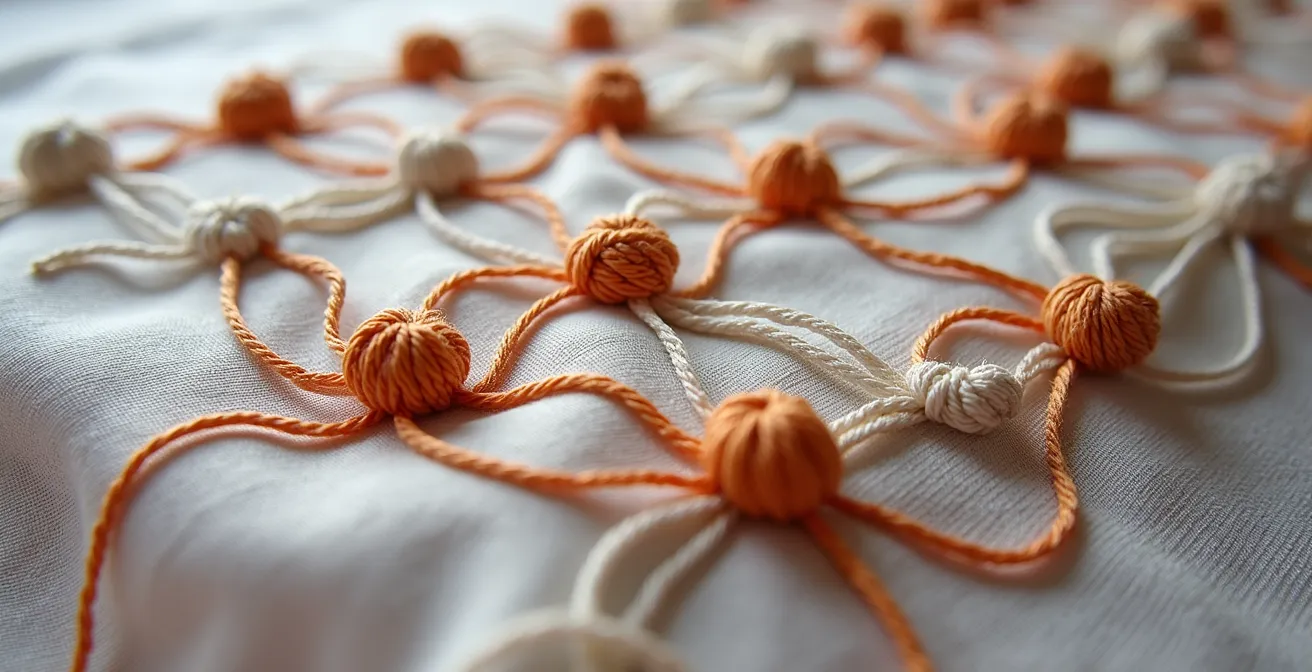
The most telling sign is often hidden. On a hand-embroidered garment, the reverse side reveals a network of neat, individual knots. A machine-made piece will show looped threads or a solid backing. This level of detail, both seen and unseen, is a fundamental component of couture quality.
Action Plan: Identifying Hand Embroidery
- Examine the reverse side: Hand tambour beading shows individual neat knots, while machine work reveals looped thread networks or backing material.
- Test the drape: Hand-beaded fabric moves with more fluidity due to varied thread tension, while machine-beaded fabric feels stiffer.
- Listen to the sound: Hand-beaded fabric creates a subtle, complex ‘rustle’ versus the flatter, uniform sound of machine beading.
- Check bead spacing: Hand work shows slight irregularities and ‘intentional imperfection’ that gives character.
- Look for the artisan’s ‘hand’: Like a painter’s brushstroke, each embroiderer has a unique signature in their work.
Prêt-à-Porter vs Couture: Is the Quality Gap Really Worth the Price Difference?
The gap between a luxury ready-to-wear (Prêt-à-Porter) garment and an Haute Couture piece is not an incremental step; it’s a leap into a different universe. The purpose and economics are fundamentally different. As one industry analysis puts it, “Haute Couture is the dazzling shield; Ready-to-Wear is the dependable sword.” A ready-to-wear line is the commercial engine of a brand, designed for profit. Haute Couture, in contrast, rarely turns a direct profit. Its purpose is prestige, a showcase of ultimate capability that elevates the entire brand.
The economic divergence begins with time. A complex ready-to-wear dress might take 10-20 hours to produce in a factory setting. In contrast, industry documentation confirms that a single Haute Couture dress takes a minimum of 150 hours, with some wedding or finale gowns requiring upwards of 700 hours of painstaking handwork by multiple artisans. This is not just labor; it’s the accumulated expertise of specialized ateliers for pleating, embroidery, feather work, and finishing.
This investment in creation leads to a different kind of value: longevity and appreciation. A ready-to-wear item depreciates the moment it leaves the store. An important Haute Couture piece, however, can become a historical artifact and a tangible asset. Sotheby’s auction records provide stark evidence of this. A Balenciaga Haute Couture piece from 1965-66 sold for 56,250 EUR, and a Chanel Haute Couture snake bracelet set from the 1960s fetched 52,920 USD. These pieces are not treated as used clothing but as appreciating art investments, a status that ready-to-wear can never achieve. The price difference reflects this chasm between a consumer good and a collectible asset.
The Stitching Error That Gives Away a Fake Designer Gown
In the world of high-stakes luxury, counterfeiting is a constant threat. However, at the Haute Couture level, fakes are betrayed not by a single stitching error but by what one industry analysis calls a “systemic failure.” A counterfeiter might be able to replicate the superficial look of a gown, but they cannot replicate the thousands of hours of fitting and engineering that define its internal soul. The giveaway is the failure of the garment as a whole system.
A true couture piece is an architectural marvel. Its perfect drape is not an accident; it is engineered with hidden weights, internal corsetry, and precisely placed boning. The fabric patterns flow seamlessly across complex curves and seams, a feat that requires exponentially more fabric and meticulous planning. Counterfeits, built for a quick visual impression, lack this internal architecture. They may use mass-produced fabrics that only approximate the look of custom-milled textiles, and they will invariably fail in how they move and sit on a body. The table below outlines these crucial, systemic differences.
| Feature | Authentic Haute Couture | Counterfeit/Fake |
|---|---|---|
| Internal Architecture | Complex internal corsetry, hidden weights for perfect drape | Basic construction, no internal support structure |
| Pattern Matching | Perfect three-dimensional pattern flow across seams, darts, and curves | Misaligned patterns, especially at complex curves |
| Fabric Origin | Custom-milled fabrics, unique weaves produced in limited runs (20-meter typical) | Mass-produced fabrics attempting to replicate appearance |
| Weight Distribution | Engineered weight placement for movement and drape | Uneven weight, pulls or sags incorrectly |
| Hand Finishing | Individual hand-sewn stitches, personalized label with client name | Machine stitching throughout, generic labels |
How to Store Vintage Couture to Prevent Fabric Disintegration?
Treating Haute Couture as a long-term asset means its preservation is paramount. Throwing a vintage beaded Chanel jacket on a wire hanger is the equivalent of leaving a Picasso in a damp basement. The forces that act on a garment over time—gravity, light, humidity, and chemical reactions—are its greatest enemies. Museum-grade storage protocols are not suggestions; they are essential for preventing irreversible damage.
The first and most critical rule is that gravity is the primary enemy of a structured or embellished garment. Hanging a heavy beaded gown will, over time, cause the fabric to stretch, tear, and seams to pull apart. Therefore, such pieces must always be stored flat. The process involves laying the garment in an archival-quality, acid-free box and using rolled acid-free tissue paper to support every single fold. This prevents creasing, which can permanently break delicate fibers like silk.
The environment is equally critical. A stable relative humidity of 45-55% and a cool, stable temperature are necessary to prevent mold growth or fabric desiccation. All storage materials must be inert; this means using materials like Tyvek for wrapping and polyethylene foam for support, while strictly avoiding wood and standard cardboard boxes, which release fabric-damaging acids over time. Specific materials even require their own micro-environments, such as providing ventilation for early plastics used by designers like Courrèges or storing metallic threads with anti-oxidation sachets. This is not just storage; it is active conservation.
Why “Genuine Leather” Is Actually the Lowest Quality Grade?
The obsessive attention to material science in Haute Couture provides a valuable lesson that can be applied to other luxury goods, particularly leather. Many consumers are misled by labeling, assuming that a product stamped with “Genuine Leather” is a mark of high quality. In reality, it is the opposite. The term signifies one of the lowest grades of leather available.
To understand why, one must look at the hide itself. The highest quality, most durable, and most desirable part of the hide is the very top layer, known as full-grain leather. It retains the natural grain, pores, and markings of the animal, and it develops a beautiful patina over time. The next best is top-grain, where the very top surface is sanded down to remove imperfections. “Genuine Leather,” however, is typically made from the lower, weaker layers of the hide (the split) or even from leather scraps bonded together with polyurethane and then painted to look like a higher grade.
This heavily processed material lacks the strength and durability of full-grain leather. Its painted surface is prone to cracking and peeling, and it will never develop the rich character and patina that signifies quality. The hierarchy of leather quality is a clear parallel to the world of couture: true value lies in the integrity of the raw material, not in a superficial finish designed to mask an inferior core.
| Grade | Layer Source | Processing | Aging Characteristics | Price Range |
|---|---|---|---|---|
| Full-Grain | Premium top layer with natural texture | Minimal processing, retains natural grain | Develops rich patina, increases in character | Highest |
| Top-Grain | Same top layer, sanded down | Imperfections removed, uniform finish | Some patina development, good durability | High |
| Genuine Leather | Lower split (suede) or bonded scraps | Heavily processed, painted surface | Prone to cracking and peeling | Low |
| Bonded Leather | Leather scraps and polyurethane | Ground and reconstituted with plastics | Rapid deterioration, peeling surface | Lowest |
Key Takeaways
- Haute Couture is a legally-protected designation, not a generic term for expensive clothing, with fewer than 20 brands qualifying.
- The value of a couture piece is in its engineering and hours of craft; it often appreciates in value like art, unlike ready-to-wear fashion.
- Identifying true quality, whether in embroidery or leather, requires looking past the surface to the material’s integrity and construction.
Why Buying Art at a Degree Show Can Be Your Best Investment Strategy?
The principle of identifying and acquiring an asset before its market value is fully realized—so central to collecting vintage couture—has a direct parallel in the art world. While established artists command high prices at major galleries, some of the most astute investment strategies focus on the very beginning of an artist’s career: the graduate degree show. This is the equivalent of acquiring a couturier’s work when they are still an apprentice, betting on their future talent.
The potential for high returns is significant. While it involves risk, analysis from auction houses suggests that early works by now-established artists show an average appreciation of 300-500% over a 10-15 year period. Buying at a degree show offers access at the lowest possible price point, directly from the artist, before gallery representation adds a significant markup. It is a high-risk, high-reward strategy that requires research, a good eye, and a willingness to engage with emerging talent.
More than just a financial transaction, buying at a degree show makes the collector part of the artwork’s history. You become the first owner, a crucial part of the piece’s provenance. Documenting the purchase, keeping the show’s catalogue, and even building a relationship with the artist adds to this story and, in turn, to the work’s long-term value. It’s an active form of collecting that shifts from passive consumption to active participation in the cultural landscape, mirroring the deep relationship between a couture house and its most valued clients.
Identifying Quality Leather Goods: How to Distinguish Genuine Grain from Synthetic Fakes?
The final lesson from the world of Haute Couture is the cultivation of a forensic eye for detail. The ability to distinguish the authentic from the fake, the masterfully crafted from the mass-produced, is a skill that transcends any single category of luxury. Having learned to scrutinize the hidden architecture of a gown, we can apply the same critical senses to other items, like leather goods, to separate true quality from clever imitation.
Identifying quality leather is a multi-sensory experience. It begins with smell; real leather has a rich, earthy, and slightly sweet smell, while synthetics often have a chemical or plastic odor. The next test is touch. Full-grain leather feels supple and warm, with minor imperfections that signal its natural origin. A synthetic material will often feel cold, smooth, and unnaturally perfect. The grain pattern is another key indicator. Natural leather has a slightly random and imperfect pore structure, whereas the pattern on faux leather is often machine-stamped and repeats uniformly.
Even a small drop of water can be revealing. On an inconspicuous spot, real leather will slowly absorb a droplet of water, while PU or PVC (the materials of faux leather) are non-porous, causing the water to bead up and roll off. This “forensic” approach—using sight, smell, touch, and even basic physics—is the ultimate takeaway from the couture mindset. It teaches us to look beyond the brand name and the price tag to find the intrinsic value embedded in the material and the craftsmanship. It is the ability to see the story written in the object itself.
Frequently Asked Questions about Identifying Quality Leather Goods: How to Distinguish Genuine Grain from Synthetic Fakes?
What does real leather smell like compared to synthetic?
Real leather has an earthy, rich, organic smell reminiscent of wood and soil. Synthetic leather typically smells of chemicals, plastic, or has no smell at all.
How can I use the water test without damaging the item?
Place a small water droplet on an inconspicuous area. Real leather will slowly absorb it within 10-30 seconds, while synthetic materials will cause the water to bead up and roll off.
What visual imperfections indicate genuine leather?
Look for tiny natural scars, pores, and variations in the grain pattern. These imperfections are proof of authenticity – perfectly uniform surfaces typically indicate synthetic or heavily corrected leather.