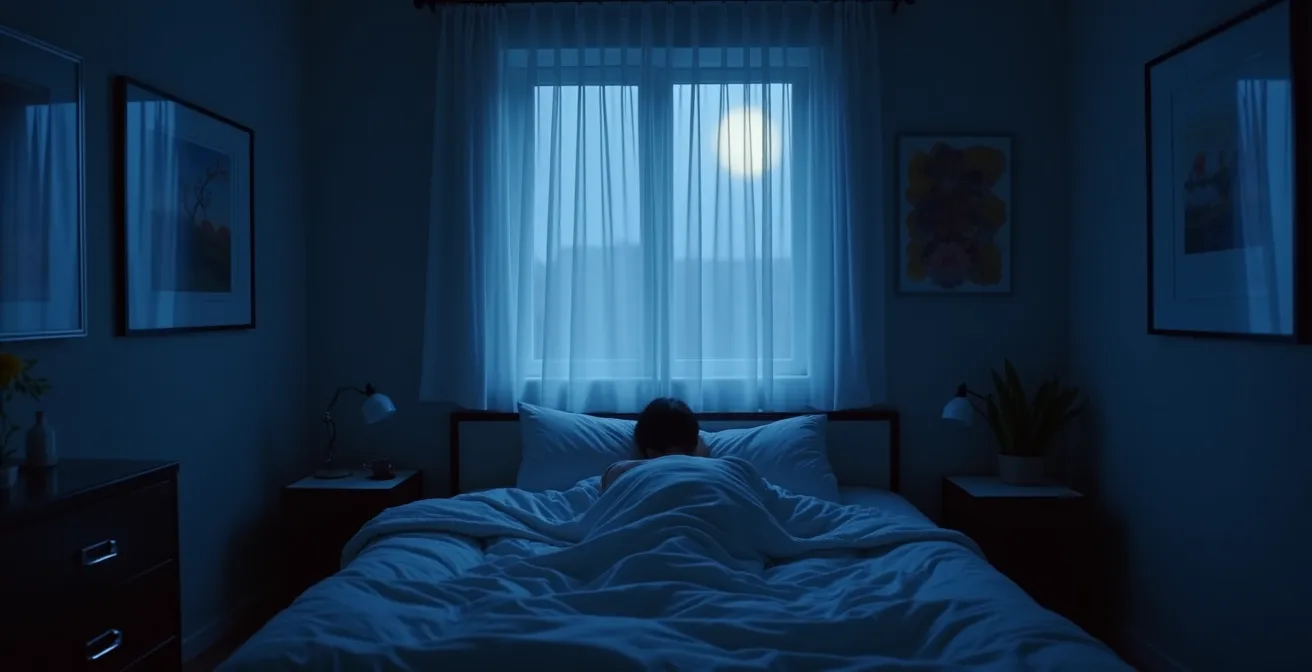
In summary:
- Your brain uses deep sleep to run a “wash cycle” (the glymphatic system) to clear out proteins linked to neurodegenerative diseases.
- Manipulating core body temperature through a “thermal cascade” is one of the most powerful levers for inducing deep sleep.
- Light is a potent drug for your brain; controlling its color and timing in the evening is critical to protect melatonin production.
- Building a consistent 60-minute pre-sleep routine can condition your brain for faster sleep onset and higher quality rest.
- Strategic use of morning sunlight is as important as darkness at night for anchoring your body’s master clock.
You meticulously track your sleep with a wearable, analyzing every dip and spike. You see the numbers—light sleep, REM, time awake—but one metric remains stubbornly low: deep sleep. You’ve tried the generic advice to avoid caffeine and keep a schedule, yet your recovery scores are stagnant, and you wake up feeling less than refreshed. This is a common frustration for the data-driven individual: having the diagnostics but lacking the specific, actionable levers to effect real change.
The common wisdom about sleep hygiene often misses the underlying physiology. It tells you *what* to do, but not *why* it works or *how* to optimize it for maximum impact. The truth is, your body operates on a series of predictable biological cues. Your sleep is not a matter of luck; it is a system that can be engineered. But if the true key to unlocking restorative sleep isn’t just about avoiding bad habits, but about actively programming your environment and biology?
This guide moves beyond the basics. We will explore the specific mechanisms that govern your sleep cycles, from brain detoxification to hormonal regulation. Instead of vague suggestions, you’ll get a series of precise protocols designed to manipulate the key levers of temperature, light, and routine. By understanding and applying these principles, you can take direct control of your sleep quality and transform your nights from a passive state of rest into an active period of powerful restoration.
For those who prefer a condensed format, the following video with Dr. Matt Walker provides a powerful overview of why sleep is non-negotiable for your health and performance. It serves as an excellent primer for the detailed strategies we are about to explore.
This article is structured to guide you through the most impactful strategies for enhancing your deep sleep. We will begin by exploring the critical role of sleep in brain health before diving into actionable protocols you can implement tonight. The following summary outlines the key areas we will cover.
Summary: A Scientific Guide to Engineering Restorative Sleep
- Why Your Brain Needs 7 Hours to Wash Away Alzheimer’s Proteins?
- How to Temperature-Control Your Room to Induce Hibernation Mode?
- Magnesium Glycinate vs Melatonin: Which Aid Is Safer for Long-Term Use?
- The Evening Screen Mistake That Delays Your REM Cycle by 40 Minutes
- How to Structure the Last 60 Minutes of Your Day for Instant Sleep Onset?
- The Wi-Fi Router Placement Error That Might Be Affecting Your Sleep
- The Lighting Error That Disrupts Melatonin Production in Your Bedroom
- Building a Holistic Lifestyle: How to Increase Healthspan by 10 Years Through Daily Micro-Habits?
Why Your Brain Needs 7 Hours to Wash Away Alzheimer’s Proteins?
While you sleep, your brain is anything but dormant. It’s performing a critical maintenance task: a deep cleanse. This process, known as the glymphatic system, is your brain’s unique waste-disposal method. During the day, metabolic byproducts, including toxic proteins like beta-amyloid, accumulate in the brain. If left unchecked, beta-amyloid can form the plaques characteristic of Alzheimer’s disease. It is primarily during deep, slow-wave sleep that this system kicks into high gear, using cerebrospinal fluid to flush these toxins out.
Think of it as the city’s waste management crew that only works at night when the streets are empty. During deep sleep, your brain cells actually shrink, widening the space between them to allow cerebrospinal fluid to flow more freely and carry away waste. Insufficient or fragmented deep sleep hobbles this process, allowing toxins to build up. A recent 2024 study directly linked poor sleep quality to impaired brain waste clearance in older adults, solidifying the connection between restorative sleep and long-term neurological health. Securing 7-8 hours of quality sleep isn’t a luxury; it’s a non-negotiable nightly appointment for brain detoxification.
Action Plan: Enhancing Your Glymphatic Function
- Map Your Sleep Schedule: List all factors affecting your bedtime and wake time. Aim for a strict, consistent schedule, even on weekends, to maximize the predictable windows for slow-wave sleep.
- Audit Your Environment: Inventory your bedroom for sleep disruptors. Focus on temperature (cool), light (total darkness), and sound (quiet or white noise).
- Assess Your Habits: Confront your evening routines. Identify alcohol consumption or late-night hydration patterns that could fragment sleep and reduce cerebrospinal fluid (CSF) volume.
- Analyze Your Sleep Position: Use your wearable’s data or a camera to check your dominant sleep posture. Experiment with side sleeping, which some research suggests may improve glymphatic drainage.
- Create an Integration Plan: Prioritize one or two changes to implement this week. Start with the easiest wins, such as setting a strict “lights out” time or moving your last glass of water to an hour before bed.
Ultimately, viewing sleep through the lens of the glymphatic system transforms it from a passive state of rest into an active, protective process essential for your cognitive future.
How to Temperature-Control Your Room to Induce Hibernation Mode?
One of the most powerful and often overlooked signals for initiating sleep is a drop in your core body temperature. Your body’s internal clock, or circadian rhythm, naturally orchestrates this temperature decline in the evening to prepare you for rest. By actively managing your environment to facilitate this process, you can significantly shorten the time it takes to fall asleep and increase the proportion of deep sleep. The goal is to create a “thermal cascade”—a rapid cooling of your core after a period of warming.
A highly effective way to trigger this is by taking a hot bath or shower 90 minutes before bed. This may seem counterintuitive, but the warm water draws blood to the surface of your skin. When you get out, the surrounding cooler air causes rapid heat dissipation from your skin, leading to a drop in your core body temperature. Studies indicate that a core body temperature drop of just 1-2 degrees Fahrenheit is a potent signal for the brain to release melatonin and enter sleep. Aim for a bedroom temperature between 60-67°F (15-19°C) to maintain this cooler state throughout the night.

As the illustration suggests, this evening ritual is not just about hygiene; it’s a therapeutic tool. The transition from the warm, steamy environment of the bath to a cool bedroom creates the ideal physiological trigger for sleep. By engineering this temperature drop, you are essentially telling your body it’s time to enter a state of conservation and repair, much like a gentle form of hibernation.
Think of your thermostat not just as a comfort control, but as a primary dial for regulating your sleep quality. This simple environmental adjustment can yield a significant return on your deep sleep score.
Magnesium Glycinate vs Melatonin: Which Aid Is Safer for Long-Term Use?
In the quest for better sleep, many turn to supplements. The two most common are melatonin and magnesium, but they work in fundamentally different ways and have vastly different safety profiles for long-term use. As sleep scientist Dr. Matthew Walker famously stated, “We have not been able to discover a single psychiatric condition in which sleep is normal,” highlighting the profound link between mental well-being and rest, which often leads people to seek external aids.
We have not been able to discover a single psychiatric condition in which sleep is normal.
– Matthew Walker, Ph.D., FoundMyFitness Interview
Melatonin is a hormone your body produces to signal sleep. Taking it exogenously is like forcing a key into a lock. It can be effective for short-term issues like jet lag, but long-term use can be problematic. Your body may reduce its own natural production, creating a dependency. Magnesium, on the other hand, is an essential mineral involved in over 300 biochemical reactions, including the regulation of neurotransmitters. Specifically, magnesium glycinate helps calm the nervous system by supporting the production of GABA, a neurotransmitter that promotes sleep. It doesn’t force sleep; it facilitates the natural process of relaxation.
For those tracking sleep data, the choice between these two should be clear. Magnesium works to correct a common nutritional deficiency and supports the body’s own sleep mechanisms, making it a much safer and more sustainable choice for long-term sleep enhancement. The following table breaks down the key differences, sourced from an analysis of sleep cycle data.
| Aspect | Magnesium Glycinate | Melatonin |
|---|---|---|
| Mechanism | Supports GABA production naturally | Directly replaces sleep hormone |
| Dependency Risk | Minimal – essential mineral | Moderate – can suppress natural production |
| Side Effects | Mild digestive effects at high doses | Grogginess, vivid dreams, hormone disruption |
| Long-term Safety | Generally safe, corrects deficiency | May reduce natural melatonin over time |
| Dosage Range | 200-400mg before bed | 0.5-5mg (lower is often better) |
Therefore, unless you are addressing a specific circadian issue like jet lag under medical advice, magnesium glycinate represents a more holistic and safer strategy for improving sleep quality over time.
The Evening Screen Mistake That Delays Your REM Cycle by 40 Minutes
You’ve heard it a thousand times: “avoid screens before bed.” But for a data-driven individual, this advice lacks precision. The real issue is not the screen itself, but a specific wavelength of light—blue light—that acts as a powerful signal to your brain. This light, emitted in high concentrations by phones, tablets, and LED lights, effectively tells your brain’s master clock that it’s still daytime. It does this by directly suppressing the production of melatonin, the hormone of darkness that orchestrates your sleep.
The impact is measurable and significant. Exposure to bright, blue-spectrum light in the evening can delay the onset of your melatonin surge, pushing back your entire sleep architecture, including the start of your REM and deep sleep cycles. Some studies suggest this delay can be as much as 40 minutes. To avoid this, research recommends a strict light curfew at least 90 minutes before your intended bedtime. This isn’t just about turning off your phone; it’s about managing your entire light environment to signal to your brain that the day is over.
Implementing a “Light Curfew Protocol” is one of the highest-leverage changes you can make for your sleep quality. The goal is to progressively shift your evening light exposure from bright and blue to dim and warm (amber or red). This protocol includes several key actions:
- Set your phone and computer to automatically enter “night mode” or use a blue-light-filtering app from sunset onwards.
- Replace standard bedroom bulbs with amber or red spectrum lights, which have a minimal impact on melatonin.
- If screen use is unavoidable in the last two hours before bed, wear a pair of quality blue-light-blocking glasses.
- Begin dimming all lights in your home progressively, starting about 2 hours before you plan to sleep.
- Install blackout curtains to completely eliminate ambient light from streetlights or early morning sun, which can disrupt the final stages of sleep.
By treating light as the potent biological signal it is, you can take direct control over your melatonin production and ensure your brain is primed for sleep at the right time, every time.
How to Structure the Last 60 Minutes of Your Day for Instant Sleep Onset?
The hour before you go to bed is not just downtime; it’s the launch sequence for a night of restorative sleep. A chaotic or stimulating final hour can leave your mind racing and your body in a state of alert, delaying sleep onset and compromising its quality. Conversely, a structured, consistent wind-down routine conditions your brain and body, creating a powerful psychological and physiological cue that sleep is imminent. This conditioning is the secret to falling asleep quickly and predictably.
Case Study: The Stanford Sleep Protocol
Research from Stanford’s leading sleep centers demonstrates the power of consistent pre-sleep routines. Their protocols show how a structured “power-down hour” can condition the brain for rapid sleep onset. A common and effective structure involves a three-phase approach: 60-30 minutes before bed for a “brain dump” (journaling thoughts and tasks for the next day to clear the mind), 30-5 minutes for quiet activity like reading a physical book under warm, dim light, and the final 5 minutes for a physiological sigh or other guided breathing exercises to down-regulate the nervous system.
This structured approach is not about adding more tasks to your day but about creating a peaceful, predictable buffer between the stress of the day and the rest of the night. The act of reading under warm light, for example, combines the benefits of light management with a cognitive activity that is engaging but not overly stimulating. It helps you disengage from problem-solving mode and transition into a more relaxed state of mind.

The final, crucial step is a deliberate shift in your physiology. The “physiological sigh,” which involves two sharp inhales through the nose followed by a long, slow exhale through themouth, is one of the fastest known ways to quell anxiety and activate your parasympathetic (rest-and-digest) nervous system. Performing this for just a few minutes can dramatically lower your heart rate and prepare your body for sleep.
By consistently executing this 60-minute protocol, you are not hoping for sleep to happen; you are actively creating the perfect conditions for it to begin.
The Wi-Fi Router Placement Error That Might Be Affecting Your Sleep
In our hyper-connected world, our homes are saturated with electromagnetic fields (EMFs), primarily from Wi-Fi routers, cell phones, and other electronic devices. While the scientific consensus on the health impacts of low-level EMFs is still evolving, a growing body of research and a wealth of anecdotal evidence suggest that for some individuals, high exposure can interfere with sleep quality. The theory is that these frequencies may disrupt the brain’s natural electrical activity and melatonin production.
For those who are particularly sensitive or simply wish to apply the precautionary principle, managing EMF exposure in the bedroom is a logical step. The intensity of EMF radiation decreases exponentially with distance. This means that the single most common and easily correctable error is placing a Wi-Fi router in or near the bedroom. Having an active router next to your bed is the equivalent of trying to sleep next to a constantly flashing light for your cells. Sleep experts who focus on environmental factors suggest maintaining a minimum distance of 6 feet from any major electrical device, including your router and charging phone.
Fortunately, reducing your nightly EMF exposure is straightforward and requires no drastic lifestyle changes. It’s about creating a quiet, electronically-uncluttered sanctuary for sleep. Here are a few key strategies:
- Relocate the Router: Move your Wi-Fi router to a room that is as far from your bedroom as possible, such as a home office or living room.
- Use a Timer: Plug your router into a simple mechanical outlet timer and set it to automatically shut off between your bedtime (e.g., 11 PM) and wake time (e.g., 6 AM).
- Create Distance: Keep your cell phone in another room or, at the very least, switch it to airplane mode and place it across the room while you sleep.
- Bed Placement: Position your bed so that your head is at least six feet away from any electrical outlets or power strips.
- Consider Hardwiring: For devices in or near the bedroom, such as a smart TV or computer, consider using a hardwired Ethernet connection instead of relying on Wi-Fi.
By creating this electronically silent period each night, you eliminate a potential variable of disruption and ensure your sleep environment is as clean and natural as possible.
The Lighting Error That Disrupts Melatonin Production in Your Bedroom
You’ve installed blackout curtains and turned off the main lights, believing your bedroom is a perfectly dark sanctuary. However, the most insidious sleep disruption often comes from sources of light you’ve learned to ignore: the tiny, persistent glow of electronic devices. These seemingly insignificant photons from LED indicator lights on televisions, smoke detectors, charging cables, and even digital clocks are potent enough to be perceived by your brain and suppress melatonin production.
Research Spotlight: The Power of a Single LED
Recent research from institutions like OHSU has demonstrated that even low levels of light pollution can have a measurable negative impact on sleep. One study found that simply covering all small light sources in the bedroom—including the minuscule LEDs on smoke detectors and power strips—led to a significant improvement in sleep quality markers. Your brain’s sensitivity to light during sleep is far greater than you might assume; it craves absolute darkness to perform its restorative functions optimally.
The lux level, a measure of light intensity, of a typical phone screen is around 40-60 lux, which is known to be highly disruptive. But even the 1-5 lux from a charging indicator can be enough to disturb the delicate process of sleep. Your mission should be to achieve a state of “light hygiene” so complete that you cannot see your hand in front of your face. This level of darkness sends the strongest possible signal to your brain that it is time for deep, uninterrupted rest.
This table illustrates the impact of common light sources found in the bedroom and provides simple, effective solutions for each. The goal is to hunt down and eliminate every last photon.
| Light Source | Lux Level | Melatonin Suppression | Solution |
|---|---|---|---|
| Phone screen | 40-60 lux | High | Keep out of bedroom |
| LED indicators | 1-5 lux | Moderate | Cover with tape |
| Street light through window | 10-20 lux | High | Blackout curtains |
| Red night light | <1 lux | Minimal | Safe for navigation |
| Clock display | 5-10 lux | Moderate | Turn away from bed |
By systematically auditing your bedroom and covering every last source of light with black electrical tape or by unplugging devices, you are taking a simple yet profound step toward protecting your nightly melatonin production.
Key takeaways
- Deep sleep is not passive rest; it’s an active brain-cleaning process (glymphatic system) essential for neuroprotection.
- You can directly control deep sleep onset by engineering a core body temperature drop via a “thermal cascade.”
- Light is the most potent signal for your circadian rhythm; managing evening light (dim, warm) and morning light (bright, natural) is critical.
Building a Holistic Lifestyle: How to Increase Healthspan by 10 Years Through Daily Micro-Habits?
Mastering the individual levers of temperature, light, and routine is powerful, but the true path to a transformative increase in healthspan—the years you live in good health—lies in integrating these actions into a consistent, holistic lifestyle. Sporadic efforts yield sporadic results. It is the rhythm and regularity of your daily micro-habits that compound over time to produce profound and lasting benefits for your sleep and overall vitality. As sleep expert Matthew Walker notes, the single most important advice for good-quality sleep is to keep it regular.
This means anchoring your circadian rhythm with unwavering consistency. The most powerful anchor is not what you do at night, but what you do first thing in the morning. Exposing yourself to natural sunlight shortly after waking is a critical signal that sets your body’s 24-hour clock. This morning light exposure triggers a healthy cortisol spike that promotes daytime alertness and, just as importantly, starts a countdown timer for the release of melatonin approximately 14-16 hours later. Sleep researchers recommend getting 10-20 minutes of morning sunlight, without sunglasses, to properly set this internal clock.

This morning ritual, combined with the evening protocols we’ve discussed, creates a virtuous cycle. Morning light anchors your wake-up time, and evening darkness (or “dimness”) protects your wind-down time. This consistent light-dark cycle, paired with regular meal times and exercise, creates a robust and resilient circadian rhythm. It is this rhythm that governs not just your sleep, but your hormone production, metabolism, and immune function—the very pillars of your healthspan.
By shifting your focus from isolated “sleep hacks” to building a consistent, rhythm-driven lifestyle, you are no longer just managing your sleep; you are investing in a future with more energy, better health, and a sharper mind.