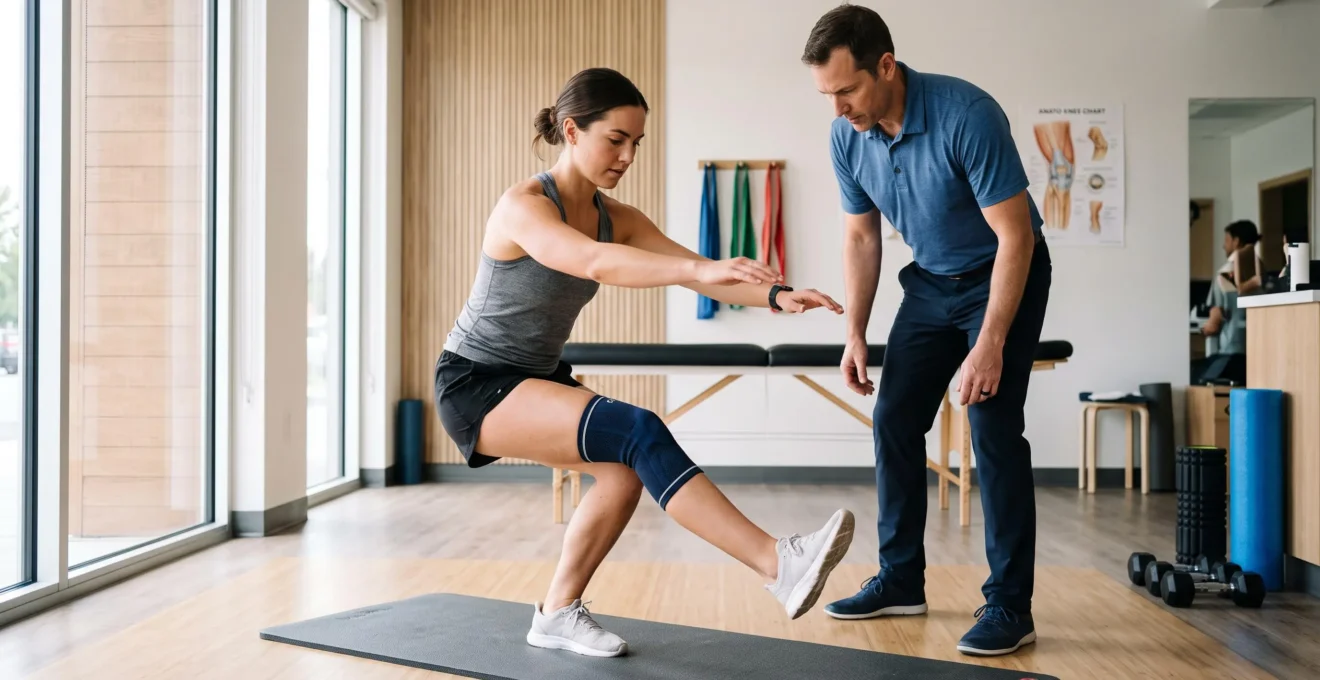
You’ve just had ACL reconstruction surgery, or you’re about to, and the question consuming your thoughts is simple: when will this be over? When can you drive again, return to work, go for a run, play the sports you love? The answers you’ve found online range wildly—some sources say six months, others insist on twelve, and you’ve heard stories of professional athletes returning in seven months. This uncertainty makes planning the next year of your life nearly impossible.
The truth is more nuanced than a single number. ACL recovery follows a biological timeline that unfolds in predictable phases, but the endpoint depends entirely on what you’re trying to do. Walking without crutches happens within weeks. Returning to competitive soccer takes closer to a year. Understanding this distinction—and the science behind it—transforms anxious waiting into informed planning.
Medical information notice
This article provides general educational information about ACL reconstruction recovery timelines based on current medical evidence. Individual recovery varies significantly based on surgical technique, graft type, associated injuries, age, and rehabilitation compliance. Always follow the specific guidance of your orthopedic surgeon and physical therapist, who can assess your unique situation and progression. Never advance to the next rehabilitation phase or return to sports without formal clearance from your medical team.
In this article
- The realistic ACL surgery recovery timeline: 6 to 12 months
- Why does ACL recovery take so long?
- The four phases of ACL rehabilitation: what happens when
- What makes your recovery faster or slower?
- When can you actually return to sports after ACL surgery?
- Recovery mistakes that delay ACL healing
- Planning your next twelve months
The realistic ACL surgery recovery timeline: 6 to 12 months
Quick answer: Full ACL recovery ranges from 6 to 12 months depending on your activity goals. Most people return to normal daily activities within 2-4 weeks, can jog in 3-4 months, and safely return to pivoting sports like soccer or basketball at 9-12 months. The wide range reflects different endpoints: riding a bike is not the same as cutting and jumping in competitive play.
When orthopedic surgeons talk about ACL recovery time, they’re measuring different finish lines for different patients. The confusion you’re experiencing comes from conflating these distinct milestones. A software engineer working from home measures success differently than a competitive soccer player, yet both search for “ACL recovery time” and receive the same oversimplified answers.
The recovery timeline breaks down into concrete, functional milestones. You’ll walk without crutches and handle basic self-care within two to four weeks. Driving returns between two and six weeks, depending on which knee was operated on and whether you drive an automatic or manual transmission. By three to four months, you can typically jog in a straight line on flat, stable surfaces. Six months represents the absolute earliest return for low-demand sports without cutting or pivoting—think cycling or swimming.
But returning to high-demand pivot sports—soccer, basketball, skiing, football—requires nine to twelve months for safe clearance. This isn’t arbitrary caution. Modern surgical techniques, including approaches developed by specialists like Pr. Etienne Cavaignac who integrate biological healing science into surgical planning, have improved outcomes significantly, yet they cannot override the fundamental biology of ligament healing.
Several factors push your personal timeline toward the shorter or longer end of this range. The type of graft your surgeon used matters: hamstring grafts generally allow earlier range of motion with less anterior knee pain, while patellar tendon grafts integrate slightly faster but cause more discomfort kneeling in the first months. Your age plays a role—younger patients often have more aggressive rehabilitation protocols but also face higher re-injury rates when they return to demanding sports. The sport itself determines the clearance threshold: a cyclist faces different demands than a basketball player.
Most importantly, the quality of your rehabilitation compliance directly influences how quickly you restore strength, range of motion, and neuromuscular control—though it cannot accelerate the underlying biological maturation of the graft tissue itself. That process follows its own incompressible timeline, which we’ll examine next.
Why does ACL recovery take so long?
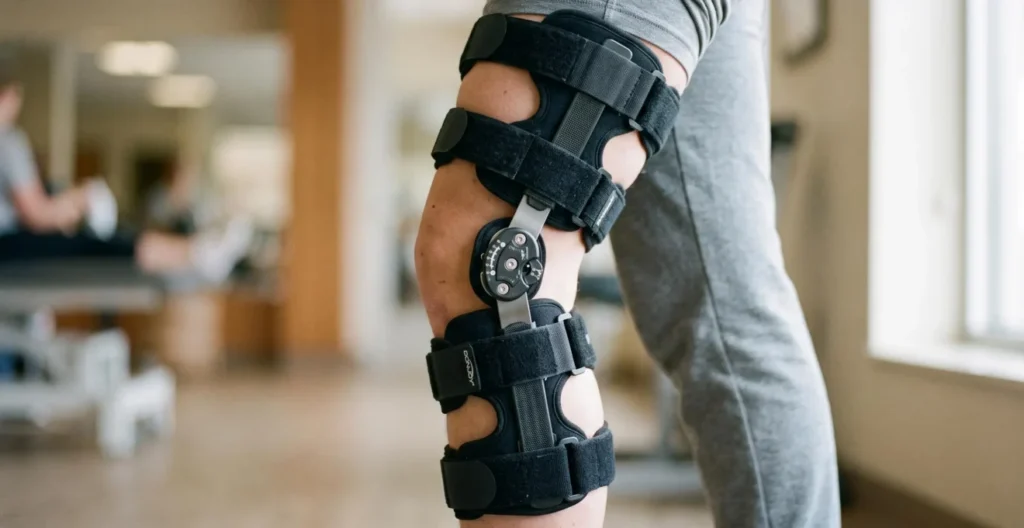
The frustrating answer to “why can’t I just heal faster?” lies in cellular biology, not in surgical technique or rehabilitation intensity. Your new ACL graft—whether harvested from your own hamstring, patellar tendon, or quadriceps tendon—must undergo a transformation called ligamentization. This biological remodeling occurs in three overlapping phases that no amount of physical therapy compliance can compress.
The 3 biological phases your graft goes through: According to a National Institutes of Health-registered clinical study description, ACL graft ligamentization occurs in three phases: early healing (0-3 months), a second phase (6 months-1 year), and final maturation after 1 year, when the graft closely resembles a native ACL.
During the first phase of early necrosis and healing, which spans roughly the first three months, something counterintuitive happens: your graft actually weakens. The transplanted tissue loses its original blood supply, and the cells that formed its structure begin to die. New cells from your body must migrate into the graft and begin the slow process of revascularization—growing new blood vessels throughout the tissue. At this stage, the graft reaches its point of maximum vulnerability, which explains the strict protection protocols your physical therapist enforces.
The second phase of revascularization and early remodeling extends from about three months to one year. New blood vessels colonize the graft, bringing nutrients and cellular signals that trigger collagen remodeling. The graft begins to gain strength, but the collagen fibers remain disorganized compared to a native ligament. Think of it like pouring a concrete foundation: it may look solid after 24 hours, but it hasn’t reached its final strength—that takes weeks of curing. Your graft follows similar laws of material science.
The third phase of maturation and remodeling continues beyond one year. Collagen fibers gradually reorganize themselves along the lines of mechanical stress—a process called Wolff’s Law in bone, with similar principles applying to ligaments. The graft slowly approaches the structural properties of your original ACL, though studies suggest it may never achieve 100% of native ligament strength.
Here’s the critical data point that explains why nine to twelve months is medically necessary, not just conservative: research shows the graft achieves only 60-80% of its final mechanical strength at six to nine months post-surgery. This is precisely when your knee feels completely normal. You have full range of motion, no pain, no swelling, and subjective stability. The disconnect between how your knee feels and how strong your graft actually is creates the danger zone for re-rupture.
Intensive physical therapy plays a vital role in your recovery, but it doesn’t accelerate graft maturation—it prepares everything around the graft. PT rebuilds the quadriceps and hamstring strength that protects your knee, restores proprioception so your nervous system can react to unstable positions, and reconditions your cardiovascular system. These adaptations are essential, but they run parallel to graft healing, not instead of it. You cannot exercise your way past biology.
The four phases of ACL rehabilitation: what happens when
Understanding what you should be able to do at each stage—and what objective criteria determine when you progress—converts abstract waiting periods into concrete, measurable milestones. Rehabilitation protocols divide recovery into four distinct phases, each with specific functional goals that must be achieved before advancing.
Phase 1: Protection and early motion (Weeks 0-6)
Your immediate post-surgical goals focus on regaining basic function without stressing the vulnerable graft. By the end of week six, you should achieve full knee extension to 0 degrees and flexion to at least 120-130 degrees. You’ll work to eliminate your walking limp and regain voluntary quadriceps control—the ability to tighten your thigh muscle and lift your straightened leg without it lagging or collapsing.
Allowed activities include progressive walking, starting with crutches and advancing to independent walking as pain and swelling permit. You can use a stationary bike with minimal or no resistance once you achieve 110-120 degrees of flexion. Forbidden activities include any pivoting, running, jumping, or sudden direction changes. This phase emphasizes protection while preventing the stiffness and muscle atrophy that complicate later recovery.
Phase 2: Strength foundation (Weeks 6-12)
As revascularization begins, you can gradually increase mechanical loading. Your goals center on restoring quadriceps and hamstring strength to 70% of your uninjured leg, measured through physical therapy assessments. You’ll begin low-impact cardio: swimming, cycling with progressive resistance, and elliptical training. The clearance criteria for advancing beyond this phase include absence of joint swelling after exercise, stable walking on uneven terrain, and meeting the strength benchmarks.
This phase frustrates many patients because progress feels slow and the activities remain deliberately boring. You’re building the foundation that will protect your graft later, even though the graft itself isn’t ready for dynamic stress.
Phase 3: Progressive loading (Months 3-6)
Between months three and four, most patients receive clearance to begin jogging—always in straight lines, on flat stable surfaces, following a graduated return-to-running program. Your strength goals increase to 80-90% of the uninjured side. You’ll introduce controlled agility drills: lateral shuffles, gentle cutting at reduced speed, and sport-specific movements under supervision.
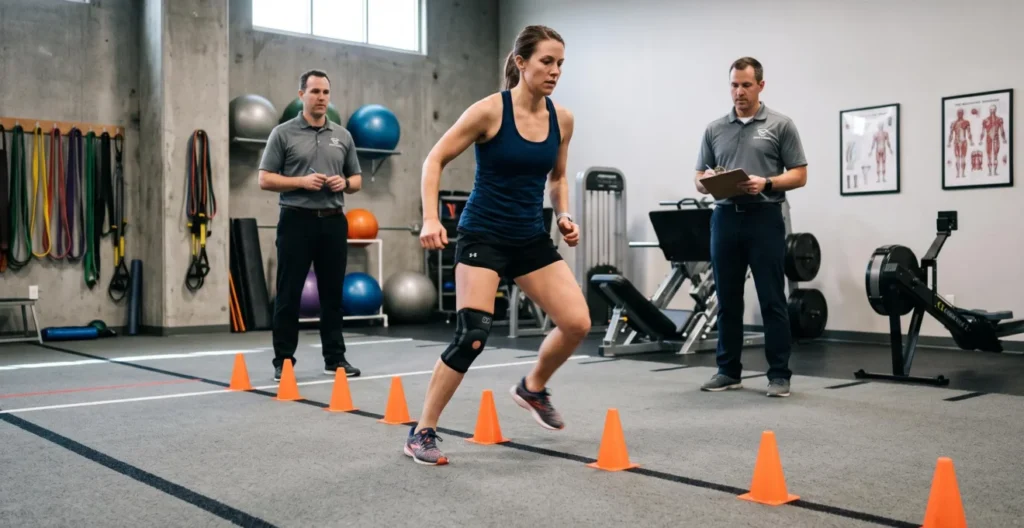
Physical therapists begin functional testing: single-leg hop for distance, triple hop, and crossover hop tests. These aren’t just exercises—they’re assessment tools that quantify whether your injured leg can produce force and absorb landing impact symmetrically with your healthy leg. You’ll also advance proprioception training to restore your nervous system’s ability to protect the knee reflexively.
This is the phase where your knee starts to feel normal. You can do most daily activities without thinking about your knee. This subjective improvement creates the temptation to push faster—which is precisely why objective testing becomes critical.
Phase 4: Return to sport preparation (Months 6-12)
The final phase bridges the gap between fitness and sport readiness. Your goals include achieving hop test symmetry greater than 90% across all test variations, demonstrating isokinetic strength symmetry, and completing sport-specific training without pain, swelling, or apprehension. According to AOSSM guidance, a quadriceps strength index of at least 90% via isokinetic dynamometry, combined with hop testing, represents the generally accepted clearance threshold for return to play.
Clearance for sport requires passing a comprehensive battery of tests, receiving formal authorization from both your surgeon and physical therapist, and demonstrating psychological readiness—the absence of fear or hesitation during cutting and pivoting movements. Many programs now include psychological screening because fear-based movement compensation can increase injury risk even when physical tests show readiness.
Never skip phases based on how your knee feels: Progressing to the next phase requires meeting objective functional criteria, not just reaching a calendar date. Some patients need additional time in a particular phase to achieve the strength, range of motion, or neuromuscular control benchmarks. Advancing prematurely based on feeling good increases re-injury risk substantially.
What makes your recovery faster or slower?
While the biological phases of graft maturation remain relatively fixed, several factors determine where you fall within the six-to-twelve-month range and how smoothly you progress through rehabilitation milestones.
Graft type and surgical technique
The tissue your surgeon uses for reconstruction influences your early recovery experience. Hamstring autografts typically allow earlier comfortable range of motion and cause less anterior knee pain, making kneeling more tolerable in the first months. Patients often prefer them for activities requiring frequent kneeling. Patellar tendon (BTB) autografts integrate bone-to-bone slightly faster and historically showed strong long-term stability, but create more discomfort in early rehabilitation, particularly with kneeling and activities that load the front of the knee.
Modern surgical techniques that add anterolateral ligament reconstruction or lateral extra-articular tenodesis improve rotational stability, particularly beneficial for pivot-sport athletes. These procedures may add two to three weeks to initial rehabilitation due to protecting the additional structure, but they can reduce long-term re-injury rates in high-risk populations.
Age and pre-injury fitness level
Younger patients under 25 often follow more aggressive rehabilitation timelines and regain athletic performance quickly, but they also face the highest re-rupture rates—driven largely by returning to very demanding sports at high intensity. Patients over 40 may need more time to rebuild muscle strength but often target less demanding recreational activities, reducing their required endpoint threshold.
Your pre-injury fitness level dramatically affects rehabilitation efficiency. An athlete who played competitive soccer three times weekly before injury has neuromuscular patterns and cardiovascular fitness that return faster than someone who was sedentary. The nervous system “remembers” skilled movements, making retraining more efficient.
Rehabilitation compliance: the factor you control
The single variable most under your direct control is rehabilitation adherence. Attending physical therapy sessions consistently, completing home exercise programs daily, and progressing load appropriately all influence how quickly you restore strength, range of motion, and proprioception. Two patients with identical surgeries can diverge by two to three months in return-to-sport timing based solely on rehabilitation compliance.
However—and this is critical—compliance cannot accelerate graft maturation itself. You can arrive at month nine with excellent strength, perfect hop test scores, and superior cardiovascular fitness, but your graft still needs those nine months of biological remodeling. Compliance determines whether you’re ready when your graft is ready; it doesn’t make the graft mature faster.
Associated injuries
Isolated ACL tears follow the timelines described above. But meniscus repairs (not just trims), cartilage damage, or multi-ligament injuries extend protection phases and delay the overall timeline by two to four months or more. A meniscus repair requires protecting the healing tissue from excessive rotational and compressive forces, limiting how quickly you can load the knee.
When can you actually return to sports after ACL surgery?
The question “when can I play sports again?” has no single answer because sports vary enormously in their demands on the ACL. Returning to sport requires matching your graft’s maturation stage and your functional capacity to your sport’s specific demands.
Sport classification by ACL demand
Low-demand sports like cycling, swimming, and straight-line running place minimal rotational stress on the ACL and typically allow return at three to four months, assuming you’ve met strength and range-of-motion benchmarks. These activities load the knee predictably without sudden cutting or pivoting.
Moderate-demand sports that involve some direction changes but limited contact—recreational doubles tennis, skiing on groomed runs, light volleyball—generally require six months minimum. The key distinction is controlled versus reactive movements. Planned cuts at moderate speed differ from reacting to an opponent.
High-demand pivot sports—soccer, basketball, football, lacrosse, competitive skiing—demand nine to twelve months minimum. These sports combine cutting, pivoting, deceleration, jumping, and often contact, all while reacting to unpredictable opponents or terrain. Your ACL bears maximum stress during these movements, and attempting them before your graft has matured creates the highest re-rupture risk.
Objective return-to-sport criteria
Medical clearance for sports should never rest on time alone. A comprehensive return-to-sport assessment includes multiple objective measures. Isokinetic strength testing should demonstrate quadriceps and hamstring strength at least 90% of your uninjured leg. Hop testing—single hop for distance, triple hop, crossover hop, and timed six-meter hop—should show limb symmetry index greater than 90% on all tests.
Dynamic stability assessments like the Y-balance test evaluate whether you can control your knee position during single-leg balance challenges. Psychological readiness screening identifies athletes who have regained physical capacity but harbor movement fear that causes compensation patterns. Finally, you need formal clearance from both your surgeon and physical therapist confirming you’ve met all criteria.
The 6-9 month danger zone: when your knee feels ready but isn’t: A prospective cohort study published in JOSPT found that returning to knee-strenuous sport before 9 months after ACL reconstruction was associated with a markedly higher rate of new ACL injury compared with delaying return. The graft achieves only 60-80% of final strength at this stage, despite feeling completely stable.
Why professional athletes sometimes return faster
You’ve seen professional athletes return to competition at six or seven months and wondered why your surgeon recommends twelve. Several factors explain this apparent contradiction. Elite athletes typically receive four to six hours of supervised rehabilitation daily—vastly more than the typical patient’s two to three sessions weekly. They have access to advanced recovery modalities, nutritional optimization, and constant medical monitoring.
More importantly, they’re making calculated risk-versus-reward decisions in a professional context where their career and income depend on playing. Some accept elevated re-injury risk for career reasons, with full awareness of the trade-offs. These cases don’t represent medical best practice for recreational athletes—they represent professional sports’ unique risk tolerance. Your recreational soccer league doesn’t justify the same risk calculation.
Recovery mistakes that delay ACL healing
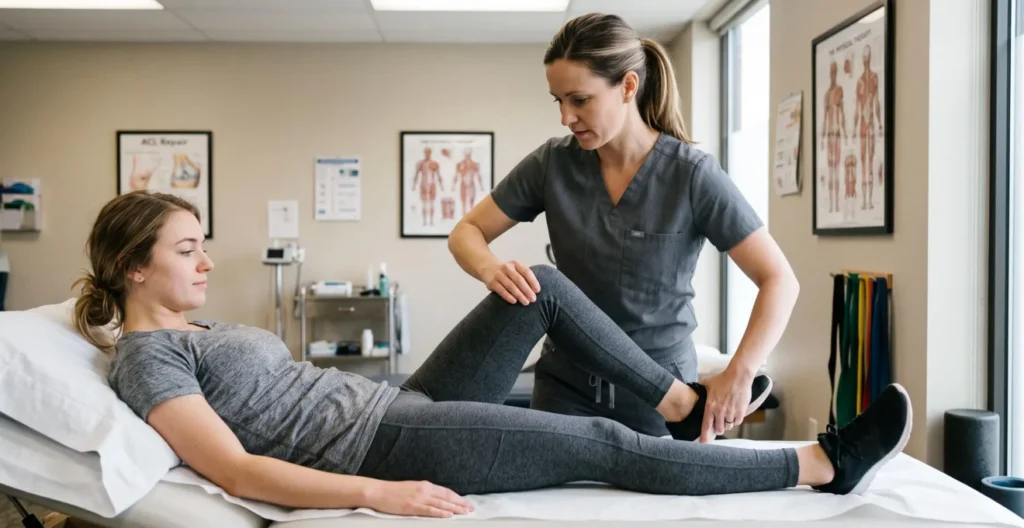
Understanding what not to do is as important as following the rehabilitation protocol. Several common errors compromise recovery or increase re-injury risk.
Returning too early because you feel normal
The most dangerous mistake is resuming high-demand activities when your knee feels completely stable but your graft hasn’t finished maturing. This typically happens between six and nine months post-surgery. You have no pain, full motion, and subjective stability—but your graft has reached only 60-80% of its final strength. The sensory nerves that detect pain and the mechanoreceptors that sense instability recover faster than the graft’s mechanical properties, creating a false sense of security.
Social pressure amplifies this temptation. Your team needs you for playoffs. Your soccer league’s championship is in eight months. You feel fine during training. But returning before meeting objective criteria and reaching nine months minimum for pivot sports creates the highest risk window for re-rupture. A second ACL surgery resets the entire timeline and carries worse long-term outcomes.
Neglecting rehabilitation after the first three months
Many patients diligently attend physical therapy for the first two to three months, then taper off once they walk normally and resume daily activities. They assume the hard work is done. But strength training, proprioception drills, and sport-specific conditioning must continue through months six, nine, and often twelve to prepare your entire lower kinetic chain—not just your healing graft—for sport demands.
Stopping PT at three months because you can walk and climb stairs leaves you with persistent strength deficits, often 20-30% weaker than your uninjured leg. When you eventually try to return to sports months later, you fail functional testing and must spend additional months rebuilding strength you could have maintained with consistent training.
Comparing your recovery to others
Your teammate returned to soccer at seven months. Your coworker was running at ten weeks. These comparisons create inappropriate expectations. Every ACL reconstruction involves different variables: graft type, surgical technique, associated injuries, age, pre-injury fitness, sport demands, and individual healing variability. What worked safely for someone else may not apply to your situation.
Even more misleading, the person who “successfully” returned early may be counting from a different starting point, may have had a different procedure, or may simply be lucky so far—their outcome doesn’t prove safety. Focus on your objective functional tests and your medical team’s assessment of your specific progression.
Ignoring warning signs
Persistent swelling after exercise, pain that doesn’t resolve with rest, sensations of catching or instability, or decreased range of motion are not normal parts of recovery. They signal potential complications: graft impingement, developing arthrofibrosis (scar tissue limiting motion), inadequate healing, or excessive inflammation.
Many patients push through these symptoms, assuming some discomfort is expected. But problematic symptoms require assessment and protocol modification. Ignoring them can lead to complications requiring additional intervention and extending overall recovery time significantly.
Red flags that require immediate contact with your medical team
- Sudden increase in swelling or pain not associated with activity
- Fever or signs of infection around surgical incisions
- Inability to achieve or maintain full knee extension after the first few weeks
- Persistent significant swelling (effusion) that doesn’t resolve with rest and ice
- Sensation of the knee giving way or buckling during normal walking
- Loss of motion or strength that you previously achieved
Planning your next twelve months
ACL reconstruction recovery demands patience through biologically incompressible phases, but understanding the science behind the timeline transforms anxious waiting into purposeful progression. Your graft must undergo necrosis, revascularization, and collagen remodeling over nine to twelve months before it can safely handle the rotational forces of pivot sports. No surgical technique or rehabilitation protocol can compress this cellular process.
What you can control is how well you prepare the muscular, neuromuscular, and cardiovascular systems that will protect and support that maturing graft. Consistent rehabilitation builds the strength and proprioception that reduce re-injury risk when you finally receive clearance. Meeting objective functional criteria—not just calendar dates—determines when you safely progress through phases.
The most important insight: feeling stable at five or six months doesn’t mean your graft has finished maturing. The danger zone for re-rupture peaks precisely when your knee feels normal but the graft has reached only 60-80% of final strength. Patience during this window, guided by functional testing and medical clearance rather than subjective confidence, protects the significant investment you’ve made in surgery and rehabilitation.
Your surgeon and physical therapist will guide your specific timeline based on your graft type, any associated injuries, your sport demands, and your individual progression. Trust the process, meet the milestones, and you’ll return to the sports you love with a knee prepared to handle them safely.