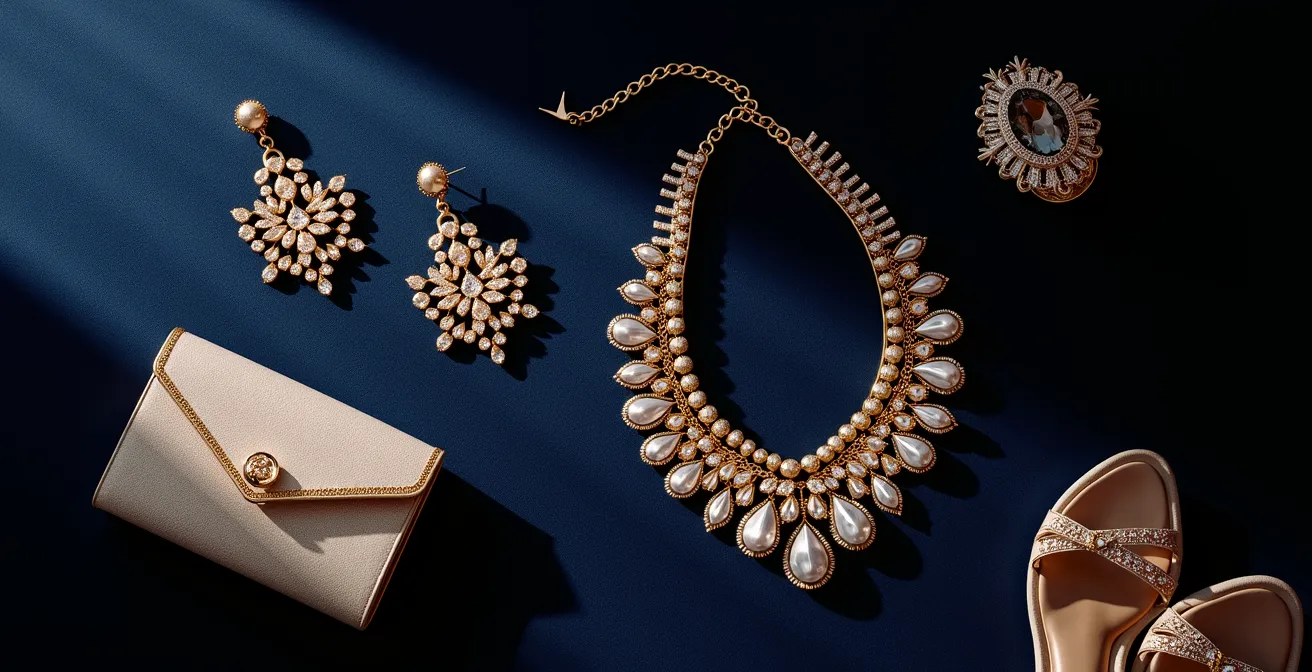
In summary:
- Treat accessorizing like a science: Use a point system to balance statement pieces and avoid a cluttered look.
- Prioritize structure over style for comfort: Test your heels for stability and your handbag for quality hardware to ensure elegance lasts all night.
- Master light and proportion: Choose metals that glow in evening light and bags that complement, rather than overwhelm, your frame.
- Follow a strict “finishing ritual”: Put jewelry on last to protect delicate fabrics and create a polished, intentional final look.
The clock strikes five, and the familiar panic sets in. You have an important dinner, a networking event, or a party to attend, with no time to go home and change. Your reliable office attire feels painfully plain for an evening affair. The common advice is to simply throw on a statement necklace or grab a clutch. But for the discerning professional, this often results in a look that feels disjointed or, worse, over-accessorized. The real challenge isn’t just adding pieces; it’s transforming the very essence of your outfit with speed and precision.
This guide moves beyond the platitudes. We will not tell you to just “add a pop of color.” Instead, we will delve into the physics of accessorizing—the strategic principles of balance, proportion, and light interaction that fashion editors use to curate a look. The key to a seamless day-to-night transition is not about piling on more, but about making deliberate, high-impact substitutions. It’s a calculated art form that, once mastered, allows you to command a room with the same confidence you bring to the boardroom.
We will deconstruct the process, from selecting structurally sound heels that can endure a 12-hour day to understanding which metal tones truly come alive after dark. You’ll learn the critical mistake that overwhelms a petite frame and the precise moment to add your jewelry to avoid ruining a silk blouse. This is your new playbook for turning a simple outfit into a statement of intent, ensuring you look polished, powerful, and perfectly appropriate for any evening event.
This article provides a structured approach to mastering your evening look. Explore the sections below to learn the specific techniques that will elevate your style. The following summary outlines the key pillars of a successful office-to-evening transformation.
Summary: The Editor’s Guide to Outfit Elevation
- Why Wearing a Necklace and Big Earrings Can Ruin Your Look?
- How to Choose Heels That Are Comfortable Enough for 12 Hours?
- Gold vs Silver: Which Metal Enhances Your Skin Tone at Night?
- The Handbag Size Mistake That Overwhelms Petite Frames
- When to Put on Jewelry: The Final Step to Avoid Snags on Delicate Fabrics
- The Zipper Detail That Instantly Cheapens Your Handbag
- Vegetable Tanned vs Chrome Tanned: Which Patina Ages Better?
- Secrets to Elevating Every Fashion Ensemble: How to Look Expensive on a High Street Budget?
Why Wearing a Necklace and Big Earrings Can Ruin Your Look?
The impulse to maximize impact by wearing both a statement necklace and large earrings is a common mistake that undermines an otherwise sophisticated look. The principle to master here is not accumulation, but balance. When multiple bold pieces are placed near the face, they compete for attention, creating visual noise that detracts from your features. Instead of creating a single, powerful focal point, this approach results in a cluttered and distracting effect. The goal is to guide the viewer’s eye, not overwhelm it.
A more strategic method is to adopt a point-based system to manage your “accessory weight.” Think of it as a budget for your upper body. A statement necklace or a pair of large, dramatic earrings might each count for three points. A delicate chain is one point, while simple studs are zero. For a polished evening look, your total should not exceed four points. This forces you to make a choice: either the bold necklace takes center stage, paired with subtle earrings, or the dramatic earrings become the star of the show, complemented by a bare neckline or a very fine chain.
This concept of a singular visual focal point is echoed by fashion insiders. As influencer Emna Habboo notes, earrings can be the most effective starting point for creating a high-impact look with minimal effort. Layering different sizes of hoops or studs in multiple piercings can create a curated statement that feels both personal and chic. Ultimately, consider the neckline of your outfit. An intricate collar or a high-neck top already creates visual interest; in this case, skipping a necklace entirely and opting for standout earrings is the most elegant choice. It allows both your garment and your accessory to shine independently.
How to Choose Heels That Are Comfortable Enough for 12 Hours?
The difference between a triumphant evening and a painful retreat often lies in your choice of footwear. A truly comfortable high heel is not a myth; it is a feat of engineering. Heel height is only one part of the equation. The key to all-day wearability lies in the shoe’s structural integrity, specifically its balance, shank rigidity, and pitch. A well-constructed shoe distributes your weight properly, reducing pressure on the ball of your foot and providing the support needed to prevent fatigue and pain.
Before committing to a pair of evening heels, perform a few simple physical tests. First, the “tap test”: place the shoe on a flat surface and gently tap the heel. Any wobbling is a red flag, indicating poor balance that will lead to instability. Next, check the shank—the part of the sole under your arch. Try to bend it. A high-quality shoe will have a rigid shank that offers firm support, while a flexible one will cause your foot to strain with every step. The pitch, or the incline of your foot, is also critical. A steep pitch places extreme pressure on the forefoot, regardless of the heel’s height. Look for platforms or designs that reduce this angle.
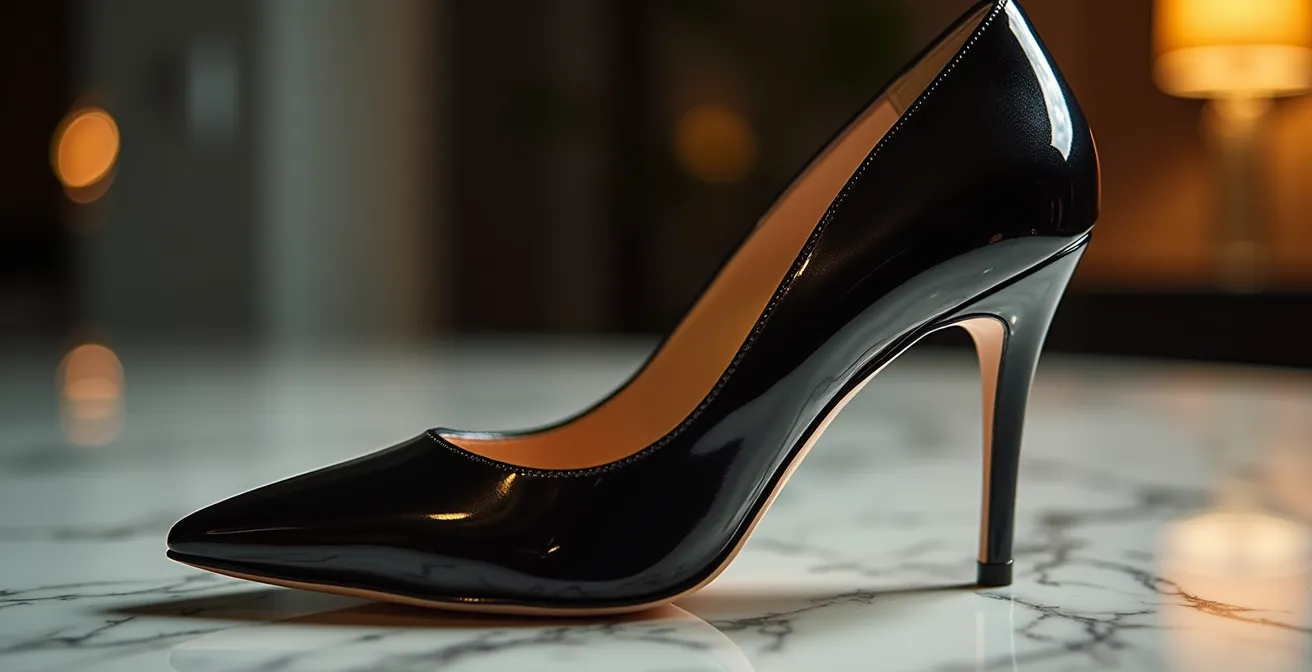
As the image above illustrates, details like cushioning and arch support are vital. The material also plays a significant role. Nappa leather is prized for its softness and ability to stretch, molding to your foot over time. Patent leather, while offering excellent structure, has no give and can be unforgiving. Finally, preparation is key. An hour before you head out, perform some foot stretches and apply an anti-blister balm to clean, dry skin on friction-prone areas like the heels and toes. This creates an invisible barrier that can make all the difference.
Gold vs Silver: Which Metal Enhances Your Skin Tone at Night?
Choosing between gold and silver is often simplified to a matter of skin undertones—cool tones for silver, warm for gold. While this is a valid starting point, evening and low-light environments introduce a new, more critical variable: light interactivity. The finish of the metal and how it reflects artificial light can dramatically alter its effect. What looks great in daylight might fall flat or appear harsh under the warm glow of a restaurant or the dynamic lighting of a cocktail bar. The jewelry segment represents a significant part of the fashion world, with 41.2% of fashion accessories market share in 2024 dedicated to it, making these nuances more important than ever.
High-polish silver, for instance, can create cool, sharp reflections that feel modern and dramatic, but it can also read as harsh. It pairs best with matte fabrics like velvet or crepe, which absorb light and allow the metal’s brilliance to stand out. Brushed or satin-finish gold, on the other hand, emits a soft, warm glow that is universally flattering in evening settings. This finish harmonizes beautifully with reflective fabrics like silk and satin, creating a cohesive, luxurious radiance rather than competing with the fabric’s shine. Rose gold, with its warm and gentle tones, is a versatile champion, mimicking the flattering hues of “golden hour” light and complementing nearly any fabric or skin tone.
To make a strategic choice, consult the specific interactions between different metals and evening conditions. This allows you to select a piece not just for its color, but for the mood and effect it will create after dark.
| Metal Type | Light Interaction | Best Fabric Pairing | Evening Effect |
|---|---|---|---|
| High-Polish Silver | Cool, sometimes harsh reflections | Matte fabrics (velvet, crepe) | Modern, dramatic |
| Brushed/Satin Gold | Soft, warm glow | Reflective fabrics (silk, satin) | Classic elegance |
| Rose Gold | Mimics golden hour tones | Any fabric type | Universal flattery |
| Gunmetal | Minimal reflection | Textured fabrics | Edgy, modern |
| Bronze | Antique warmth | Rich, deep colors | Vintage luxury |
The Handbag Size Mistake That Overwhelms Petite Frames
The timeless advice to swap a work tote for an evening clutch is sound, but it overlooks a crucial detail: proportion. The biggest handbag mistake isn’t necessarily carrying a bag that’s too large, but one that is incorrectly scaled to your body, particularly for those with petite frames. An oversized or ill-fitting bag can disrupt your silhouette, making you appear shorter and wider. The goal is to choose a bag that complements your body’s vertical line, not one that visually bisects it. This attention to detail is part of a growing appreciation for accessories as style enhancers, a trend reflected in market research indicating that the handbags and purses segment is expected to grow at a significant rate.
To ensure your handbag enhances your look, use your own body as a measuring tool. The “torso test” is a simple but effective rule: the width of a clutch or top-handle bag held at your side should not exceed the width of your torso. For shoulder bags, the bottom should never hang below your hip bone, as this visually shortens the legs. This is especially important for crossbody bags; adjust the strap so the bag rests at or above your hip, preserving the long line from your waist to your feet. For petite frames, a short-strap shoulder bag that tucks neatly under the arm is often a more flattering choice than a long crossbody.
Beyond dimensions, consider the bag’s visual weight. A bag made of a bulky, textured material in a bright color with heavy hardware will appear much larger than a sleek, minimalist bag of the same size. For an evening look, a structured clutch or a small, top-handle bag in a refined material not only fits the occasion but also maintains the integrity of your silhouette, ensuring the focus remains on your overall ensemble, not on a disproportionate accessory.
When to Put on Jewelry: The Final Step to Avoid Snags on Delicate Fabrics
The final touches of getting ready are often the most rushed, yet they hold the most potential for disaster. Putting on jewelry seems like a simple task, but the timing is critical. Adding bracelets, necklaces, or rings too early in your routine is the number one cause of snags on delicate fabrics like silk, chiffon, or fine-knit cashmere. A prong setting can easily catch on a loose thread, causing a pull that can ruin an expensive garment. Likewise, hairspray and perfume can tarnish metals and damage porous gemstones over time.
To prevent these costly mistakes, fashion stylists and editors adhere to a strict and methodical getting-dressed ritual. The core principle is simple: jewelry should always be the penultimate step, put on just before you grab your handbag and walk out the door. This ensures that all other elements of your look are complete and minimizes the risk of accidental damage. Your outfit is on, your shoes are fastened, and your hair and makeup are set. Perfume should be applied directly to the skin (pulse points are ideal) and allowed to dry completely before any fabric or jewelry comes near it.
Adopting this deliberate sequence transforms the act of accessorizing from a hasty afterthought into an intentional “finishing ritual.” It protects your investment pieces—both clothing and jewelry—and ensures a polished, flawless result. For a truly professional approach, follow a clear, step-by-step plan every time you prepare for an evening event.
Your Action Plan: The Stylist’s Getting-Dressed Ritual
- Lingerie and hosiery foundation: Start with the base layers of your outfit.
- Put on your outfit completely: Dress fully, including zipping up and buttoning everything.
- Add shoes to establish your height and silhouette: This sets the final length of your pants or skirt.
- Complete hair styling including all sprays: Ensure all aerosols are used before delicate items are introduced.
- Apply makeup including setting spray: Let your face dry completely to avoid smudges on collars.
- Apply perfume directly on skin, never on fabric: Wait a moment for the alcohol to evaporate.
- Add jewelry as the penultimate step: Carefully fasten all clasps and check for loose prongs.
- Grab your handbag as you head out: This is the absolute final action.
The Zipper Detail That Instantly Cheapens Your Handbag
In the art of looking expensive, the devil is in the details. Nowhere is this truer than with handbag hardware, and the zipper is often the most telling component. A high-quality zipper not only functions better but also signals a level of craftsmanship that elevates the entire piece. Conversely, a cheap, flimsy zipper can instantly downgrade an otherwise beautiful bag, betraying its high-street origins. Recognizing the difference is a key skill for any savvy shopper aiming for a luxury aesthetic without the luxury price tag.
The most significant distinction lies in the teeth. Premium zippers, like those from renowned manufacturers Riri, Lampo, or YKK’s high-end Excella line, feature teeth that are individually cut, polished, and plated. This results in a smooth, substantial glide and a rich metallic sheen. Cheap zippers, by contrast, have teeth that are stamped from a sheet of metal, often leaving them with rough edges and a tinny feel. This difference is not just visual; it’s audible. A quality zipper produces a quiet, satisfying hum, while a cheap one emits a high-pitched, scratchy “zzzzing” sound.
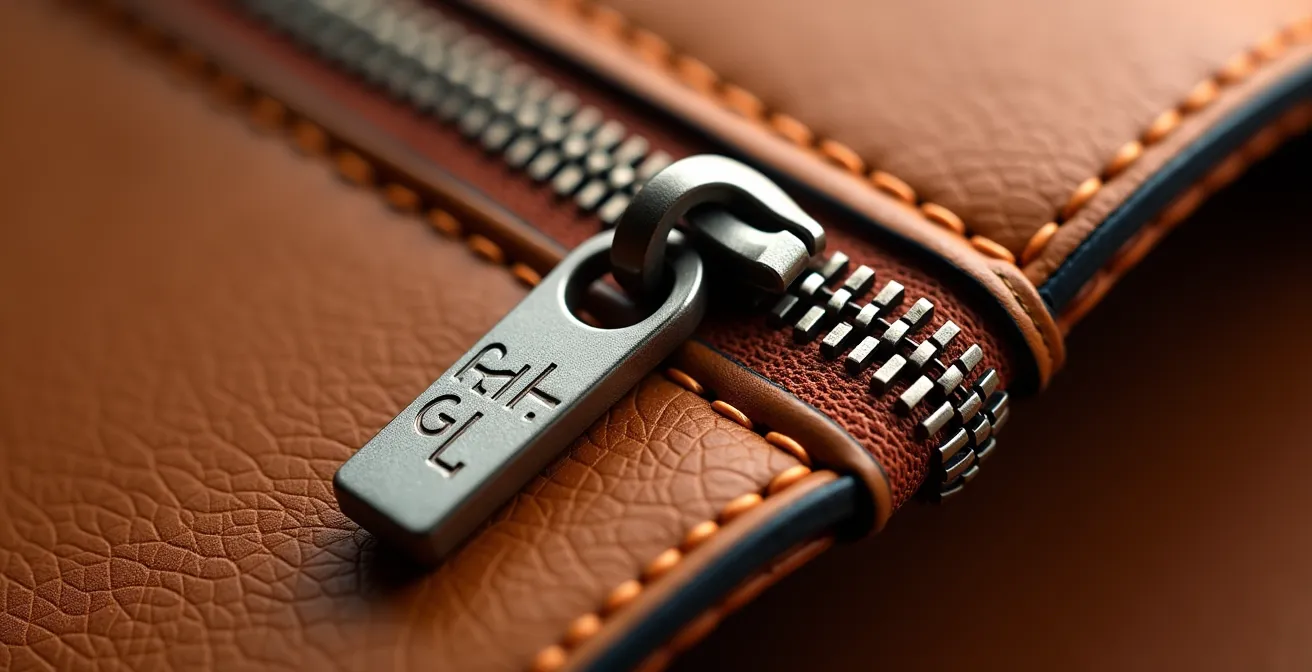
Pay attention to the other components as well. The fabric tape on a quality zipper will be sturdy and perfectly color-matched to the bag’s leather or fabric. On a cheaper bag, the tape is often thin, flimsy polyester in a slightly mismatched shade. The pull tab is another giveaway. Look for a pull that feels solid and weighted in your hand. Luxury brands often use custom-designed, branded pulls, while cheaper bags will have generic, hollow-feeling hardware. This meticulous attention to what are often considered minor details is fundamental to the perceived value of an accessory, a principle driving the entire fashion accessories market.
| Component | High-Quality Zipper | Cheap Zipper |
|---|---|---|
| Teeth | Individually cut and polished | Stamped metal with rough edges |
| Tape | Color-matched sturdy fabric | Flimsy polyester, often mismatched |
| Pull | Solid, weighted, often branded | Lightweight, hollow, unbranded |
| Sound | Quiet, smooth, substantial | High-pitched, scratchy ‘zzzzing’ |
| Brand Examples | Riri, Lampo, YKK Excella | Generic unbranded hardware |
Vegetable Tanned vs Chrome Tanned: Which Patina Ages Better?
A high-quality leather accessory is not a static object; it is a dynamic piece that evolves with you. The way it ages—the development of its unique patina—is a significant part of its value and character. However, not all leathers are created equal in this regard. The tanning process used to treat the hide determines how it will wear over time. The two primary methods, vegetable tanning and chrome tanning, produce vastly different results, making the choice between them a critical decision for anyone purchasing an accessory as a long-term investment.
Vegetable-tanned leather is the traditional, artisanal choice. It uses natural tannins from tree bark and other plant matter in a slow, meticulous process. Its defining characteristic is its ability to develop a rich, complex patina. With exposure to sunlight, natural oils from your hands, and daily use, it will gradually darken, soften, and acquire unique markings that tell the story of its life. This is the leather that truly gets better with age, transforming from a uniform product into a personalized heirloom. This aligns with a broader market shift, where consumers increasingly view accessories as investment pieces that reflect quality craftsmanship.
Chrome-tanned leather, by contrast, is a modern, industrial process that uses chromium salts. It is much faster and cheaper, and it produces a leather that is soft and pliable from day one, with a more consistent and water-resistant color. However, this stability comes at a cost: chrome-tanned leather does not develop a significant patina. It is designed to resist change, meaning the bag or belt you buy today will look largely the same in five years. While this is desirable for certain applications, it lacks the storytelling potential of its vegetable-tanned counterpart. For an accessory that is meant to mature and gain character, vegetable-tanned leather is the unequivocal winner. You can even guide this process:
- Choose vegetable-tanned leather for items you’ll use daily to develop character.
- Apply controlled sun exposure by rotating the item evenly for 15 minutes weekly for a honey coloring.
- Use specific conditioners like natural beeswax-based products quarterly; avoid silicone sealers that prevent the leather from breathing.
- Embrace natural oils by handling the item regularly to transfer skin oils that darken and soften the leather.
Key takeaways
- The 4-Point Rule: Balance your look by assigning points to statement pieces and keeping the total around the face under four.
- Silhouette Integrity: Choose accessories with proportions and visual weight that enhance, rather than disrupt, your body’s natural lines.
- The Finishing Ritual: Protect your garments and perfect your look by putting on all jewelry as the absolute last step before you leave.
Secrets to Elevating Every Fashion Ensemble: How to Look Expensive on a High Street Budget?
Cultivating an expensive-looking wardrobe is not about the price tags on your clothes; it’s about the strategic curation of your entire ensemble. The secret lies in using high-quality accessories to elevate more affordable high-street pieces. A single, well-chosen accessory can anchor an entire outfit, lending it an air of quality and intention that belies its cost. This is the “One Hero Piece” philosophy: investing in one timeless, versatile, and impeccably crafted item that becomes the cornerstone of your style. This powerful approach is validated by consumer behavior, as recent e-commerce data reveals that 29.5% of all online sales in the US are in the apparel and accessories category, showing a strong willingness to invest in items that complete a look.
Your hero piece could be a classic leather belt with a solid buckle, a beautifully engineered watch, or a fine silk scarf from a reputable brand. The key is its versatility and undeniable quality. When you pair this hero piece with a simple Zara dress or an H&M blazer, it instantly elevates the perceived value of the entire outfit. This effect is amplified when you combine it with other sartorial principles, such as the “Rule of Three Textures.” By mixing different textures—for example, a smooth silk camisole, a soft cashmere cardigan, and a structured leather handbag—you create a look with depth and richness that feels far more luxurious than the sum of its parts.
Ultimately, developing a signature style is about intentionality. Consistently wearing a certain type of accessory, whether it’s a particular style of earring or always belting your dresses, creates a personal brand. It signals that your look is not an accident but a deliberate choice. This mastery of detail and commitment to a cohesive vision is the true secret to looking expensive. It’s not about what you spend, but how you assemble it.
Your next evening out begins not with a new outfit, but with a new perspective on the pieces you already own. By applying these strategic principles, you can transform your wardrobe and your confidence. Start building your transformative accessory toolkit today.