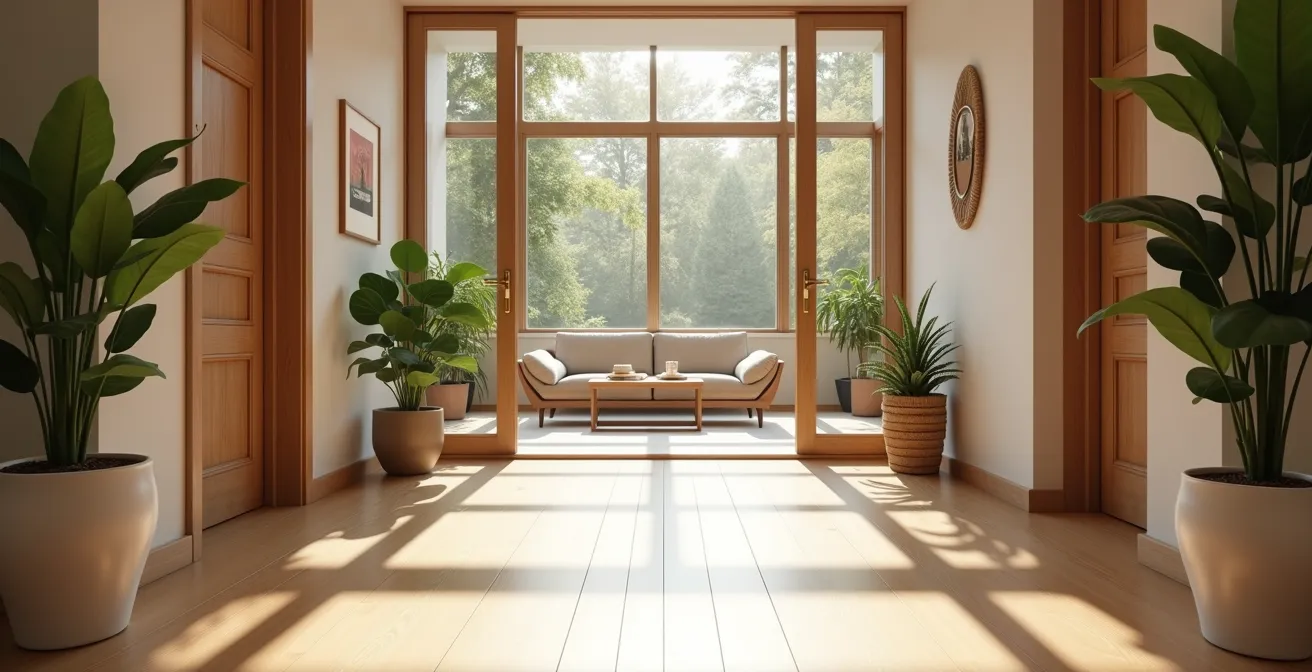
True home wellness isn’t about decor, but about managing the invisible biological stressors embedded in your living space.
- Your home’s layout and environment directly influence stress hormones, sleep quality, and even endocrine function.
- Optimizing unseen factors like air quality, humidity, and electromagnetic fields provides measurable health benefits that aesthetics alone cannot.
Recommendation: Shift your focus from how your home looks to how it performs as a biological support system, starting with the air you breathe and the paths you walk.
For many health-conscious individuals, the home is the last frontier of well-being. You curate your diet, your exercise, and your mindfulness practices, yet your own living space can feel draining, chaotic, or simply not restful. The common advice often revolves around familiar platitudes: declutter with Marie Kondo, add more houseplants, or paint a room a calming shade of blue. These actions have merit, but they only scratch the surface of a much deeper reality.
What if the most significant factors impacting your health at home are the ones you can’t see? The true key to residential wellness lies in understanding and shaping your home’s “invisible architecture”—the quality of its air, the balance of its humidity, the flow of its movement, and the presence of unseen fields. This is not interior decorating; it is bio-systemic design, where your home becomes an active partner in supporting your biological functions, from regulating stress hormones to promoting restorative sleep.
This guide moves beyond aesthetics to offer a science-backed framework. We will explore how specific, often-overlooked aspects of your home environment directly impact your physiological and mental state. By making strategic changes, you can transform your home from a passive container into a dynamic sanctuary that actively enhances your healthspan and well-being.
To help you navigate these concepts, this article is structured around key environmental stressors and their solutions. You will find actionable advice and scientific insights to help you build a truly holistic and healthy living space.
Summary: A Blueprint for a Health-Conscious Home
- Why a Blocked Entryway Immediately Spikes Your Cortisol Levels?
- How to Carve Out a Silence Corner in a Busy Family Home?
- HEPA Filter vs Ionizer: Which Device Actually Removes Allergens?
- The Wi-Fi Router Placement Error That Might Be Affecting Your Sleep
- How to Balance Indoor Humidity to Prevent Dry Skin and Viruses?
- How to Incorporate Plants into Your Decor to Lower Blood Pressure?
- The Plastic Container Mistake That Messes with Your Hormones
- Building a Holistic Lifestyle: How to Increase Healthspan by 10 Years Through Daily Micro-Habits?
Why a Blocked Entryway Immediately Spikes Your Cortisol Levels?
The moment you walk through your door, your body performs an unconscious environmental scan. A cluttered, blocked, or narrow entryway triggers a primal, low-grade stress response. This isn’t a matter of taste; it’s a matter of biology. When your path is obstructed, your brain perceives a subtle threat, a navigational problem that requires cognitive resources and vigilance. This micro-stressor is enough to elevate cortisol, the body’s primary stress hormone. Repeating this experience daily creates a chronic stress pattern associated with the very act of coming home.
Architectural psychology refers to the concepts of “prospect and refuge.” We are wired to feel safest when we have a clear view ahead (prospect) from a protected position (refuge). A blocked entryway denies you this immediate sense of prospect, forcing your nervous system into a state of heightened alert instead of signaling safety and relaxation. The goal is to design an entrance that allows your cortisol levels to drop, not spike, upon arrival.
Beyond simple decluttering, advanced layout solutions can fundamentally change this experience. The key is to create clear sightlines from the door to a point of interest, like a window or a piece of art. This immediately establishes “prospect.” Using strategically placed mirrors can expand the perceived space, but they should never be directly opposite a door, as this can create a startle reflex. Most importantly, reconfiguring furniture flow paths to eliminate daily navigational frustrations enables a smooth, effortless transition from the outside world to the inner sanctuary of your home.
By engineering a seamless entry, you are not just organizing your foyer; you are programming a physiological response of calm and safety every single day.
How to Carve Out a Silence Corner in a Busy Family Home?
In a world of constant digital notifications and urban background noise, true silence has become a luxury. A busy family home, filled with life and activity, can inadvertently create a high sensory load on its inhabitants. This constant auditory stimulation prevents the nervous system from fully downshifting into a state of rest and recovery, hindering mental clarity and contributing to chronic stress. The solution is not to demand an unnaturally quiet house but to intentionally design a space for acoustic refuge.
This concept is at the heart of an emerging trend known as “silent architecture.” It focuses on creating acoustically balanced, low-stimulation zones that actively promote mental clarity and tranquility. These are not soundproof rooms but spaces engineered to absorb and soften sound, reducing reverberation and creating a palpable sense of peace.
Case Study: Creating Silent Architecture for Mental Clarity
The 2025 Wellness Architecture & Design Initiative has identified “silent architecture” as a key trend for promoting well-being at home. This approach moves beyond simply blocking noise to shaping the soundscape of a space. Implementations focus on using materials that absorb sound rather than reflecting it, such as natural felt, cork, and even terra-cotta. The design often incorporates soft, curved walls and organic materials to reduce sharp sound reflections and enhance a feeling of tranquility, effectively creating an architectural “hug” for the user.
To create your own silence corner, identify a space away from high-traffic areas. The key is to introduce soft, sound-absorbing surfaces. This can include thick rugs, heavy curtains, upholstered furniture, and textile wall hangings. Specialized materials like acoustic felt panels can be both a beautiful design element and a highly effective tool for sound dampening.

As seen in the texture of these materials, the intricate, non-uniform fibers work to trap and break up sound waves. This creates an environment where your auditory system is not on high alert, allowing for deeper focus, meditation, or simply a moment of quiet contemplation. This corner becomes a dedicated tool for managing your sensory diet, providing an essential reset button in a busy home.
Ultimately, a well-designed silence corner is a powerful statement that rest and mental peace are priorities worthy of their own dedicated space.
HEPA Filter vs Ionizer: Which Device Actually Removes Allergens?
One of the most critical components of your home’s “invisible architecture” is the air you breathe. Indoor air can be two to five times more polluted than outdoor air, filled with allergens, viruses, dust, and volatile organic compounds (VOCs). While air purifiers are a common solution, the technology they use matters immensely. The two most prevalent types, HEPA filters and ionizers, work in fundamentally different ways with vastly different outcomes for your health.
A High-Efficiency Particulate Air (HEPA) filter is a mechanical filter. It works like an incredibly fine net, physically trapping particles as air is forced through it. True HEPA filters are certified to remove 99.97% of particles as small as 0.3 micrometers. This includes dust mites, pollen, pet dander, and even some bacteria and viruses. Their effectiveness is proven and measurable; real-world testing shows HEPA filters achieve a 78.8% reduction in PM2.5 and 63.9% reduction in PM10 in primary rooms.
Ionizers, on the other hand, use an electrical charge. They release negatively charged ions into the air, which attach to airborne particles like dust and pollen. This makes the particles heavier, causing them to clump together and fall out of the air onto surfaces like floors and furniture. The critical flaw is that the particles are not removed from the room, merely relocated. They can be easily stirred back into the air. More concerningly, this process can produce ozone as a byproduct, a known lung irritant that can be harmful to health.
This table offers a clear comparison of their effectiveness, highlighting why one is a superior choice for a wellness-focused home. The data is based on an analysis of air purification technologies.
| Feature | HEPA Filter | Ionizer |
|---|---|---|
| Mechanism | Physical trap (99.97% of 0.3μm particles) | Electrical clump and drop |
| PM2.5 Reduction | 78.8% in primary room | Limited data, potential ozone production |
| Viral Diversity Reduction | 32.8% reduction | Varies, less consistent |
| Safety Concern | None | May produce lung-irritating ozone |
| Best For | Allergens, viruses, PM | Light dust (with caution) |
For a truly healthy home, the choice is clear. A HEPA filter actively cleans the air, providing a verifiable improvement in air quality, while an ionizer presents potential risks with less effective results.
The Wi-Fi Router Placement Error That Might Be Affecting Your Sleep
In our hyper-connected world, the Wi-Fi router has become as essential as any other utility. However, its constant emission of radiofrequency (RF) electromagnetic fields (EMFs) is a part of the “invisible architecture” that warrants careful consideration, especially concerning sleep. While the science on the long-term health effects of low-level EMFs is still evolving and often debated, a growing body of research suggests a potential link between nighttime exposure and the disruption of melatonin production.
Melatonin is the hormone that governs our sleep-wake cycle, or circadian rhythm. It is produced in darkness and signals to the body that it’s time to sleep. Some studies suggest that exposure to EMFs, even at low levels, could interfere with this delicate process, potentially leading to lighter, less restorative sleep, difficulty falling asleep, and next-day fatigue. The most common and easily correctable mistake is placing the Wi-Fi router in or near the bedroom.
Creating a sleep sanctuary requires minimizing all potential disruptions, both seen and unseen. Just as you would use blackout curtains to block light pollution, it is prudent to manage your exposure to EMF pollution during critical sleep hours. This doesn’t mean giving up Wi-Fi; it means managing it intelligently through a clear hierarchy of optimization.
The first step is optimal placement. Your router should be positioned as far away from sleeping areas as possible, a minimum of 20 feet is a good guideline, and never in a bedroom. The second, and perhaps most impactful step, is to install an inexpensive outlet timer to automatically turn the Wi-Fi off during your primary sleep hours (e.g., 11 p.m. to 6 a.m.). This completely eliminates exposure when your body is supposed to be in its deepest recovery state. Finally, reducing overall dependence on Wi-Fi by hardwiring stationary devices like smart TVs and desktop computers with ethernet cables lowers the ambient RF levels throughout your home at all times.
By managing your Wi-Fi router’s placement and activity, you are taking a proactive, low-cost step to protect your sleep quality and support your body’s natural nightly regeneration process.
How to Balance Indoor Humidity to Prevent Dry Skin and Viruses?
Humidity is another crucial, yet often ignored, element of your home’s invisible environment. Both too much and too little moisture in the air can have significant consequences for your health, comfort, and even the longevity of your home. The key is to maintain a “Goldilocks zone” of indoor humidity, which experts widely agree is between 40% and 60%. Falling outside this range can turn your home into a breeding ground for problems.
When humidity drops below 40%, a common issue in winter when heating systems are running, the air becomes excessively dry. This leaches moisture from your skin and mucous membranes, leading to dry skin, chapped lips, and irritated sinuses. More importantly, this dry environment allows viruses, including influenza and coronaviruses, to survive longer in the air and travel farther. Your own dehydrated respiratory passages also become more susceptible to infection.
Conversely, when humidity rises above 60%, it creates an ideal breeding ground for mold, mildew, and dust mites. These allergens can trigger asthma and other respiratory issues, creating a different set of health challenges. Therefore, actively managing your home’s humidity is a powerful lever for preventive health.
As a leading expert from a Mass General Brigham study confirms, balancing humidity is a cornerstone of creating a healthier indoor environment, working in concert with other measures like air filtration. This simple environmental control can have a profound impact on well-being.
In addition to air filtration or better ventilation, maintaining classroom humidity between 40% and 60% may help lower viral exposures and improve comfort
– Dr. Peggy Lai, Mass General Brigham Study on Viral Exposure
To achieve this balance, use a hygrometer to measure your home’s humidity levels. In dry conditions, a humidifier can add necessary moisture to the air. In damp conditions, a dehumidifier or improved ventilation can help reduce it. This simple act of balancing your indoor climate is a foundational step in bio-systemic home design.
By treating indoor humidity with the same attention as temperature, you create an environment that supports respiratory health, skin comfort, and overall resilience against airborne pathogens.
How to Incorporate Plants into Your Decor to Lower Blood Pressure?
The advice to “add more plants” is a common wellness platitude, but it often misses the deeper principle at play: biophilic design. This is the practice of connecting humans with nature within the built environment. It’s not just about the presence of a plant, but about creating an ecosystem that fosters a visual and psychological connection to the natural world. This connection has been shown to improve mood, reduce stress, enhance cognitive function, and even lower blood pressure.
While plants do improve air quality to some extent, their most potent wellness benefit is psychological. The simple act of having natural elements in view provides a “micro-restoration” for our brains, which are wired to find nature inherently fascinating and calming. This effortless attention helps to reduce mental fatigue and restore focus. Indeed, a 2020 global study found that 74% of people with vegetation in their homes reported greater emotional wellbeing.
To truly leverage the power of biophilic design, go beyond a single decorative plant. Think in terms of creating a “view.” Cluster plants of varying heights and textures near a window to create a lush, layered scene. Incorporate natural materials like wood, stone, and wool in your furniture and textiles. Most importantly, engage with your plants. The mindful act of caring for them—watering, pruning, observing their growth—is a powerful meditative practice in itself.

The image above captures the essence of this interaction. It’s not a passive design element but an active relationship. This hands-on connection to a living thing grounds you in the present moment, offering a tangible respite from digital-world anxieties. It transforms plant ownership from a decorative choice into a daily mindfulness ritual that actively supports mental health.
By thoughtfully weaving natural elements into your home and daily routines, you create a space that doesn’t just look serene but actively contributes to your physiological and psychological calm.
The Plastic Container Mistake That Messes with Your Hormones
The wellness of your home extends to the materials you use every day, especially in the kitchen. A significant part of the “invisible architecture” that affects your health is your exposure to chemicals, particularly endocrine-disrupting chemicals (EDCs). These substances, found in many common plastics, can interfere with your body’s hormonal system, potentially impacting everything from metabolism to reproductive health. The biggest mistake is unknowingly leaching these chemicals into your food.
Plastics, especially when heated or scratched, can release EDCs like BPA and phthalates. Storing hot leftovers in a plastic container or microwaving food in one dramatically increases this risk. Similarly, using a scratched non-stick pan or a plastic spatula that melts slightly can introduce unwanted chemicals into your meal. Achieving hormonal homeostasis requires a conscious effort to minimize this exposure.
The solution is not to live in fear, but to make strategic swaps that make your kitchen a safer environment. This is a core tenet of bio-systemic design: making the healthy choice the easy choice. By replacing high-risk items with inert, stable materials like glass, stainless steel, wood, and cast iron, you systematically reduce your body’s chemical burden without having to think about it every time you cook or eat.
This audit will help you identify and prioritize the most important changes to make in your kitchen to reduce your exposure to endocrine disruptors.
Your 5-Step Kitchen Toxin Audit
- Points of Contact: Make a complete list of all plastic items that regularly touch your food and drinks, including containers, utensils, cutting boards, and water bottles.
- Heat Exposure Inventory: Circle every item on your list that is used with hot foods or beverages, or is placed in the microwave or dishwasher. These are your highest-risk items.
- Material & Condition Check: Examine your non-stick pans for scratches and your plastic containers for signs of wear, deep scratches, or cloudiness. Confront these items with safety values—if they’re damaged, they must be replaced.
- Memorability & Emotion Audit: Ask yourself which plastic items you use purely out of convenience versus necessity. Note where a simple habit change could eliminate a plastic item’s use altogether.
- Phased Replacement Plan: Create a prioritized plan to swap out high-risk items first. Start with replacing your most-used plastic food container with a glass or stainless steel alternative.
These small, intentional changes accumulate over time, creating a kitchen environment that nourishes and supports your body from the inside out.
Key Takeaways
- Your home’s layout and design directly impact physiological responses, including stress hormone levels and sleep cycles.
- Invisible factors like indoor air quality, humidity, and electromagnetic fields are critical pillars of a truly healthy home.
- By using intentional “choice architecture,” you can design your space to make healthy habits feel effortless and automatic.
Building a Holistic Lifestyle: How to Increase Healthspan by 10 Years Through Daily Micro-Habits?
Increasing healthspan—the number of years we live in good health—is the ultimate goal of a wellness-focused lifestyle. While diet and exercise are critical, the environment where we spend the majority of our time plays an equally powerful role. The previous sections have detailed specific interventions, from purifying your air to balancing your home’s humidity. The final and most profound step is to weave these elements together into a cohesive system that makes healthy living the path of least resistance. This is achieved through the concept of choice architecture.
Choice architecture is the practice of designing your environment to “nudge” you toward better decisions. Your home is not a neutral space; its layout and contents are constantly influencing your behavior. A home designed for wellness places healthy choices in plain sight and makes unhealthy ones less convenient. This could be as simple as keeping a bowl of fresh fruit on the counter instead of a cookie jar, or creating a clear, inviting floor space that encourages a morning stretch routine.
Each element we’ve discussed is a form of environmental nudge. A quiet corner prompts you to take a moment for mindfulness. Clean air and balanced humidity support your body’s resilience without conscious effort. A Wi-Fi-free bedroom removes a potential obstacle to deep sleep. When these micro-habits are embedded into the very fabric of your home, they cease to be “habits” you must remember and become a natural extension of your daily life.
This approach transforms your home from a passive backdrop into an active participant in your well-being. It becomes a system that supports rest, encourages movement, promotes clarity, and fosters comfort. The effort of “being healthy” diminishes because your environment is doing much of the work for you, gently guiding you toward choices that extend not just your lifespan, but your healthspan.
Begin today by choosing one area of your home’s invisible architecture to improve. By systematically upgrading your environment, you are making a profound and lasting investment in your future health.