
For time-crunched parents, the key to boosting cardiovascular fitness isn’t just “more intensity.” It’s about a strategic polarization of effort. The most common mistake is getting stuck in the moderate-intensity “gray zone,” which leads to burnout without maximizing results. This guide reveals how to combine low-intensity fat-burning sessions with surgical high-intensity bursts to significantly improve your VO2 max and overall health in just 20-minute windows.
The life of a parent is a masterclass in time management, where personal well-being often gets relegated to the bottom of the to-do list. Finding an hour for the gym feels like a logistical fantasy. The common advice is to just “squeeze in a quick, intense workout.” So you run, feeling the burn, thinking that this breathless, uncomfortable pace must be the price of progress. You push through, day after day, feeling tired but assuming that’s just part of the “no pain, no gain” mantra.
But what if that breathless, grinding effort is actually one of the least efficient ways to train? What if the key to unlocking significant cardiovascular gains—like a higher VO2 max, the gold-standard metric of aerobic fitness and longevity—isn’t about constantly pushing yourself into a state of exhaustion? The real breakthrough for busy parents lies not in raw effort, but in physiological efficiency. It requires moving away from the chaotic middle ground of training intensity and embracing a more structured, data-driven approach.
This is the principle of polarized training. Instead of living in the moderately hard “gray zone,” you strategically alternate between very easy efforts that build your metabolic engine and very hard, short bursts that expand its capacity. It’s a method that delivers superior results in less time, all while reducing the risk of burnout and injury that plagues so many well-intentioned parents.
This article will deconstruct this powerful training model. We will explore the science behind why slow jogging is a potent tool for fat loss, how to structure a truly effective high-intensity workout that requires zero equipment, and why your recovery—from the air you breathe to the sleep you get—is the non-negotiable foundation of your fitness.
Summary: A Parent’s Strategic Guide to 20-Minute Cardio Fitness
- Why Slow Jogging Burns More Fat Than Sprinting for Beginners?
- How to Structure a Tabata Workout That Requires Zero Equipment?
- Rower vs Elliptical: Which Machine Saves Your Knees While Torching Calories?
- The “No Pain No Gain” Mistake That Leads to Heart Strain
- When to Do Cardio: Before or After Lifting for Muscle Preservation?
- HEPA Filter vs Ionizer: Which Device Actually Removes Allergens?
- The Implementation Error That Causes 70% of Digital Transformations to Fail
- Mastering Restorative Sleep Cycles: How to Double Your Deep Sleep Score Tonight?
Why Slow Jogging Burns More Fat Than Sprinting for Beginners?
The idea that moving slower can produce better results feels counter-intuitive, especially when time is your most precious commodity. Yet, for building a robust aerobic base and becoming a more efficient fat-burning machine, slow is precisely the goal. This is the domain of Zone 2 training, an intensity so low you can comfortably hold a conversation. It’s not about speed; it’s about physiology. When you train in this zone, typically at a heart rate of 60-70% of your maximum, you teach your body to become better at using fat as its primary fuel source.
This process improves your metabolic flexibility, the ability to efficiently switch between fuel sources. For a busy parent, this is a game-changer. It means more stable energy levels throughout the day, reduced reliance on sugar for energy, and a more efficient engine for any activity, from chasing a toddler to tackling a high-intensity workout. The image of a parent steadily jogging with a stroller perfectly captures the essence of this sustainable, foundational effort.

This training develops the density and efficiency of your mitochondria, the powerhouses of your cells. However, it’s crucial to understand that Zone 2 is not the complete picture. While it builds the engine’s foundation, evidence also suggests that prioritizing higher exercise intensities is critical to maximize cardiometabolic health benefits, especially with limited training time. This is why Zone 2 is not the end goal, but rather one half of a powerful polarized training strategy, designed to build your base without adding excessive fatigue.
How to Structure a Tabata Workout That Requires Zero Equipment?
On the opposite end of the intensity spectrum from Zone 2 lies the surgical application of maximum effort: High-Intensity Interval Training (HIIT). For the time-crunched parent, the Tabata protocol is the epitome of efficiency. It’s a four-minute workout that can elevate your metabolism for hours after you’re done, a phenomenon known as Excess Post-exercise Oxygen Consumption (EPOC). The structure is brutally simple but demands your absolute full commitment during the work intervals.
A true Tabata consists of eight rounds of 20 seconds of all-out effort, followed by 10 seconds of complete rest. The key is choosing exercises that allow you to reach that maximum intensity safely. Bodyweight movements are perfect for this, as they can be done anywhere, anytime—no gym membership or bulky equipment required. The goal is to push your cardiovascular system to its peak, triggering powerful adaptations that improve your VO2 max.
Your Action Plan: Build the Perfect 4-Minute Tabata
- Choose Your Movement: Select a full-body exercise you can perform with maximum intensity (e.g., burpees, high knees, mountain climbers, squat jumps).
- The 20-Second Push: Perform the exercise for 20 seconds at your absolute maximum possible effort. Go all out.
- The 10-Second Recovery: Rest for exactly 10 seconds. This is non-negotiable; you need this brief recovery to go hard again.
- Repeat Eight Times: Complete a total of eight of these 20/10 intervals, for a total of four minutes.
- Cool Down: Don’t just stop. Spend a few minutes walking and stretching to allow your heart rate to come down gradually.
For parents, the context of the workout matters as much as the content. A high-impact exercise like burpees might not be feasible while a baby is sleeping. The beauty of bodyweight Tabata is its adaptability. You can tailor your exercise choice to your environment, ensuring you can always fit in a session.
| Exercise Category | Examples | Best Time to Use | Noise Level |
|---|---|---|---|
| Silent Moves | Squats, Glute Bridges, Planks | During naptime | Minimal |
| Playful Moves | Bear Crawls, Frog Jumps | With kids awake | Moderate |
| Max-Effort Moves | Burpees, Jump Squats | Alone time | High |
Rower vs Elliptical: Which Machine Saves Your Knees While Torching Calories?
While bodyweight workouts are incredibly convenient, cardio machines offer controlled environments to precisely target heart rate zones. For busy parents, especially those with sensitive joints, the choice of machine is critical. The elliptical is famously low-impact, offering a smooth, gliding motion. It’s a safe and effective way to elevate your heart rate, making it a solid choice for Zone 2 sessions or moderate-intensity recovery days. However, when the goal is to torch calories and spike VO2 max, the rowing machine often has the edge.
The rower is a total-body workout, engaging over 85% of your body’s muscles in every stroke. This massive muscle recruitment demands more oxygen, driving your heart rate higher and leading to a greater calorie burn and more significant cardiovascular adaptation. It’s an exceptionally powerful tool for the high-intensity portion of your polarized training plan. Pushing your effort to 85-100% of your maximum heart rate on a rower is one of the most effective ways to challenge your VO2 max, all while remaining seated and putting minimal stress on your ankles, knees, and hips.
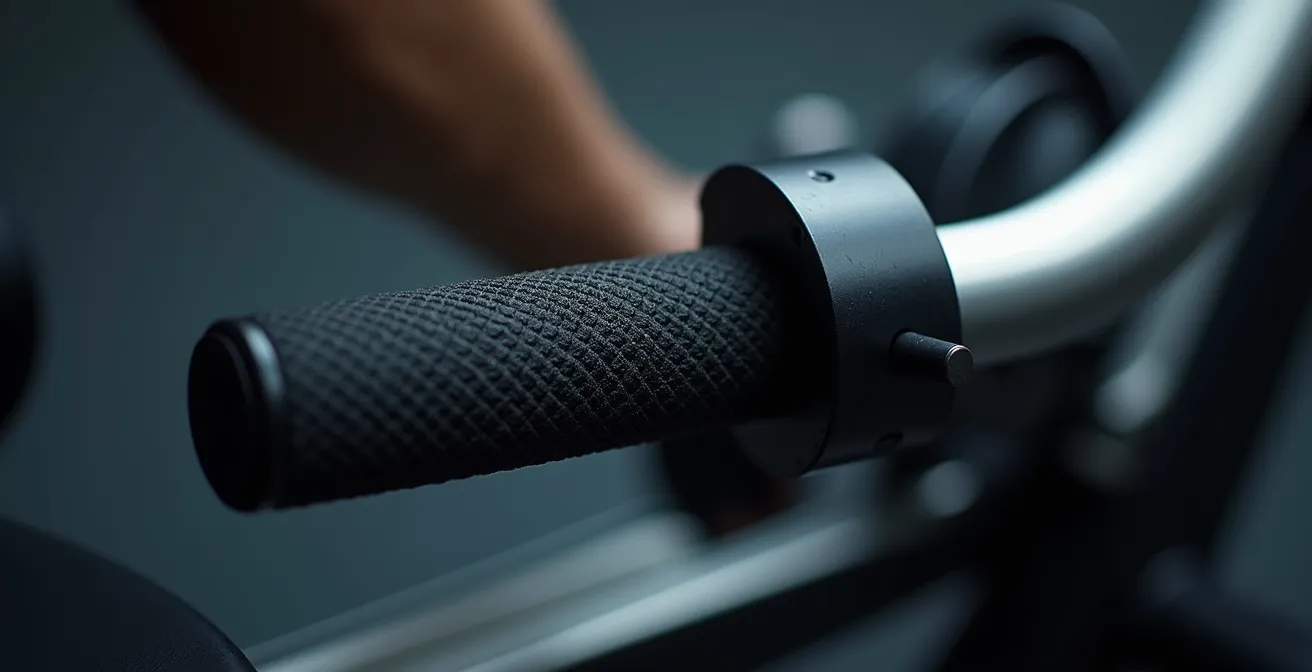
To truly leverage the rower for VO2 max improvement, specific interval structures are key. As noted by BC Parent Newsmagazine, one of the most tested protocols is the 4×4 interval workout.
4×4 intervals: This is a gold standard for VO2 max. Four minutes of high-intensity effort (where you’re breathing hard), followed by three minutes of active recovery.
– BC Parent Newsmagazine, How To Gain More Life In 2026? VO2 Max Is Your Answer
Performing four of these intervals on a rower is a potent, time-efficient 28-minute workout (including a warm-up) that can produce remarkable fitness gains. The elliptical is a great supporting actor for recovery, but the rower is often the star for peak performance.
The “No Pain No Gain” Mistake That Leads to Heart Strain
The “go hard or go home” mentality is pervasive in fitness culture, but for a busy parent running on limited sleep and high stress, it’s a direct path to burnout. This is the danger of the “gray zone” or “black hole” training—an intensity that feels moderately hard but is neither easy enough for optimal recovery nor hard enough for maximal adaptation. It creates significant physiological stress without a proportional reward, leading to a state of chronic fatigue known as Overtraining Syndrome (OTS).
From a physiological standpoint, OTS is not just a feeling of tiredness; it’s a measurable state of systemic stress. One of the clearest indicators is a change in your heart’s behavior. A clinical review of Overtraining Syndrome highlights that it is associated with an elevated resting heart rate and an altered heart response to exercise. Your body is stuck in a ‘fight or flight’ mode, unable to fully recover. This is the opposite of building a resilient cardiovascular system.
Another powerful metric is Heart Rate Variability (HRV), the variation in time between each heartbeat. A high HRV is a sign of a well-rested, resilient nervous system, while a low HRV indicates fatigue and stress. Pushing too hard, too often, without adequate recovery, tanks your HRV. For instance, one study on athletes showed significantly reduced heart rate variability during a period of intense training, a clear signal of accumulating fatigue. For a parent, monitoring resting heart rate or HRV can be a data-driven way to “listen to your body” and know when to push and when to prioritize a Zone 2 session or complete rest.
When to Do Cardio: Before or After Lifting for Muscle Preservation?
For parents incorporating strength training, the question of when to do cardio is a common point of confusion. The answer depends on your primary goal for that day. If your goal is to lift heavy and build strength or muscle, performing an intense cardio session *before* your lifts will fatigue your muscles and nervous system, compromising your performance and increasing injury risk. In this scenario, it’s best to lift first, when you are fresh, and add your cardio session afterward. Alternatively, you can separate the sessions entirely, for example, lifting in the morning and doing a Zone 2 session in the evening.
This separation of stimuli is known as “interference,” where the adaptations from endurance training can sometimes blunt the signals for muscle growth from strength training. While this is a minor concern for general fitness, prioritizing your main goal for each session is a simple way to optimize your results. If cardio is your focus, do it first. If strength is your focus, do it first.
The most important factor, however, is not timing but volume. The risk of “cardio killing your gains” comes from excessive volume and inadequate recovery, not from the cardio itself. Adhering to a polarized model naturally manages this risk. Your high-intensity days are potent but infrequent. As Dr. Charlotte from Peloton advises, moderation is key for high-intensity work.
When using interval training to improve your VO2 max, less is more. For most, a maximum of two sessions per week, separated by at least one easy or rest day, is plenty.
– Dr. Charlotte, Peloton – 3 VO2 Max Workouts for Any Type of Exercise
This approach ensures you get the stimulus for VO2 max improvement without creating so much fatigue that it interferes with your other workouts or, more importantly, your ability to be an engaged and energetic parent.
HEPA Filter vs Ionizer: Which Device Actually Removes Allergens?
Your ability to train effectively is directly tied to your ability to recover completely. For a busy parent, sleep is the most powerful recovery tool available, and the quality of your home environment profoundly impacts your sleep. Poor air quality, filled with allergens like dust, pollen, and pet dander, can trigger inflammation and disrupt sleep, sabotaging your recovery and leaving you too fatigued to train. Optimizing your bedroom’s air is a simple, passive way to enhance recovery. This brings up the common debate: HEPA filters versus ionizers.
A HEPA (High-Efficiency Particulate Air) filter works by physically trapping airborne particles. Air is forced through a fine mesh that captures a very high percentage of particulates down to a very small size. It is a proven, mechanical process that removes allergens from the air you breathe. It’s the gold standard for purification.
An ionizer, on the other hand, works by emitting charged ions into the air. These ions attach to airborne particles like dust and pollen, causing them to become heavy and fall out of the air, settling on surfaces like floors and furniture. While this removes them from the air, it doesn’t remove them from the room and can produce trace amounts of ozone, an irritant. For the purpose of creating the cleanest possible sleep environment for maximum recovery, a device with a true HEPA filter is the more effective and reliable choice for actually removing allergens from your breathing space.
The Implementation Error That Causes 70% of Digital Transformations to Fail
It may seem like a stretch, but the reasons why massive corporate projects fail are remarkably similar to why most personal fitness plans fall apart. A fitness journey is, in essence, a personal transformation project, and it is susceptible to the same strategic errors. Understanding these pitfalls through the lens of business strategy can provide a powerful framework for success.
One of the primary reasons for failure is the lack of clear, measurable goals. A company might aim to “be more digital” without defining what that means in terms of revenue or efficiency. Similarly, a parent might aim to “get in shape” without setting specific, measurable targets like a target resting heart rate, a specific 5k time, or a consistent HRV score. Without a metric, progress is invisible, and motivation wanes.
Another common error is trying to do everything at once. In business, this is “boiling the ocean.” In fitness, it’s starting a new diet, a new lifting program, and daily HIIT sessions all in the same week. It’s unsustainable and leads directly to burnout. The polarized model, by contrast, is a focused system. You have one of two goals on any given day: go easy (Zone 2) or go hard (HIIT). This clarity prevents strategic chaos. The final parallel is ignoring feedback. A business that ignores user data is doomed. A person who ignores the body’s feedback—persistent soreness, a high resting heart rate, poor sleep—is on a fast track to injury or overtraining.
Key takeaways
- The ‘polarized’ model, combining low-intensity Zone 2 work and high-intensity intervals, is more effective for time-crunched individuals than constant moderate-intensity training.
- Avoid the ‘gray zone’ of training; it creates significant fatigue for minimal cardiovascular benefit, leading to burnout.
- Recovery is not passive. Proactively managing sleep, nutrition, and your environment is essential for realizing fitness gains from your workouts.
Mastering Restorative Sleep Cycles: How to Double Your Deep Sleep Score Tonight?
All the sophisticated training plans and dietary strategies in the world are meaningless without the foundation upon which all physiological adaptation is built: sleep. For busy parents, sleep is often the first thing to be sacrificed, yet it is the single most powerful performance-enhancing tool you have. During deep sleep, your body releases growth hormone, repairs muscle tissue, and consolidates memory. It is the work your body does during sleep that turns the stress of your workouts into tangible fitness gains.
Improving sleep quality doesn’t require adding more hours you don’t have; it requires making the hours you do get more potent. The goal is to maximize your time in the most restorative stages: deep sleep and REM sleep. This can be achieved through disciplined sleep hygiene, a set of practices designed to signal to your brain and body that it’s time to power down. The impact of these small, consistent actions can be profound.
Start by creating a sleep sanctuary. Your bedroom should be cool, completely dark, and quiet. Use blackout curtains and cover or remove any electronics with lights. An hour before bed, begin a wind-down routine. This means turning off screens, as the blue light they emit can suppress melatonin production, the hormone that regulates sleep. Read a book, listen to calming music, or do some light stretching. Finally, maintain a consistent sleep schedule, even on weekends. Going to bed and waking up at the same time reinforces your body’s natural circadian rhythm, making it easier to fall asleep and improving the quality of that sleep. These are not luxuries; for a parent aiming to be fit and energetic, they are necessities.
To apply these principles effectively, the next logical step is to analyze your current routine. By identifying where you can strategically introduce polarized training and enhance your sleep hygiene, you can begin to transform your fitness and energy levels today.