
The key to eliminating brain fog isn’t another supplement, but mastering how your body absorbs nutrients from real food.
- Many multivitamins offer poor bioavailability, with key nutrients passing through your system unused.
- Proper food preparation (like soaking legumes) and meal timing can dramatically boost nutrient uptake and cognitive function.
Recommendation: Start by auditing your current diet’s bioavailability, not by adding more pills to your routine.
That mid-afternoon mental haze descends, making focus feel like a distant memory. For many knowledge workers, this cognitive slump is a daily battle fought with endless cups of coffee, energy drinks, or a cabinet full of supplements promising clarity. We’re told to pop a multivitamin, try the latest nootropic, or simply push through the fatigue. This approach treats the symptom—brain fog—as a simple deficiency that can be plugged with a pill.
But what if the root of the problem isn’t a lack of nutrients, but a failure to access the ones you’re already consuming? The conventional wisdom overlooks a critical factor: bioavailability. True cognitive enhancement from food isn’t about just *what* you eat, but about understanding *how* to prepare, combine, and time your meals to unlock and absorb their full nutritional potential. It’s about turning your diet into a systemic process that outperforms any isolated supplement.
This guide moves beyond simplistic “eat this, not that” advice. We will explore the science of nutrient absorption, the hidden anti-nutrients in “healthy” foods, and the powerful connection between your gut, your internal clock, and your mental clarity. By mastering these principles, you can build a truly nutrient-dense diet that fuels your brain for sustained, peak performance—no supplements required.
Summary: A Systemic Approach to Diet for Eliminating Brain Fog
- Why Your Multivitamin Might Be Passing Straight Through Your System?
- How to Meal Prep for the Week to Ensure Maximum Vitamin Retention?
- Organic vs Local: Which Produce Has Higher Nutrient Density?
- The Legume Preparation Error That Blocks Mineral Absorption
- How to Time Your Carbs to Match Your Circadian Rhythm?
- Why Chronic Inflammation Is the Silent Root of Your Fatigue?
- Why Painting Your Kitchen Blue Might Suppress Your Appetite?
- Cardiovascular Physical Activity for Busy Parents: How to Boost VO2 Max in 20 Minutes?
Why Your Multivitamin Might Be Passing Straight Through Your System?
The promise of a multivitamin is seductive: a simple, all-in-one insurance policy for your nutritional needs. However, the reality is often disappointing due to poor bioavailability—the proportion of a nutrient that is actually absorbed and utilized by the body. Many commercial supplements are made with synthetic forms of vitamins and minerals that the body struggles to recognize and absorb effectively.
These supplements are often packed with fillers, binders, and artificial colorings that can interfere with absorption. Furthermore, they present nutrients in isolated forms, ignoring the complex synergies required for them to work. For example, your body needs vitamin C to absorb iron effectively, and vitamin D to utilize calcium. A pill cannot replicate the intricate matrix of a whole food. In fact, research indicates that synthetic vitamin absorption rates can be as low as 5–10%, meaning the vast majority is simply excreted, providing little more than expensive urine.
Instead of relying on an ineffective insurance policy, the goal should be to maximize nutrient uptake from your food. This involves understanding food preparation, pairing, and timing to ensure your body gets what it needs. Before adding another supplement, it’s far more effective to audit the bioavailability of your current diet.
Your Bioavailability Audit Checklist: 5 Steps to Unlock More Nutrients
- Preparation Methods: Are you soaking legumes and grains to reduce anti-nutrients? Are you lightly steaming vegetables instead of boiling them to preserve water-soluble vitamins? List your top 5 most-eaten foods and their prep methods.
- Strategic Food Pairings: Inventory your typical meals. Are you pairing iron-rich foods (like spinach or lentils) with a source of vitamin C (like bell peppers or lemon juice) to boost absorption?
- Anti-Nutrient Awareness: Identify foods high in phytates (unsoaked grains, nuts) or oxalates (raw spinach, rhubarb) in your diet. Are you taking steps like cooking, soaking, or sprouting to mitigate their mineral-blocking effects?
- Gut Health Indicators: Monitor for signs of poor digestion like bloating, gas, or discomfort after meals. These can signal an impaired ability to absorb nutrients, suggesting a need to focus on gut-healing foods like fermented products and bone broth.
- Energy & Focus Mapping: For one week, keep a simple journal of your meals and your energy/focus levels 1-2 hours afterward. This helps identify which food combinations fuel you effectively versus those that contribute to a slump.
How to Meal Prep for the Week to Ensure Maximum Vitamin Retention?
Meal prepping is a cornerstone of a consistent, nutrient-dense diet, but if done incorrectly, it can lead to significant nutrient degradation. Vitamins, especially water-soluble ones like Vitamin C and B vitamins, are sensitive to oxygen, light, and heat. The moment you chop a vegetable, you initiate an oxidation process that diminishes its nutritional value.
The key to effective meal prep is to minimize this exposure. This means choosing the right storage methods and prepping ingredients in a way that preserves their cellular integrity for as long as possible. Airtight glass containers are superior to plastic as they are less permeable to oxygen and don’t leach chemicals. The visual below demonstrates an ideal setup for keeping prepped ingredients fresh and vibrant.
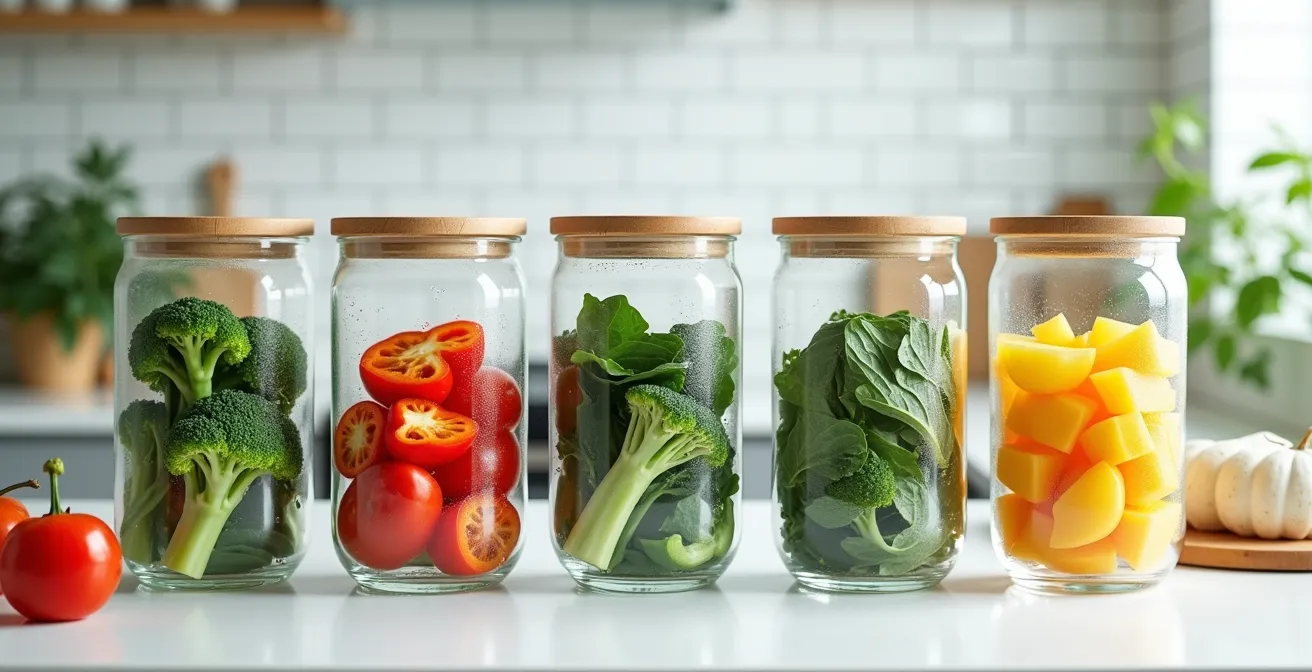
As you can see, separating components and using proper storage techniques is crucial. For instance, storing leafy greens with a paper towel absorbs excess moisture that accelerates spoilage. By adopting a strategic protocol, you ensure that the meal you eat on Friday is nearly as nutritious as the one you prepped on Sunday.
Weekly Meal Prep Protocol for Nutrient Retention
- Day 1 (Prep Day): Wash and thoroughly dry leafy greens, then store them wrapped in paper towels inside an airtight container. Blanch cruciferous vegetables (broccoli, cauliflower) for 2-3 minutes in boiling water, then immediately plunge them into an ice bath to halt the cooking process and lock in nutrients.
- Day 1-2: Cook hardy grains like quinoa or brown rice. Once cooled, store in airtight containers.
- Day 2-3: Prep proteins by portioning and marinating them, but hold off on cooking until the day you plan to eat them to maintain texture and moisture.
- Day 3-4: Chop hard vegetables like carrots, bell peppers, and celery. Chopping just before cooking is ideal, but prepping them mid-week is a good compromise.
- Throughout the week: Postpone prepping delicate items like avocado, tomatoes, and soft herbs until the day of consumption to prevent browning and mushiness.
Organic vs Local: Which Produce Has Higher Nutrient Density?
The debate between organic and local produce can be confusing for health-conscious consumers. “Organic” refers to farming practices that avoid synthetic pesticides and fertilizers, which can result in higher levels of certain antioxidants. “Local,” on the other hand, refers to the distance the food travels from farm to table. Both have distinct advantages, but when it comes to nutrient density, time is often the most critical factor.
Nutrient levels, particularly of fragile vitamins like vitamin C and folate, begin to decline as soon as produce is harvested. An organic apple shipped from thousands of miles away may have spent over a week in transit and storage, losing a significant portion of its nutritional value by the time it reaches you. Conversely, a conventionally grown apple from a local farm, consumed within a day or two of being picked, might retain more of its vital nutrients.
To make an informed decision, it’s helpful to consider a third option: flash-frozen produce. This method involves freezing fruits and vegetables at their peak ripeness, which effectively locks in nutrients. As a comparative analysis shows, frozen produce can sometimes be more nutrient-dense than “fresh” options that have traveled long distances.
| Factor | Organic (Non-Local) | Local Conventional | Flash-Frozen |
|---|---|---|---|
| Vitamin C Retention | 60-70% after 7 days transit | 85-90% if consumed within 2 days | 90-95% locked at harvest |
| Antioxidant Levels | Higher due to farming practices | Variable, depends on soil | Well-preserved if frozen quickly |
| Time to Table | 5-14 days average | 1-3 days | Months (but nutrients stable) |
The optimal strategy is often a hybrid approach: prioritize local produce when it’s in season, supplement with high-quality frozen options for convenience and year-round access, and choose organic for items on the “Dirty Dozen” list to minimize pesticide exposure.
The Legume Preparation Error That Blocks Mineral Absorption
Legumes like beans, lentils, and chickpeas are celebrated as nutritional powerhouses, packed with fiber, protein, and essential minerals like iron, zinc, and magnesium. However, they contain a natural defense mechanism: phytic acid. This compound, often referred to as an “anti-nutrient,” binds to minerals in the digestive tract, forming insoluble complexes that your body cannot absorb. Eating improperly prepared legumes can mean you’re missing out on a huge portion of their mineral content, which is critical for energy production and brain function.
The common mistake is to simply cook dried legumes directly or use canned beans without rinsing them. This fails to neutralize the phytic acid, effectively locking away the very nutrients you’re trying to obtain. Fortunately, traditional preparation methods passed down through generations hold the key to unlocking their full potential.
The most effective and simple technique is soaking. This process activates enzymes within the legume that begin to break down phytic acid. Research demonstrates that soaking legumes for 12 hours reduces phytic acid by up to 60%, significantly improving the bioavailability of crucial minerals. For even greater benefit, sprouting or fermenting legumes can neutralize phytic acid almost entirely, transforming them into a highly digestible and nutrient-rich food.
To implement this, simply cover your dried legumes with water and a splash of acidic medium like lemon juice or apple cider vinegar, and let them sit on the counter for at least 12 hours before cooking. Always discard the soaking water, as it will contain the leached anti-nutrients. This small, extra step can make a profound difference in the nutritional impact of your meals.
How to Time Your Carbs to Match Your Circadian Rhythm?
Not all calories are created equal, and when you eat them can be just as important as what you eat. The field of chrononutrition studies how food intake interacts with our body’s internal clocks, or circadian rhythms. Your metabolism, insulin sensitivity, and digestive efficiency fluctuate predictably throughout the day, and aligning your carbohydrate consumption with this natural rhythm can have a major impact on energy levels and mental clarity.
The body is most efficient at metabolizing carbohydrates in the morning. This is when the stress hormone cortisol is naturally at its peak, which in turn enhances insulin sensitivity, allowing your cells to uptake glucose from the bloodstream more effectively for energy. Consuming the bulk of your complex carbohydrates earlier in the day provides your brain and body with a steady supply of fuel for peak performance. Conversely, a large, carb-heavy meal late at night, when insulin sensitivity is low, is more likely to cause blood sugar spikes and be stored as fat, contributing to sluggishness the next day.
This principle is supported by leading experts in nutritional science. As nutritionist Dr. Rhonda Patrick highlights in her research:
The brain’s glucose uptake varies by up to 20% throughout the day, with peak efficiency occurring during morning hours when cortisol naturally elevates insulin sensitivity.
– Dr. Rhonda Patrick, Nutrition and Brain Health Research
Adopting a carb-tapering approach—front-loading your complex carbs at breakfast and lunch and having lighter carb portions for dinner—can help stabilize blood sugar, prevent afternoon energy crashes, and improve sleep quality, all of which are crucial for combating brain fog.
Circadian Carb Timing Protocol
- 6-8 AM (Breakfast): Consume the largest portion of your daily complex carbs (approx. 40%) here. Think steel-cut oats, quinoa, or whole-grain toast to align with your morning cortisol peak.
- 12-1 PM (Lunch): Include a moderate portion of complex carbs (approx. 30%), such as sweet potatoes, brown rice, or legumes, to ensure sustained energy for the afternoon.
- 6-7 PM (Dinner): Your carb portion should be its smallest (approx. 20-30%). Focus on non-starchy vegetables with a small serving of complex carbs to support serotonin production without overwhelming your system.
Why Chronic Inflammation Is the Silent Root of Your Fatigue?
Brain fog is often perceived as a purely cognitive issue, but its origins frequently lie in the body’s physiological state—specifically, chronic low-grade inflammation. Unlike acute inflammation, which is a healthy and temporary response to injury, chronic inflammation is a persistent, systemic state of alert that taxes the immune system and drains energy resources. This constant inflammatory hum is a major contributor to feelings of fatigue and mental sluggishness.
This inflammation is heavily influenced by diet. Ultra-processed foods, laden with refined sugars, industrial seed oils, and artificial additives, are primary drivers of this inflammatory state. These substances can damage the gut lining, leading to a condition known as “leaky gut,” where undigested food particles and toxins enter the bloodstream. The immune system flags these as invaders, triggering an inflammatory cascade that isn’t confined to the gut. These inflammatory messengers, called cytokines, can cross the blood-brain barrier and cause neuroinflammation, directly impairing cognitive function.
The link between diet and cognition is not theoretical. A study published in *Nutrients* found that people consuming high amounts of ultra-processed foods showed 28% poorer cognitive performance compared to those who ate a whole-foods diet. The most direct way to combat brain fog is to reduce the inflammatory load on your body by eliminating these trigger foods and focusing on an anti-inflammatory diet rich in whole fruits, vegetables, healthy fats, and quality proteins.
Case Study: The Gut-Brain Axis and Inflammation
Research at Massachusetts General Hospital provided compelling evidence of this connection. The study tracked patients with chronic fatigue and brain fog who implemented a strict anti-inflammatory diet. This protocol eliminated common trigger foods while introducing gut-healing nutrients. The results were remarkable: within just 8 weeks, 73% of participants reported a significant improvement in their mental clarity, highlighting how quelling gut inflammation can directly resolve cognitive symptoms.
Why Painting Your Kitchen Blue Might Suppress Your Appetite?
Our eating habits are not governed by biology alone; they are profoundly influenced by our environment. The colors, sounds, and even the layout of the space where we eat can subconsciously cue us to eat more or less. This is the domain of environmental psychology, and one of its most fascinating findings relates to the color blue and its effect on appetite.
Evolutionarily, blue is an exceptionally rare color for natural foods. Aside from a few exceptions like blueberries, blue in nature often signals spoilage, mold, or poison. This has created a deep-seated, subconscious aversion that can be leveraged for modern appetite control. When we are surrounded by the color blue, especially on plates or in the kitchen environment, it can act as a subtle appetite suppressant, making us less likely to overeat or mindlessly snack.
In contrast, warm colors like red, orange, and yellow are known appetite stimulants—a fact fast-food chains have exploited for decades. These colors evoke feelings of energy and excitement, which can translate into eating more, and more quickly. By consciously designing your eating environment, you can create a space that promotes mindful consumption rather than impulsive indulgence.
Painting a kitchen or dining room in a calming shade of blue, using blue plates, or even changing the lighting to a cooler tone can help create this effect. This isn’t a magic bullet for weight loss, but rather a tool to support a more mindful and controlled approach to eating. It encourages you to slow down, savor your food, and become more attuned to your body’s actual hunger and satiety signals, which is a foundational skill for maintaining a healthy, nutrient-dense diet.
Key Takeaways
- True nutritional power lies in bioavailability—how well your body absorbs nutrients—not in taking isolated supplements.
- Strategic food preparation (soaking, sprouting) and meal timing aligned with your circadian rhythm are critical for maximizing nutrient uptake.
- Chronic inflammation, largely driven by ultra-processed foods, is a primary and often overlooked root cause of brain fog and fatigue.
Cardiovascular Physical Activity for Busy Parents: How to Boost VO2 Max in 20 Minutes?
While diet is the foundation for clearing brain fog, physical activity is the catalyst that amplifies its effects. For busy parents or professionals, finding time for exercise can feel impossible. However, the science is clear: you don’t need hours at the gym. Short bursts of high-intensity cardiovascular activity can deliver profound benefits for both physical fitness and cognitive function.
One of the most powerful mechanisms is the production of Brain-Derived Neurotrophic Factor (BDNF), often called “Miracle-Gro for the brain.” BDNF is a protein that supports the survival of existing neurons and encourages the growth of new ones, playing a vital role in learning, memory, and mood. Intense exercise is one of the most potent ways to stimulate its release. In fact, cutting-edge neuroscience research shows that 20 minutes of HIIT increases BDNF levels by 200-300% for up to two hours post-exercise.
High-Intensity Interval Training (HIIT) involves short periods of all-out effort followed by brief recovery periods. This method is exceptionally efficient at improving VO2 max—a measure of your body’s maximum oxygen uptake and a key indicator of cardiovascular health. A higher VO2 max means more efficient oxygen delivery to your entire body, including your brain. The following protocol can be done at home with no equipment.
20-Minute VO2 Max Protocol for Busy People
- Minutes 0-3: Warm up with light jogging in place, jumping jacks, or high knees.
- Minutes 3-11 (6 Rounds): Perform a 30-second sprint at 85-90% maximum effort (e.g., fast running in place, burpees), followed immediately by a 30-second rest or slow walk.
- Minutes 11-13: Complete a 2-minute active recovery period of walking and deep breathing.
- Minutes 13-17 (4 Rounds): Begin the final push. Go for 20 seconds of 100% all-out effort, followed by 40 seconds of complete rest.
- Minutes 17-20: Cool down with a slow walk and gentle stretching for major muscle groups.
Your journey to mental clarity starts not in the supplement aisle, but in your kitchen and your daily habits. Begin today by applying one principle from this guide—whether it’s properly soaking your beans or trying a 20-minute HIIT session—and observe the powerful, systemic difference it makes.