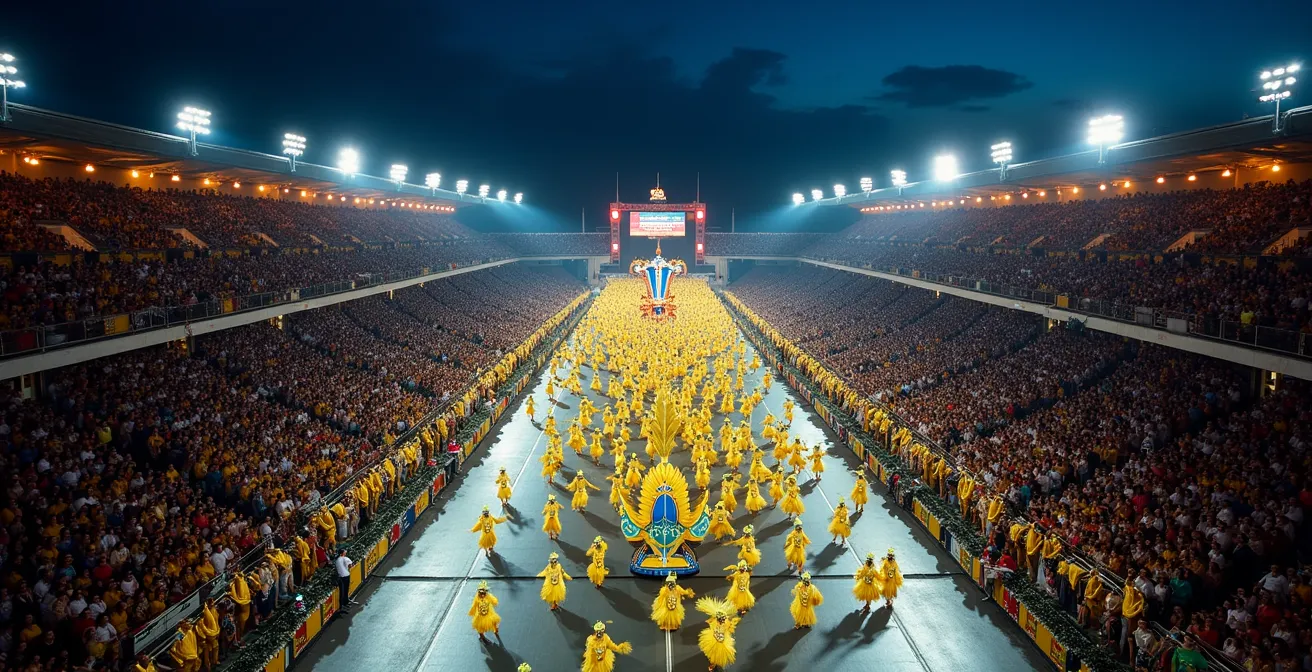
The secret to a successful Rio Carnival is not avoiding crowds, but mastering the systems of crowd flow, timing, and cultural logistics that locals use.
- Generic advice leads to generic experiences; strategic planning unlocks authentic participation.
- Your biggest vulnerabilities—from pickpocketing to poor views—come from signaling “tourist” instead of “participant.”
Recommendation: Shift your mindset from being a passive spectator to an active strategist. Plan your movements, seating, and safety based on the festival’s internal logic, not a tourist checklist.
The first time you step into a major cultural event like the Rio Carnival, the scale is staggering. It’s a sensory overload of sound, color, and motion. Millions of people surge through the streets, music thunders from monolithic sound trucks, and an electric energy hangs in the air. The typical advice you’ve read—book in advance, watch out for your wallet, try the caipirinhas—feels laughably inadequate. It prepares you to be an observer, a tourist on the sidelines, but it doesn’t teach you how to actually navigate the beautiful, glorious chaos.
Most guides focus on what you should see, not how you should operate. They’ll point you to the Sambadrome and the most famous blocos (street parties), but they won’t explain the critical logistics that separate a frustrating ordeal from an unforgettable experience. The truth is, these massive festivals operate on a set of unwritten rules and logistical systems. Understanding these systems is the difference between being swept away by the crowd and learning to ride the wave.
But what if the key wasn’t just to follow a better set of tips, but to adopt an entirely different mindset? What if you could approach the festival not as a tourist trying to tick boxes, but as a strategist mastering the event’s internal logic? This is the core of moving from a passive observer to an active participant. It’s about understanding event-time arbitrage, developing spatial intelligence, and managing the signals you send to blend in.
This guide will deconstruct the systems behind the spectacle. We’ll break down how to secure the best views and value, choose your accommodation and transit routes with logistical precision, and engage with the culture in a way that goes beyond a simple photo opportunity. It’s time to learn how to experience Carnival like a veteran.
This article breaks down the essential strategies for mastering a massive festival. The following sections provide a roadmap to shift from a spectator to a savvy participant, covering everything from parade seating to street-level logistics.
Summary: A Logistical Guide to Experiencing Rio Carnival Authentically
- Why General Admission at Major Festivals Often Means Seeing Nothing?
- How to Book Housing for Oktoberfest 12 Months in Advance?
- Opening Ceremony vs Closing Night: Which Offers the Best Spectacle?
- The Backpack Mistake That Makes You a Target at Street Parades
- How to Navigate Public Transit When the City Is Gridlocked by a Festival?
- The Cultural Blind Spot That Cost Major Brands Millions in Lost Revenue
- The Phone Etiquette Mistake That Enrages Actors and Audience Alike
- Attending Theatrical Performances: How to Select the Best Seats for Acoustics and View?
Why General Admission at Major Festivals Often Means Seeing Nothing?
The biggest rookie mistake at any mega-event is assuming a ticket is a guarantee to a good experience. At Rio’s Carnival, this is especially true for the main event: the Sambadrome parade. The Sambadrome, with its 90,000-person capacity, is an exercise in managed chaos, and where you sit determines what you see, hear, and feel. General admission often lands you in the “popular sectors” like 12 and 13, located at the very end of the parade route. From here, the samba schools have often lost their initial energy, the floats are sometimes breaking down, and the acoustics are notoriously poor. You’re physically present, but you’re missing the spectacle.
This isn’t just about a bad view; it’s about a complete disconnect from the performance. The heart of the parade is the “bateria” (drum section) and the intricate details of the costumes and floats. In the cheaper seats, the sound is a delayed echo, and the visual details are lost. You’re essentially watching the event’s exhausted finale over and over. True system mastery begins with understanding that not all seats are created equal and that paying a little more for a strategic location offers an exponentially better return on experience. The goal is to trade a “get in the door” ticket for a seat that places you in the heart of the action.
Choosing the right sector isn’t about spending the most money; it’s about matching a location to your desired experience. Are you a purist who wants perfect sound? Or a partier who wants the best atmosphere? Each sector offers a different value proposition. The key is to make an informed choice rather than letting a ticketing algorithm decide for you.
Your Action Plan: Selecting Your Sambadrome Sweet Spot
- The Purist: Choose Sector 9. Known for perfect acoustics and the availability of multi-language guides, it’s where you go for an unadulterated appreciation of the music and performance.
- The Strategist: Book tickets for the Champions’ Parade. Held the Saturday after Carnival, it features the top 6 schools in a celebratory, less-pressured atmosphere, often at significantly lower prices.
- The Insider: Attend the technical rehearsals. In the weeks leading up to Carnival, schools hold full-run rehearsals at the Sambadrome that are free or very cheap, offering a raw, behind-the-scenes look.
- The Value Seeker: Select sectors 6 or 7. These are located in front of the judges’ booths, guaranteeing you’ll see every school at their absolute peak performance.
- The Local Experience: Pick sectors 10 or 11. These are closest to the drummers’ niche, offering an intense, authentic atmosphere where the raw power of the bateria is undeniable.
Ultimately, treating your ticket purchase as a strategic decision rather than a simple entry fee is the first step toward moving from a passive observer to an engaged participant.
How to Book Housing for Oktoberfest 12 Months in Advance?
The infamous challenge of booking housing for Oktoberfest a year ahead is a perfect analogy for the planning required for Rio Carnival. While the timeline might be slightly more forgiving, the principle is identical: the best, most strategically located, and fairly priced accommodations are gone months in advance. Waiting until the last minute forces you into overpriced, inconvenient locations, sabotaging your entire logistical plan. For Rio, spatial intelligence—understanding the city’s geography in relation to the festival’s activities—is your most powerful tool.
The key is to book your lodging based on your “Carnival circuit.” Do you plan to spend most of your time at blocos in Ipanema and Copacabana? Or are you focused on the more traditional parties in the city center (Centro) and Santa Teresa? A travel blogger’s case study highlights a winning strategy: staying in the Zona Sul (South Zone) neighborhoods like Copacabana or Ipanema provides the best balance, with walkable access to countless blocos and a direct metro line to the Sambadrome. For a less tourist-heavy vibe, the adjacent Botafogo and Flamengo neighborhoods offer great alternatives, while the bohemian hills of Santa Teresa provide a unique experience but pose significant logistical challenges with transit during peak times.
Beyond traditional hotels and Airbnbs, savvy travelers employ creative hacks. Consider booking in Niterói, a city a short ferry ride away, where prices can be up to 50% lower. Locals also know that “love hotels” (motels rented by the hour) offer clean, secure, and surprisingly available rooms during the chaos. When booking online, always use an incognito browser window and check prices on local Brazilian domains (.com.br), as this can sometimes save you over a hundred dollars on the same room.

As this view of the Zona Sul shows, proximity to both the beach (where many blocos congregate) and the main avenues (with metro access) is crucial. Your choice of neighborhood dictates your mobility for the entire week. A bad choice can leave you stranded by gridlock, spending hours in transit instead of enjoying the festivities.
Your accommodation isn’t just a place to sleep; it’s your strategic home base. Choosing it with logistical precision is non-negotiable for a successful Carnival experience.
Opening Ceremony vs Closing Night: Which Offers the Best Spectacle?
A common dilemma for first-timers is choosing which Sambadrome parade night to attend. The options seem confusing: there are two main nights of competition, a preliminary group, and a final Champions’ Parade. This is a classic case of “Event-Time Arbitrage,” where understanding the function of each night allows you to maximize value and experience. The “best” spectacle depends entirely on what you’re looking for: raw competition or pure celebration.
The main competition nights, Sunday and Monday, are the high-stakes core of the event. Here, the samba schools are judged on every detail, from the drum section’s rhythm to the lead dancers’ performance. The atmosphere is tense, electric, and filled with the suspense of a major sporting final. This is for the purist, the person who wants to see the performance at its most technically precise and emotionally charged. However, these are also the most expensive and crowded nights.
Conversely, the Champions’ Parade, held the following Saturday, is a victory lap for the six highest-ranking schools. The pressure is off, and the atmosphere is pure, unadulterated joy. Performers are more relaxed, interacting with the crowd, and celebrating a year of hard work. For party-seekers and those wanting the most spectacle-per-dollar, this is often the best choice. According to Sambadrome ticketing data, you’ll see the top performers for ticket prices that are up to 40% lower than main competition nights, with better ticket availability.
The following table breaks down the strategic choice, helping you align your investment with your desired experience.
| Event Type | Best For | Atmosphere | Price Range |
|---|---|---|---|
| Sunday/Monday Competition | Sports fans who thrive on suspense | High-stakes, intense competition | $200-$500+ |
| First Night Main Group | Purists seeking raw energy | Hopeful, fresh performances | $150-$400 |
| Champions’ Parade (Saturday) | Party seekers wanting spectacle | Celebratory, relaxed | $100-$300 |
| Access Group (Serie Ouro) | Authentic experience seekers | Fierce, passionate competition | $50-$150 |
Ultimately, there is no single “best” night. The savvy traveler analyzes this system and chooses the event that best fits their budget, temperament, and definition of a great spectacle.
The Backpack Mistake That Makes You a Target at Street Parades
At the blocos, Rio’s massive, chaotic street parties, your biggest security risk isn’t the crowd itself, but the signals you send to it. The single greatest mistake is wearing a backpack. To a local, a backpack signals one thing: you are an outsider, an observer, and you are likely carrying valuables. It creates a physical and social barrier, marking you as someone who is not fully participating. This is a critical failure in signal management.
It’s not just perception; it’s a statistical reality. In fact, a security analysis reveals that tourists wearing backpacks are 3x more likely to be pickpocketed at street parades. A backpack is an easy target in a dense crowd, vulnerable to being slashed or unzipped without you ever noticing. It screams “I have a passport, a large camera, and a lot of cash in here.” It’s the opposite of blending in. The local approach is to carry the absolute bare minimum, just enough to get through the day, in a way that is both secure and integrated into your outfit.
The Local’s Bloco Survival Kit
Instead of a backpack, a seasoned participant’s kit is about minimalism and security. Cash is carried in a “doleira,” a flat money belt tucked inside your pants, invisible to everyone. You bring only what is essential: enough Reais for water and beer, a single payment card, and maybe your ID. Many locals wear a plastic cup on a string around their neck for drink reuse, a practical and social signal of participation. A small sachet of sunscreen that fits in a pocket or tiny belt bag and a paper fan (“leque”) for cooling complete the kit. This setup allows for total freedom of movement and sends the signal that you are there to dance, not to spectate.
This minimalist approach isn’t just about security; it’s about liberation. Without a bulky bag to worry about, you can move freely, dance without hitting people, and immerse yourself completely in the experience. You shift from being a worried observer guarding their possessions to a carefree participant enjoying the moment.
Ditching the backpack is the most significant step you can take to decrease your risk profile and increase your enjoyment. It’s a practical application of the core philosophy: act like a participant, not a tourist.
How to Navigate Public Transit When the City Is Gridlocked by a Festival?
During Carnival, Rio’s streets transform into a pulsating gridlock. Roads close for blocos, buses are rerouted unpredictably, and ride-sharing services become prohibitively expensive and slow. Trying to cross the city by car is a fool’s errand. The only reliable way to move across large distances is the Metro, but even that becomes a challenge of crowd management. The key to mobility is combining strategic Metro use with a hyperlocal, on-foot approach—a form of spatial intelligence.
The smartest strategy is to choose a neighborhood “circuit” for the day and stick to it. Instead of trying to hop from a bloco in Ipanema to one in Centro, which could take hours, you embrace the local flow. As a local guide demonstrates, you can create a “walkable circuit” within a single area. For example, you can start with the Banda de Ipanema parade, then walk 15 minutes to the Simpatia é Quase Amor bloco, hitting several smaller street parties along the 2-kilometer route. This strategy saves hours of transit frustration and allows for a more spontaneous, immersive experience. You discover the neighborhood’s unique Carnival flavor instead of just seeing the famous headliners.
When you absolutely must cross the city—for instance, to get to the Sambadrome—the Metro is your only friend. But it requires its own strategy. Buy your special multi-day Carnival pass well in advance to avoid monstrous lines at the ticket machines. Travel during off-peak windows if possible (e.g., head to the Sambadrome a bit earlier than the main rush). Be prepared for packed cars and learn to navigate the crowd flow with purpose. Know your station and your exit in advance. It’s a system within a system, and mastering it is essential.

Thinking of the metro not as a simple A-to-B line but as a network of high-traffic arteries and choke points helps you plan smarter routes. Avoid transferring at major hubs like Central or Botafogo during peak hours, as these stations become human gridlock zones themselves.
By limiting your range and embracing a walkable circuit, you trade the futile ambition of “seeing everything” for the much more rewarding experience of “being somewhere” completely.
The Cultural Blind Spot That Cost Major Brands Millions in Lost Revenue
When major international brands try to capitalize on Carnival, they often fail by treating it as a marketing backdrop. They see the glitter and the feathers, but they miss the heart. This costly mistake stems from a cultural blind spot: viewing the parade as a mere “show” rather than the culmination of a year-long community effort. The exact same blind spot is what costs travelers their chance at an authentic experience.
The Rio Carnival is not a performance put on for tourists. The Guinness World Records elected it the world’s largest Carnival in 2004, a title earned through the massive scale of its community-driven samba schools. These schools are deep-rooted social and cultural institutions, often based in a specific favela or neighborhood. The 80-minute parade you see is the result of 365 days of fundraising, costume-making, songwriting, and rehearsals. It represents the pride, passion, and investment of an entire community. To see it as just a pretty spectacle is to miss the point entirely.
Overcoming this blind spot requires a shift from passive consumption to active engagement. The goal is to connect with the “why” behind the parade. This means doing a little homework and seeking out the cultural context. Instead of just picking a parade night, you pick a samba school to root for. You learn the lyrics to their “samba-enredo” (theme song) for the year. You understand the story their floats and costumes are trying to tell. Suddenly, you’re not just watching a parade; you’re invested in a competition, connected to a community’s story.
The most rewarding experiences happen before the main event. A pro-tip for any traveler is to take a taxi to a samba school’s “quadra” (rehearsal hall) for a practice night in the weeks before Carnival. Here, you’ll find an electric atmosphere, see the community come together, and feel the raw energy of the bateria in a way that’s impossible at the formal parade. This is where you transform from a tourist to a true supporter.
By investing a small amount of time to understand the cultural fabric of the event, you gain access to a level of authenticity that most visitors will never see.
The Phone Etiquette Mistake That Enrages Actors and Audience Alike
In the Sambadrome, a sea of glowing screens rises from the stands during the parade. Tourists, eager to capture every moment, hold their phones high, recording long videos. From the spectator’s perspective, it seems harmless. But from the performer’s perspective, it’s deeply disrespectful. This is the phone etiquette mistake that transforms you from a supportive audience member into a source of frustration. It reinforces the idea that you see them not as artists, but as objects for your social media feed.
What most tourists fail to grasp is the immense personal and financial investment each performer has made. A survey of samba school participants revealed that creating a single costume costs, on average, between $500 and $2,000 of their own money. Many spend an entire year saving, designing, and building their “fantasia.” They pour their heart and soul into preparing for their 80 minutes on the parade grounds. When they look into the crowd and see a wall of phones instead of engaged faces, they report feeling objectified and dehumanized. You are not just a spectator; you are part of the energy that fuels their performance.
Participant vs. Photographer: An Insider’s Perspective
An interview with a long-time “passista” (lead dancer) reveals the emotional toll of this behavior. She explained, “We are not characters in a movie. We are athletes, we are artists, and we are celebrating our culture. When I see someone staring at their screen while I am performing my heart out a few feet away, it feels like they are stealing a piece of my soul without ever truly seeing me.” This perspective reframes the act of recording from simple documentation to a form of disengagement that disrespects the performers’ sacrifice and artistry.
The veteran’s code is simple: be present. Take a few quick photos to capture the memory, then put the phone away. Clap, sing along (especially if you’ve learned the theme song), and make eye contact. Your energy is part of the show. By being an engaged and appreciative audience member, you give back to the performers and, in turn, have a much more powerful and connected experience. Your memory of the event will be etched in your mind, not just stored on a memory card.
The best spectacle is the one you experience with your own eyes, not through a 6-inch screen. Your full attention is the greatest respect you can pay to the artists on the floor.
Key Takeaways
- Strategic Inaction is Key: The best plan often involves doing less. Stick to a walkable neighborhood circuit instead of attempting to cross a gridlocked city.
- Value Lies in the Shoulders: The best experiences (and prices) are often found just outside the peak, such as the Champions’ Parade or technical rehearsals.
- Blend In to Stand Out: Ditch the backpack and tourist signals. Adopting a minimalist, local-style kit enhances both your security and your immersion.
Attending Theatrical Performances: How to Select the Best Seats for Acoustics and View?
Just as selecting the best seats in a theater depends on understanding acoustics and sightlines, positioning yourself within a sprawling street bloco requires a similar level of strategic thinking. A bloco is not a uniform mass of people; it’s a living, breathing organism with distinct zones, each offering a radically different experience. Simply diving into the middle is a recipe for sensory overload. The veteran move is to choose your position based on the experience you want, using the sound truck as your anchor.
The sound at a bloco emanates from the “trio elétrico,” a massive truck loaded with speakers. The quality of that sound changes dramatically depending on your proximity and angle. Acoustic analysis and official attendance figures, which can reach 2 million daily participants across all blocos, show that the audio is optimized for a specific range. For music purists, the sweet spot is the zone parallel to the speakers, roughly 10-20 meters away. Here, the sound is clearest and most balanced, allowing you to appreciate the music as intended.
But not everyone is a purist. The area directly between the sound truck and the percussion section is the high-energy “mosh pit”—intensely crowded, incredibly loud, and fueled by raw adrenaline. It’s for those who want to be at the absolute epicenter of the party. In contrast, the sidewalks and edges of the parade route are the social zones. Here, there’s room to move, it’s easier to chat with friends, and you can dip in and out of the main crowd. For families or those seeking a more relaxed vibe, the tail end of the bloco offers the most space and a calmer atmosphere.
This table breaks down your positioning strategy, applying theatrical principles to the chaos of the street.
| Position | Best For | Experience | Crowd Density |
|---|---|---|---|
| Between sound truck & percussion | Mosh Pit Maniacs | Maximum energy, loudest music | Extreme |
| Parade edges/sidewalk | Social Butterflies | Easy movement, conversations possible | Moderate |
| Tail end of bloco | Families | Relaxed vibe, more space | Light |
| Parallel to speakers | Music Purists | Optimal sound quality | High |
By consciously choosing your spot, you take control of your environment. You are no longer just a body in a crowd; you are an attendee who has curated their own perfect theatrical experience on the streets of Rio.