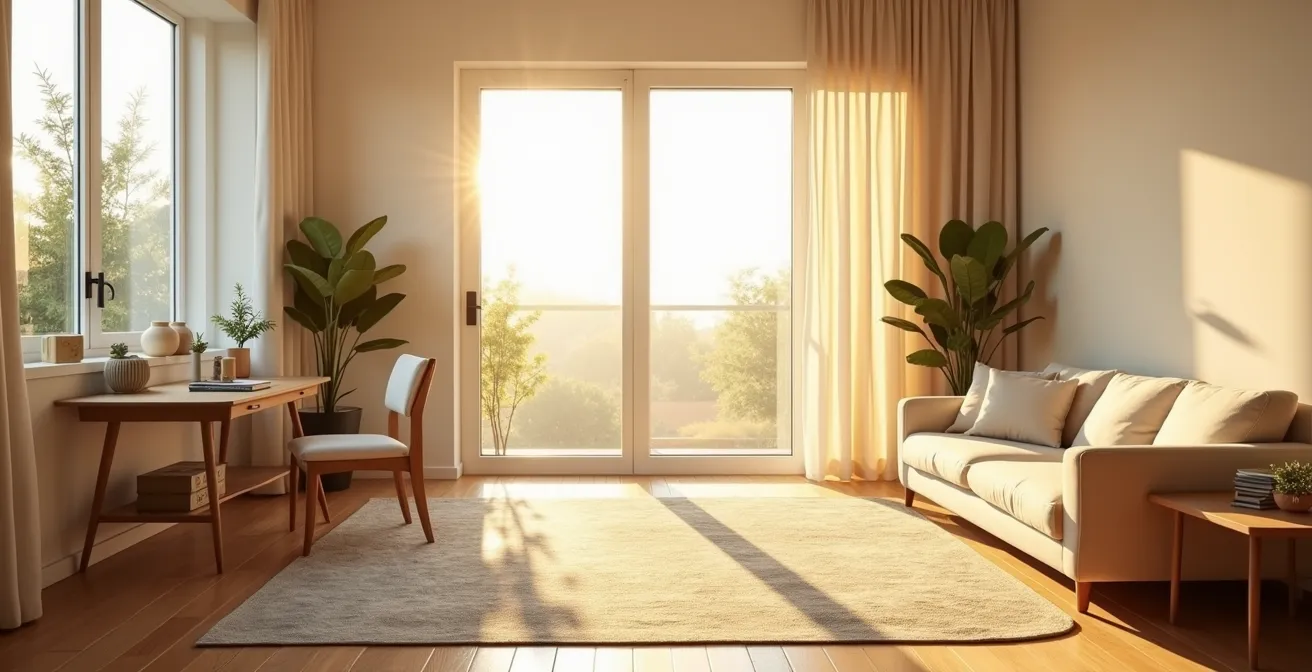
Maximizing indoor light isn’t about white paint and mirrors; it’s a science of timing and dosing light to reset your body’s internal clock for optimal health.
- Morning sunlight acts as the primary signal to wake up your brain and body, setting the stage for restorative sleep later.
- The spectral quality (color) of light and its angle are as crucial as brightness for managing your energy and focus throughout the day.
Recommendation: Treat light like a nutrient. Get a large, direct dose of bright, blue-rich light within the first hour of waking to powerfully synchronize your circadian rhythm.
If you live in a northern climate or a light-deprived apartment, you’ve likely heard the standard advice: paint your walls white, hang mirrors, and clean your windows. These tips, while helpful, barely scratch the surface of a much deeper biological need. For those suffering from the winter blues or Seasonal Affective Disorder (SAD), simply making a room *appear* brighter often isn’t enough to make you *feel* better. The conventional approach treats light as a decoration, an aesthetic element to be manipulated for visual appeal.
But what if the true key to boosting mood and energy isn’t just about the quantity of light, but its quality, timing, and “dose”? The real solution lies in understanding the profound, non-visual effects of light on our biology. This is the practice of light hygiene: a deliberate strategy for managing your daily light exposure to support your body’s master clock, known as the circadian rhythm. It involves seeing light not as ambiance, but as a vital nutrient your body requires at specific times to function correctly.
This guide moves beyond simple interior design tricks. We will explore how to strategically engineer your indoor environment to provide the right light at the right time. We’ll decode the science of how morning light sets your sleep-wake cycle, how to arrange your workspace for focus without glare, and how to use artificial light to your advantage on the darkest days. It’s time to stop just illuminating your home and start nourishing your body with light.
This article provides a comprehensive roadmap for transforming your home into a healthier, more energizing environment. Below, we detail the core principles and actionable steps to master your indoor light exposure.
Summary: How to Harness Indoor Light for Better Health and Sleep
- Why Lack of Morning Light Is Ruining Your Sleep Cycle?
- How to Orient Your Home Office Desk to Maximize Daylight Without Glare?
- Sheer Curtains vs Blinds: Which Option Maximizes Privacy While Letting Light In?
- The Sun Exposure Oversight That Fades Your Hardwood Floors and Art
- How to Layer Lighting to Mimic Sunlight on Overcast Days?
- The Lighting Error That Disrupts Melatonin Production in Your Bedroom
- The Evening Screen Mistake That Delays Your REM Cycle by 40 Minutes
- Mastering Restorative Sleep Cycles: How to Double Your Deep Sleep Score Tonight?
Why Lack of Morning Light Is Ruining Your Sleep Cycle?
Your body’s sleep-wake cycle is governed by a master clock in your brain, which is synchronized primarily by light. Morning sunlight is the most powerful signal for this process, known as circadian entrainment. When bright light hits specialized receptors in your eyes, it sends a direct message to your brain to suppress the production of melatonin (the sleep hormone) and trigger the release of cortisol, which promotes wakefulness and alertness. This morning light “event” effectively sets a timer for your body to naturally feel sleepy again 14-16 hours later.
Without a sufficient dose of morning light, this signal is weak or delayed. Your body remains in a state of “circadian misalignment,” leading to difficulty waking up, daytime grogginess, and trouble falling asleep at night. The key is the intensity, or “dose,” of the light. For effective circadian signaling, Stanford Health Care recommends that morning exposure to 10,000 lux for 30-90 minutes is the clinical standard for resetting the sleep cycle. For context, a brightly lit office is only about 500 lux, while direct sunlight is over 50,000 lux. Getting light through a window significantly reduces this intensity, but it’s far more effective than standard indoor lighting.
This light exposure does more than just regulate sleep. Research shows a direct link between natural light and mental well-being. A large-scale UK study analyzing data from 500,000 people found that each additional hour spent outside in natural light was associated with a lower risk of depression and increased happiness. While light through a window doesn’t provide the UVB rays needed for Vitamin D synthesis, the UVA and visible light that do pass through are crucial for this mood-regulating, clock-setting effect.
Failing to get this morning signal is like starting a race without hearing the starting gun; your entire day’s rhythm is thrown off, directly impacting your ability to achieve deep, restorative sleep at night.
How to Orient Your Home Office Desk to Maximize Daylight Without Glare?
For anyone working from home, the home office is the primary arena for daily light exposure. However, optimizing this space is a delicate balance. You need enough natural light to boost alertness and mood, but you must also avoid screen glare and direct-light eye strain, which can cause headaches and reduce productivity. The most common mistake is to face the desk directly towards or away from a window. Facing a window creates intense backlighting, forcing your eyes to constantly adjust between a bright view and a dimmer screen. Placing your back to the window is even worse, as it causes direct, disabling glare on your monitor.
The optimal solution, recommended by workplace health experts, is to position your desk perpendicular to the window. This setup allows natural light to illuminate your workspace from the side, providing ample ambient light without shining directly into your eyes or onto your screen. It’s the best of both worlds: you get the benefits of daylight while maintaining a comfortable, glare-free view of your monitor.

This side-lit arrangement provides a soft, diffused light that reduces shadows and creates a more pleasant working environment. The official OSHA Computer Workstation Guidelines reinforce this, stating a key ergonomic principle is to “position your computer screen at right angles to windows (perpendicular) rather than directly facing them or having them directly behind you.” This simple change can dramatically improve visual comfort and focus over an eight-hour workday.
To visualize the impact of different setups, consider this breakdown of desk positions relative to a window and their effects on your work environment.
| Desk Position | Glare Level | Natural Light Access | Focus/Distraction | Best For |
|---|---|---|---|---|
| Facing Window | High (direct glare) | Excellent | High distraction | Creative tasks, breaks |
| Back to Window | High (screen glare) | Good | Low distraction | Not recommended |
| Perpendicular to Window | Low | Good | Balanced | Most work types |
By implementing this perpendicular strategy, you move from fighting against natural light to working in harmony with it, enhancing both your well-being and your professional performance.
Sheer Curtains vs Blinds: Which Option Maximizes Privacy While Letting Light In?
Once your furniture is correctly positioned, the next layer of light management is your window treatments. The goal is to strike a balance between maximizing daylight transmission and maintaining an adequate level of privacy. Two popular options, sheer curtains and blinds, offer very different approaches to this challenge. Sheer curtains excel at diffusing light beautifully, softening harsh sunbeams and filling a room with a gentle, ambient glow. They allow significant light transmission (often 70-80%), but this comes at the cost of privacy, especially at night.
Blinds, particularly Venetian or top-down/bottom-up styles, offer unparalleled adjustability. By tilting the slats of Venetian blinds, you can precisely direct light—bouncing it up toward the ceiling to illuminate the room indirectly or angling it down to avoid glare. This granular control allows you to adapt to the sun’s position throughout the day. Top-down/bottom-up blinds provide an even more versatile solution, allowing you to cover the bottom half of the window for privacy while leaving the top half open to let in maximum daylight.
For those seeking the ultimate in modern light control, newer technologies like solar shades and smart window film offer advanced solutions. Solar shades are designed with specific openness factors (e.g., 3%, 5%) that block UV rays and heat while preserving the view, though they offer limited privacy at night. Smart film can switch from transparent to opaque with the flick of a switch, offering on-demand privacy without sacrificing light.
The best choice depends on your specific needs, such as the room’s orientation (south-facing windows require more control) and its floor level (ground-floor rooms demand more privacy). Often, the most effective strategy is to layer treatments, such as pairing sheer curtains for daytime diffusion with blackout blinds for nighttime privacy and light blocking.
| Window Treatment | Light Transmission | Privacy Level | Adjustability | Cost Range |
|---|---|---|---|---|
| Sheer Curtains | 70-80% | Low-Medium | Limited | $ |
| Venetian Blinds | 0-70% (adjustable) | High | Excellent | $$ |
| Top-Down/Bottom-Up Blinds | Variable | High | Excellent | $$$ |
| Smart Window Film | 5-70% (switchable) | High | Electronic control | $$$$ |
| Solar Shades | 30-50% | Medium-High | Good | $$ |
Ultimately, your window treatments should function as a dynamic filter, allowing you to actively manage indoor sunlight as a valuable resource throughout the day.
The Sun Exposure Oversight That Fades Your Hardwood Floors and Art
While we seek to maximize sunlight for our health, we often overlook its damaging effects on our homes. The same ultraviolet (UV) radiation in sunlight that can harm our skin is also the primary culprit behind the fading of hardwood floors, furniture, rugs, and precious artwork. This slow, cumulative damage can permanently alter the color and integrity of your most valued possessions. Many people assume that standard window glass provides adequate protection, but it only blocks most UVB rays, leaving the damaging UVA rays and visible light to penetrate indoors.
The most effective defense against this is the application of specialized UV-blocking window films. These transparent films are a modern technological solution designed to be virtually invisible while offering powerful protection. High-quality options like 3M Window Films can block up to 99% of UV rays, dramatically slowing the fading process. This is the same technology used in museums and art galleries to preserve priceless artifacts, now available for residential use.
However, it’s crucial to understand that UV radiation is only part of the equation. Visible light and heat also contribute to fading. Therefore, a comprehensive protection strategy often involves more than just a clear UV film, as demonstrated by professional conservation practices.
Case Study: The Museum-Grade UV Protection Strategy
To protect their collections, museums understand that UV film is just the first line of defense. While it significantly slows the fading of floors and artwork, it doesn’t stop it completely because visible light and heat still contribute to degradation. To achieve comprehensive, long-term preservation, institutions incorporate additional measures. This includes using lightly tinted films that also reduce a portion of the visible light spectrum and implementing the occasional use of shades or blinds during peak sun hours. This layered approach demonstrates that true protection requires managing the full spectrum of light, not just the invisible UV portion.
By adopting this multi-faceted approach, you can enjoy the mood-boosting benefits of a sunlit home without sacrificing the longevity and beauty of your furniture and decor.
How to Layer Lighting to Mimic Sunlight on Overcast Days?
On gray, overcast days or during the long months of winter, natural light alone is often insufficient to provide the strong circadian signal our bodies need. This is where a strategic approach to artificial lighting becomes essential. The goal isn’t just to make a room brighter, but to layer different types of light to mimic the qualities of natural sunlight. This means paying attention to brightness, color temperature, and the direction of the light.
First, focus on the spectral quality of your bulbs. Instead of generic “full-spectrum” marketing claims, look for bulbs with a high Color Rendering Index (CRI) of 90 or above. A high CRI means the light source renders colors realistically, much like the sun. For daytime simulation, choose bulbs with a color temperature between 5000K and 6500K, which matches the cool, blue-rich light of midday. This type of light is most effective at promoting alertness and focus. Using smart bulbs allows you to automate this process, shifting from a bright, cool white in the morning to a warm, amber light (around 2700K) in the evening to support melatonin production.
Second, mimic the directionality of the sun. The sun is a single, powerful point source high in the sky. You can create a similar effect by using narrow-beam spotlights aimed at a light-colored wall or ceiling from a high angle. This creates a bright, localized “patch of sun” that your eyes perceive as a powerful daytime signal. This technique is far more effective for circadian entrainment than a diffuse, evenly lit room from an overhead fixture. Combining this with general ambient lighting (from ceiling lights) and task lighting (like a desk lamp) creates depth and mimics the complex layers of natural daylight.
For those with diagnosed SAD, this layered approach complements the use of a dedicated light therapy lamp. While traditional light therapy has proven effective, with studies showing a 40%-60% reduction in SAD symptoms by resetting the circadian rhythm, a whole-room lighting strategy enhances these benefits throughout the day.
Your Action Plan: Creating a Circadian Lighting System
- Choose bulbs with a high Color Rendering Index (CRI >90) for realistic light.
- Set color temperature to 5000K-6500K for morning and midday “daylight” simulation.
- Create artificial sunbeams using narrow-beam spotlights aimed at walls from high angles.
- Install smart bulbs that automatically shift from bright blue-white morning light to warm amber evening light.
- Layer lighting sources: combine ambient ceiling lights, task desk lamps, and accent lighting for depth.
By thinking like a lighting designer, you can turn your home into a dynamic environment that supports your energy and mood, no matter the weather outside.
The Lighting Error That Disrupts Melatonin Production in Your Bedroom
While bright morning light is essential for waking up, exposure to the wrong kind of light at night is equally detrimental to your sleep. The most common and disruptive error is the presence of overhead lighting in the bedroom. Our brains have evolved over millennia to associate bright, overhead light with the midday sun—a powerful signal to be awake and alert. When you switch on a ceiling light in the evening, you are sending a profoundly confusing message to your internal clock, actively suppressing the production of melatonin just when your body needs it most.
The position of the light source is critical. Light entering the eyes from above is the strongest circadian stimulant. In contrast, light from a low source is perceived as less activating and more calming, mimicking the light from a sunset or a campfire. This is why using low-wattage table lamps or floor lamps positioned below eye level is a cornerstone of good light hygiene for the bedroom.
Our brains are hardwired to associate overhead light with midday sun, signaling ‘wake up,’ whereas light from a low source (like a fire) is calming.
– Sleep Research Study, Natural Light and Mental Health Research
Beyond overhead fixtures, your bedroom is likely filled with other subtle sources of melatonin-disrupting light. The standby LEDs on televisions, chargers, and air purifiers, the glow from a digital alarm clock, or the sliver of light from the hallway under the door can all fragment sleep and reduce its restorative quality. The solution is a thorough “light audit” to identify and eliminate every single source of unwanted light. This involves switching to amber or red-toned bulbs for evening use, as these long-wavelength colors have the least impact on melatonin, and physically covering or removing any electronic light sources.
To create a true sleep sanctuary, consider implementing these steps:
- Install blackout curtains or blinds to completely block urban light pollution.
- Cover all standby LED lights on electronics with black electrical tape.
- Replace bright digital clocks with non-illuminated analog ones or cover the display.
- Use low-positioned lamps with warm-toned bulbs (below 2700K) for any evening lighting needs.
- Block light from seeping under the door with a door draft stopper.
By treating your bedroom as a dark-zone, you provide the clear, unambiguous signal your brain needs to initiate and maintain deep, uninterrupted sleep.
The Evening Screen Mistake That Delays Your REM Cycle by 40 Minutes
In our modern world, the single greatest disruptor of evening light hygiene is the screen. Smartphones, tablets, computers, and televisions all emit bright, blue-rich light that is exceptionally effective at suppressing melatonin and tricking your brain into thinking it’s still daytime. The common mistake isn’t just using screens at night, but *how* we use them. Many people underestimate the impact of proximity. The intensity of light exposure follows the inverse square law: doubling your distance from a light source reduces your exposure by 75%. Holding a phone 12 inches from your face is a far more potent circadian disruptor than watching a television 10 feet away.
Furthermore, software features like “Night Shift” or “blue light filters” are often insufficient. While they warm the color temperature of the screen, they often don’t eliminate enough of the alerting blue wavelengths, and the sheer brightness of the screen can still be enough to delay the onset of sleep. A more effective strategy is to switch devices to a true red-scale mode, an accessibility feature on many smartphones that removes blue and green light entirely. This, combined with aggressive screen dimming, significantly reduces the light’s biological impact.
The content you consume also matters. Engaging with emotionally stimulating material—like work emails, stressful news, or intense social media debates—can raise cortisol levels, the stress hormone that directly counteracts melatonin. This creates a state of “tired but wired,” where your body is physically exhausted but your mind is too alert to sleep. Establishing a digital curfew, not just for screen time but for stimulating content, is a critical component of a restorative pre-sleep routine.
To mitigate the damage, a strict evening screen protocol is necessary:
- Activate true red-scale mode on all devices at least two hours before bed.
- Physically increase your distance from screens whenever possible.
- Wear certified blue-light blocking glasses (with amber or red lenses) if screen use is unavoidable.
- Avoid emotionally activating content after a set time, such as 8 PM.
- Set all devices to automatically dim to their lowest brightness setting in the evening.
By consciously managing both the light from your screens and the content on them, you can prevent technology from hijacking your sleep cycle.
Key takeaways
- Circadian Alignment is Key: Your sleep quality tonight is determined by your light exposure this morning.
- Light is a Nutrient: Treat light like a medicine, with specific doses (brightness), timing (morning vs. evening), and quality (color).
- Defense is Crucial: Protecting your environment from unwanted light (UV damage, evening light pollution) is as important as seeking out good light.
Mastering Restorative Sleep Cycles: How to Double Your Deep Sleep Score Tonight?
Mastering your restorative sleep cycles is not a passive activity; it is the direct result of the active choices you make about light exposure throughout the entire 24-hour day. The journey to doubling your deep sleep score begins the moment you wake up. By intentionally seeking out bright, natural light in the morning, you are sending the most important signal of the day to your internal clock, establishing a robust rhythm that will culminate in powerful sleep pressure in the evening.
Throughout the day, positioning yourself to receive ample, indirect daylight in your workspace maintains that alertness signal, boosting productivity and mood. As evening approaches, the strategy shifts from seeking light to actively avoiding it. This means dimming the lights, switching to warm color tones, eliminating all sources of blue light from screens and electronics, and creating a bedroom environment that is a sanctuary of darkness. Each of these steps works in concert, reinforcing the natural rise and fall of melatonin and cortisol that govern deep, restorative sleep.
The cumulative effect of this consistent light hygiene is profound. It goes far beyond simply feeling less tired. It leads to measurable improvements in sleep quality and duration. For instance, office workers with more window exposure get significantly more rest; studies show that increased daylight exposure can provide up to 46 minutes of extra sleep per night. This isn’t just about more time in bed; it’s about more time in the crucial deep sleep and REM stages where your body and brain repair and consolidate memories.
Begin today by implementing these light hygiene strategies. By consciously managing your environment, you can take direct control over your sleep quality, mood, and overall well-being, transforming your home from a simple shelter into a powerful tool for better health.