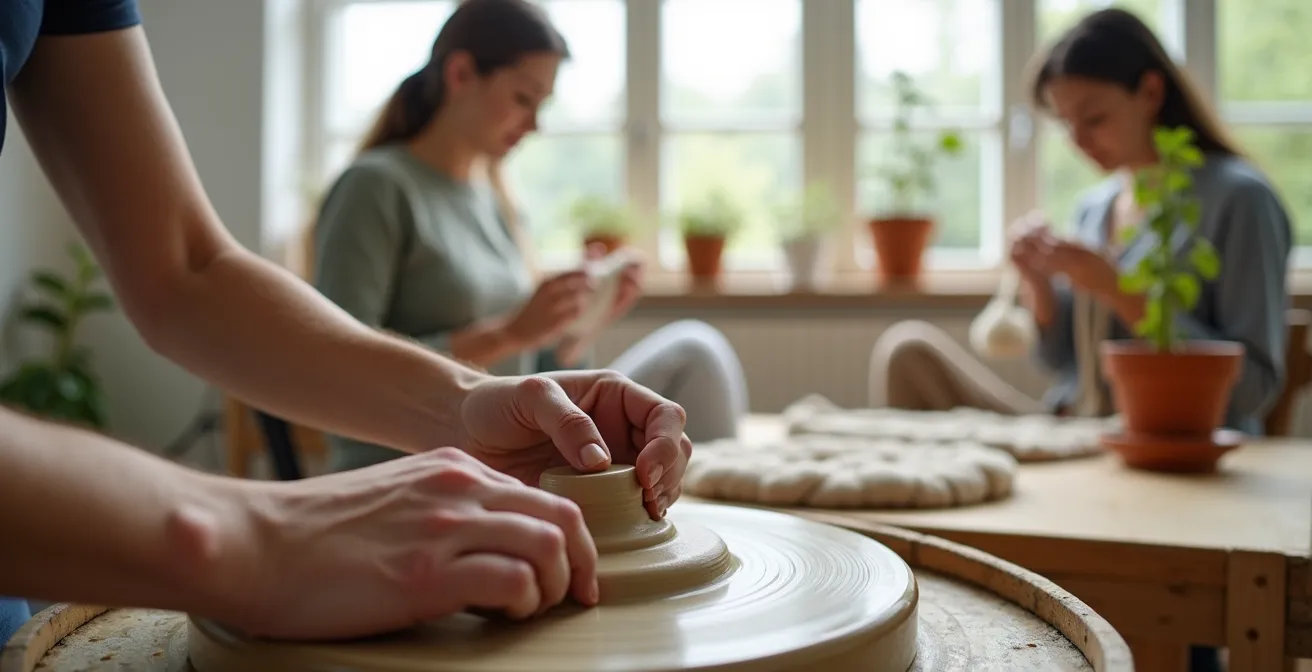
Contrary to popular belief, crafting is not just a quaint hobby; it is a powerful tool for somatic regulation that directly counteracts the effects of digital burnout.
- Repetitive creative motions physiologically calm the nervous system, lowering heart rate and cortisol while boosting serotonin.
- The key is to match the craft’s cognitive load to your specific stress type—not just picking what looks “easy.”
Recommendation: Begin by viewing a simple craft not as a project to be perfected, but as a scheduled, 15-minute practice of mindful, tactile engagement to reset your mental state.
In a world saturated with glowing screens and relentless notifications, the feeling of being perpetually “on” has become a baseline for many professionals. You end your workday with frayed nerves, a buzzing mind, and a deep-seated exhaustion that sleep doesn’t seem to fix. The common advice—to meditate or exercise—can sometimes feel like another task on an already overflowing to-do list. We seek a tangible escape, a way to quiet the noise not by emptying our minds, but by occupying our hands in a meaningful way.
This is where crafting workshops enter, not merely as a quaint pastime, but as a form of active, therapeutic intervention. While many understand intuitively that hobbies are “relaxing,” they often miss the profound physiological mechanisms at play. We’re not just talking about distraction; we’re talking about a neurochemical reset. The true magic lies in the deliberate, rhythmic, and tactile nature of handmade creation, which serves as a direct antidote to the disembodied, fast-paced nature of digital work.
But what if the very act of choosing a craft or the way you practice it could either amplify or negate these benefits? The key isn’t simply to *start* crafting, but to understand *how* to craft for maximum mental relief. This guide moves beyond the surface to explore the science of how handmade hobbies reduce cortisol. We will delve into the specific ways repetitive motions soothe your nervous system, how to choose a workshop that aligns with your personality and patience, and how to create a sustainable practice that serves as a genuine sanctuary from modern stress.
This article provides a comprehensive look into the therapeutic power of crafting. Explore the sections below to understand the science, find the right practice for you, and learn how to integrate this restorative habit into your life.
Summary: Joining Crafting Workshops: How Handmade Hobbies Reduce Cortisol Levels?
- Why Repetitive Motions like Knitting Calms the Nervous System?
- How to Choose a Craft Workshop That Matches Your Patience Level?
- Pottery Wheel vs Painting Class: Which Is Better for Socializing?
- The Posture Mistake That Causes Wrist Pain in Crafters
- When to Move from Kits to Custom Projects: Avoiding the Plateau
- The “Uniform” Trap That Makes Capsule Wardrobes Feel Restrictive
- When to Disconnect: The 2-Hour Window Before Bed That Saves Your Adrenals
- Designing for Residential Wellness: 5 Layout Changes to Improve Sleep and Mental Clarity
Why Repetitive Motions like Knitting Calms the Nervous System?
The soothing effect of activities like knitting, weaving, or molding clay is not just a feeling; it’s a profound neurological and physiological event. When your hands are engaged in a repetitive, rhythmic task, you are initiating a process of somatic regulation. Your brain shifts from the scattered, high-alert state of multitasking to a focused, single-channel mode. This immersion is often referred to as a “flow state,” where you are so absorbed in the activity that the chatter of daily anxieties fades into the background.
This mental shift has a direct physical impact. The repetitive motions send calming signals to the brain, which in turn helps regulate the autonomic nervous system. This process is proven to have a significant effect on your body’s chemistry. Studies demonstrate that knitting can trigger a serotonin boost of up to 27% while reducing cortisol, the primary stress hormone. Serotonin is a key neurotransmitter responsible for mood regulation, happiness, and a sense of well-being. This chemical rebalancing is a core reason why crafting feels so restorative.
The effect is so powerful it has been compared to other well-known mindfulness practices. As a landmark study from Harvard Medical School found:
A 2007 study conducted by Harvard Medical School’s Mind and Body Institute, found that knitting lowers heart rate, by an average of 11 beats per minute, and induces an ‘enhanced state of calm,’ similar to that of yoga.
– Harvard Medical School, Textile Arts Center – Knitting as Therapy
Furthermore, this regular engagement has long-term benefits. A Mayo Clinic study of over a thousand older adults found that those who engaged in crafts like knitting had a diminished chance of developing mild cognitive impairment. By engaging both mind and body in this gentle, focused way, you are not just calming the present moment; you are building cognitive resilience for the future.
How to Choose a Craft Workshop That Matches Your Patience Level?
The path to a relaxing craft experience can be quickly derailed by choosing an activity that clashes with your current mental state. A stressed professional suffering from burnout has different needs than someone with mild anxiety. The key is to match the cognitive load of the craft to your personal needs. Instead of asking “what’s easy?”, ask “what does my brain need right now?”
For individuals experiencing high stress or burnout, a low-cognitive-load craft is ideal. These activities require minimal decision-making and allow for a more immediate entry into a flow state. Think of abstract watercolor, where the focus is on the movement of color on paper, or simple clay hand-building, where the tactile sensation is the primary focus. Conversely, someone with mild anxiety might benefit from a higher-cognitive-load craft, such as detailed jewelry making or embroidery, which requires enough focus to occupy an anxious mind and prevent it from wandering.
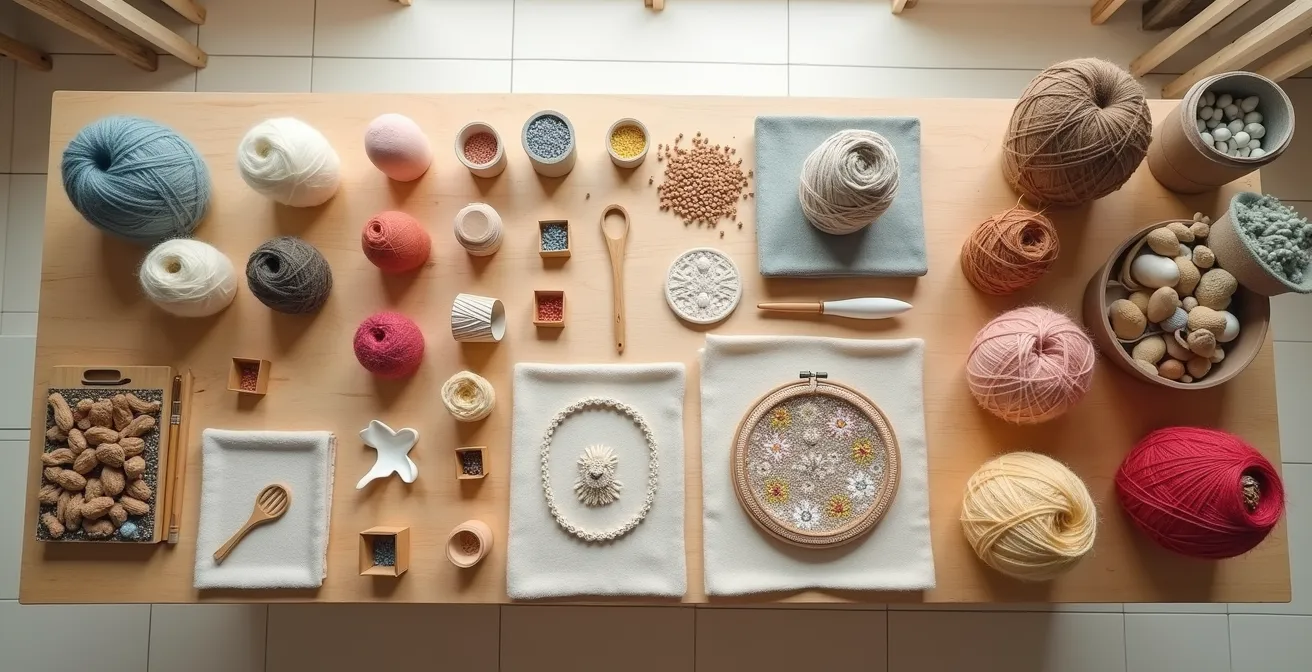
As the variety of materials suggests, the complexity can be tailored. If you’re suffering from decision fatigue after a long week, a structured kit—like a paint-by-numbers set or a pre-packaged knitting project—can provide the creative outlet without the mental effort of starting from scratch. If, however, your stress stems from a lack of autonomy, an unstructured craft like freestyle pottery or intuitive painting can restore a much-needed sense of control and self-expression. Building a sustainable practice often starts with short, manageable sessions of just 15-30 minutes.
Pottery Wheel vs Painting Class: Which Is Better for Socializing?
Crafting workshops are not only a sanctuary for the self but also a fertile ground for connection. However, the social dynamics of different crafts vary significantly. Your choice can determine whether you find quiet companionship or lively conversation. The environment of a pottery studio, for instance, is fundamentally different from that of a painting class. This choice should be guided by the type of social interaction you’re seeking.
Pottery wheel classes often foster what is known as “parallel play”—a concept borrowed from child psychology where individuals are engaged in a similar activity side-by-side, but with minimal direct interaction. The focus required by the wheel and the physical distance between stations create an atmosphere of quiet, shared experience. The connection is non-verbal and tactile, built on the mutual understanding of a shared challenge. This is often ideal for introverts or those who want to feel part of a community without the pressure of constant conversation.
Painting classes, by contrast, are typically set up to encourage active discussion. With easels often arranged in rows or circles, it’s natural to chat with your neighbors, comment on each other’s work, and discuss color choices or techniques. This setup is better suited for extroverts or anyone looking to forge more direct, verbal connections. The visual nature of the craft provides an easy entry point for conversation. As research shows, joining crafting groups can significantly reduce loneliness by fostering supportive environments where individuals share ideas and encouragement.
To help you decide, consider this breakdown of their social dynamics:
| Aspect | Pottery Wheel | Painting Class |
|---|---|---|
| Interaction Style | Parallel play – quiet companionship | Active conversation – side-by-side setup |
| Studio Layout | Scattered communal spaces (wheels, kilns) | Rows encouraging neighbor interaction |
| Social Connection Type | Non-verbal, tactile shared experience | Visual discussion, color/composition talk |
| Long-term Community | Studio memberships, kiln-sharing groups | Art collectives, local exhibitions |
| Best For | Introverts seeking quiet connection | Those wanting direct conversation |
The Posture Mistake That Causes Wrist Pain in Crafters
You’ve found your calming craft, you’re entering a flow state, and you feel the stress melting away. But an hour later, a dull ache in your wrist or a sharp pain in your neck shatters the tranquility. This is a common and critical pitfall: poor ergonomics. The irony is that the physical discomfort from improper posture can actively negate the mental health benefits you’re seeking. When your body is in pain, it creates a stress response of its own.
This isn’t just a minor annoyance; it’s a biochemical issue. Chronic physical stress from poor posture can trigger elevated cortisol levels, creating a vicious feedback loop. The very hormone you’re trying to reduce through crafting can be inadvertently increased by *how* you craft. The most common mistake is a bent or flexed wrist, especially prevalent in activities like knitting, crocheting, and drawing. Holding this position for extended periods strains the tendons and can lead to conditions like carpal tunnel syndrome.
Another frequent issue is hunching over your work, which creates tension in the neck and shoulders. This not only causes pain but also restricts breathing, preventing the deep, diaphragmatic breaths that promote relaxation. To protect both your body and your mental peace, integrating simple ergonomic routines into your crafting sessions is non-negotiable. These small adjustments ensure that your hobby remains a source of relief, not another source of physical strain.
Your Ergonomic Crafting Checklist
- Regular Body Scans: Every 15 minutes, perform a 30-second body scan to check and correct your posture—ensure your back is supported, shoulders are relaxed, and feet are flat on the floor.
- Craft-Specific Stretches: Before and after sessions, perform targeted stretches. For potters, this means 2-minute finger and wrist flexor stretches; for knitters, neck and shoulder rolls every 15 minutes.
- Eye Care for Detail Work: If you’re painting or doing embroidery, practice eye-palming exercises (gently covering your closed eyes with your palms) to reduce strain from focusing on details.
- Tool Selection Audit: Assess your tools. Are they right for your body? Choose knitting needles with an appropriate diameter and paintbrushes with a weight that doesn’t strain your hand.
- Create an Ergonomic Station: Ensure your chair provides good lumbar support, your workspace is at a comfortable height, and you have adequate lighting to avoid leaning in and straining your eyes or neck.
When to Move from Kits to Custom Projects: Avoiding the Plateau
Starting with a kit is a fantastic way to dip your toes into a new craft. It removes the intimidation of choosing materials and provides a clear, guided path to a finished object. This structured approach is comforting and provides an immediate sense of accomplishment. However, there comes a point where the comfort of the kit can become a creative plateau. The initial thrill wanes, and the activity may start to feel more like assembly than creation. Recognizing this moment is key to keeping your practice engaging and therapeutically effective.
Moving from kits to custom projects is about reclaiming creative agency. Neurologically, this step is vital. According to Dr. Kelly Lambert, a neuroscientist who has studied the effects of handiwork on the brain, the act of creating with one’s hands—planning, problem-solving, and executing—triggers the brain’s reward system, powerfully counteracting feelings of helplessness. When you design your own project, you are engaging a much wider range of cognitive functions, which is deeply satisfying.
This progression doesn’t have to be a daunting leap. It can be a series of small, incremental steps. If you’ve been knitting scarves from kits, your next step could be choosing your own yarn and pattern. If you’ve been doing paint-by-numbers, try recreating a simple photograph on a blank canvas. This intentional increase in challenge is not a source of stress, but a source of stimulation and growth. In fact, research on therapeutic crafting found that such challenges lead to greater satisfaction and mental engagement. Participants in the study deliberately chose projects with a level of difficulty that matched their emotional needs, using the problem-solving aspect as a form of needed mental stimulation.
The “Uniform” Trap That Makes Capsule Wardrobes Feel Restrictive
In our quest for efficiency and minimalism, many of us adopt “uniforms” in various aspects of life, from capsule wardrobes to standardized daily routines. While intended to reduce decision fatigue, this hyper-optimization can sometimes lead to a “uniform trap”—a state of monotony that stifles personal expression and creativity. Life becomes a seamless, efficient, but ultimately colorless experience. The antidote to this trap often lies in reintroducing small, deliberate acts of unique creation.
This is where handmade items become more than just accessories; they become acts of personal rebellion against standardization. Adding a single handmade piece to a capsule wardrobe can completely transform it, breaking the monotony and injecting your unique personality. A hand-knitted scarf in a vibrant color, a piece of custom-made jewelry, or even hand-embroidered details on a basic t-shirt serve as a powerful statement of individuality. It’s a way to restore creative agency in a part of your life that may have become overly restrictive.
This principle extends beyond clothing. If your daily routine has become a rigid “uniform,” introducing a small, creative, handmade ritual can break the cycle. The process of choosing a project that complements your existing life—whether it’s a colorful accessory for a neutral wardrobe or a unique ceramic mug for your morning coffee ritual—is an act of mindful personalization. These handmade additions offer variety without creating clutter, allowing you to reap the benefits of a streamlined life while still feeding your soul’s need for beauty and expression.
When to Disconnect: The 2-Hour Window Before Bed That Saves Your Adrenals
The boundary between work and rest has become increasingly blurred, with many of us scrolling through emails or social media right up until we turn off the lights. This constant digital stimulation keeps our adrenal system on high alert, disrupting the body’s natural wind-down process and sabotaging our sleep. There is a critical 2-hour window before bed that, if protected, can significantly improve sleep quality and overall mental clarity. This is the ideal time to engage in a calming, screen-free activity like crafting.
Your body is designed to follow a natural rhythm where cortisol, the stress hormone, peaks in the morning to wake you up and gradually tapers off throughout the day. However, late-night screen time, with its blue light and stimulating content, can artificially keep cortisol levels elevated. Research confirms that cortisol levels are designed to decline by evening to allow for rest, and engaging in a calming activity helps facilitate this natural process. Crafting provides the perfect “off-ramp” for a busy mind.
The key is to choose an evening craft that is genuinely relaxing, not frustrating. This is not the time to tackle a complex new pattern or a project with a tight deadline. The goal is gentle, repetitive motion that doesn’t require intense concentration. An ideal “evening wind-down craft menu” might include:
- Simple knitting or crochet patterns with familiar, repetitive stitches.
- Adult coloring books featuring calming, geometric, or nature-based designs.
- Hand-sewing small, simple projects like sachets or mending.
- Setting up your crafting space with warm, comfortable lighting that won’t strain your eyes.
By swapping your phone for a pair of knitting needles or a sketchbook during this crucial pre-sleep window, you send a powerful signal to your brain and body that the day is done and it’s time to rest.
Key Takeaways
- Crafting is a physiological tool: Repetitive motions actively lower heart rate and cortisol while boosting mood-regulating serotonin.
- Match the craft to your stress: Use low-cognitive-load crafts (e.g., abstract painting) for burnout and higher-load crafts (e.g., jewelry making) for anxiety.
- Ergonomics are crucial: Poor posture can create physical pain that triggers a cortisol spike, negating the stress-reducing benefits of your hobby.
Designing for Residential Wellness: 5 Layout Changes to Improve Sleep and Mental Clarity
True wellness is not just about the activities we do; it’s also about the environments we inhabit. Your home can either be a source of underlying stress or a sanctuary that actively promotes mental clarity. By making a few intentional layout changes, you can transform your living space into an environment that supports your crafting practice and your overall well-being. The most impactful of these changes is the creation of a dedicated “analog corner.”
As noted by Environmental Psychology Research, creating a dedicated space signals to the brain that it’s time to disconnect from digital stress and engage in mindful creation. This doesn’t require a separate room. It can be a comfortable armchair in a quiet corner of your living room, with a good lamp and a basket for your supplies. The key is that this space is reserved for screen-free, tactile activities. When you sit in that chair, your brain learns to associate it with relaxation and flow, making it easier to slip into a meditative state.
Beyond this cornerstone, other layout adjustments can amplify the benefits. Consider organizing your craft supplies in a way that is visually calming and accessible, using natural material baskets or closed cabinets to reduce clutter. Position your crafting nook near a source of natural light to boost your mood during the day. Ensure the seating is ergonomic and supportive to prevent physical strain. Finally, declutter the immediate area around your analog corner to minimize distractions and create a peaceful visual field. These small changes collectively create a powerful message to your nervous system: this is a place of rest, creativity, and restoration.
Now that you understand the profound connection between your hands, your brain, and your well-being, the next step is to put this knowledge into practice. It begins not with a grand project, but with a small, intentional choice to reclaim a few moments for tactile, mindful creation.