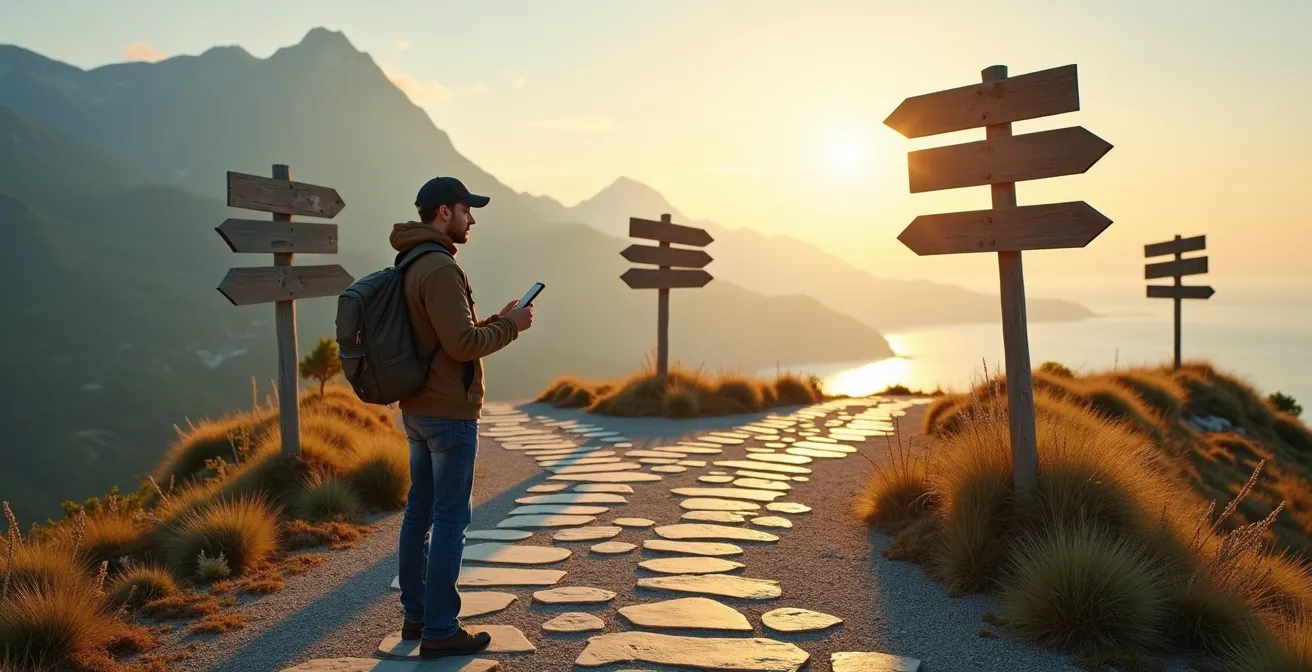
The secret to a fulfilling trip isn’t finding the right destination, but architecting an experience that aligns with your innate personality.
- Generic “Top 10” itineraries often lead to burnout by ignoring individual needs for stimulation and rest.
- A successful trip treats your personal energy as the most valuable resource, balancing high-stimuli activities with strategic downtime.
Recommendation: Shift from a ‘checklist’ mindset to a ‘narrative’ approach, building your itinerary around a theme or story that resonates with you personally.
The promise of travel is one of discovery and rejuvenation, yet the reality for many discerning travelers is a subtle sense of disappointment. You follow the guides, tick off the landmarks, and yet the experience feels hollow—a frantic race against a checklist rather than a genuine connection with a place. You may have even taken a “travel personality” quiz, only to be given a simplistic label—The Adventurer, The Relaxer, The Connoisseur—that fails to capture the nuances of what truly recharges you.
These conventional approaches fail because they focus on destinations, not on the traveler’s internal landscape. They overlook the most critical factor in travel satisfaction: personal energy management. The frustration doesn’t come from choosing the wrong city, but from an itinerary that creates a constant deficit in your energetic bank account, leaving you more drained than inspired. What if the key to bespoke travel wasn’t about matching a personality type to a country, but about becoming the architect of your own experience?
This guide moves beyond simplistic labels. It provides a framework for deconstructing your personal needs for stimulation, structure, and connection. We will explore how to design an itinerary that actively manages your sensory threshold, transforms a trip from a bootcamp into a narrative, and leverages modern tools to unlock truly exclusive experiences. It’s time to stop fitting into a pre-packaged vacation and start designing a journey that is an authentic extension of you.
In this detailed guide, we will walk you through the essential strategies for crafting a truly personalized journey. The following sections offer a comprehensive look at how to align your travel plans with your core personality, ensuring every trip is a source of fulfillment, not stress.
Summary: Architecting Your Perfect Trip: A Personality-Driven Guide
- Why an Adventure Trip Might Stress Out an Introvert?
- How to Build a “Coffee Lover’s Route” Through Italy?
- Travel Designer vs DIY Booking: Is the Commission Fee Worth the Access?
- The “Fear of Missing Out” Mistake That Turns Vacations into Bootcamps
- How to Use Social Media to Find Local Guides Before You Arrive?
- Why Hiring a Local Guide Is Worth 10x More Than an Audio Guide?
- Why Your Renovation Budget Will Likely Overshoot by 20%?
- Choosing Your Dream Destination: How to Spot Underrated Locations That Offer 5-Star Experiences for Less?
Why an Adventure Trip Might Stress Out an Introvert?
The common misconception is that introverts dislike adventure. This is fundamentally untrue. The issue is not the activity itself—be it hiking a volcano or exploring a bustling market—but the relentless demand on their sensory and social energy. For an introvert, personal energy is a finite resource that depletes with high stimulation. A trip packed with back-to-back group tours, noisy hostels, and constant social interaction, no matter how “exciting,” can lead to a sensory overload, turning a dream vacation into a stressful ordeal.
The key is not to avoid adventure, but to architect an itinerary that honors one’s sensory threshold. This means strategically building in moments of quiet sanctuary to recharge. The goal is to balance the thrill of discovery with the deep need for solitude and reflection. Instead of a packed 10-day tour, a longer stay in a single location allows for deeper immersion without the pressure of constant movement. It’s about choosing experiences that energize rather than drain.

As the image suggests, the quality of your downtime is as important as the quality of your activities. A quiet corner, a good book, or simply a window with a view can be the most vital part of an introvert’s travel day. Effective travel planning for this personality type involves scheduling this “non-activity” with the same intention as booking a museum ticket. Here are a few practical strategies:
- Practice Slow Travel: Opt for longer stays in one or two cities rather than a whirlwind tour of many. This allows you to adopt a local rhythm and explore without a frantic pace.
- Choose Quiet Accommodations: When booking, search within reviews for terms like “quiet” or “peaceful.” A private apartment or a boutique hotel away from the main tourist drag is often a better investment than a centrally located but noisy hostel.
- Schedule Strategic Downtime: Consciously block out periods for rest. This could mean returning to your hotel in the afternoon to read or enjoying an early dinner to avoid the evening crowds and noise.
How to Build a “Coffee Lover’s Route” Through Italy?
For the discerning traveler, a trip should be more than a collection of sights; it should tell a story. This is the fundamental difference between a ‘checklist’ itinerary and a ‘narrative’ one. A checklist approach to a coffee tour of Italy would involve a disconnected list of the “Top 10 Cafes.” A narrative approach, however, crafts a journey that explores the cultural story of coffee itself, transforming the trip into a meaningful quest. This is the essence of experience architecture.
Building a narrative route requires a shift in planning. Instead of asking “What are the most famous places?”, you ask “What story do I want to experience?”. For an Italian coffee route, the story could be the evolution of espresso culture. You might start in Naples, the birthplace of the quick, stand-up espresso ritual, and travel north to Trieste, a city with a deep-seated, leisurely coffeehouse tradition inherited from the Austro-Hungarian Empire. The journey becomes a study in regional identity, told through the medium of coffee.
This method, as detailed in an analysis of Type-A travel planning, involves mapping points of interest by theme and proximity, creating a logical and efficient flow. The tools for this are more sophisticated than a generic guidebook, involving layers on Google My Maps, following local experts on Substack, and deep-diving into niche Instagram hashtags.
| Approach | Route Method | Checklist Method |
|---|---|---|
| Focus | Narrative journey with cultural story | Disconnected list of hotspots |
| Planning Tools | Google My Maps layers, Instagram hashtags, Substack experts | TripAdvisor ratings, generic guides |
| Experience | Understanding the ‘why’ behind traditions | Visiting famous locations |
| Example | Espresso culture: Naples (quick ritual) vs Trieste (leisurely affair) | Top 10 cafes to visit in Italy |
Travel Designer vs DIY Booking: Is the Commission Fee Worth the Access?
The decision to hire a travel designer versus planning a trip yourself is a deeply personal one, hinging on your personality, the complexity of the trip, and what you value most: control or access. For some, the research and booking process is a joyful part of the experience. For others, it’s a logistical nightmare that stands in the way of the vacation itself. The commission fee is not just for booking flights and hotels; it’s payment for expertise, curated access, and peace of mind.
A travel designer’s true value lies in their network and knowledge. They can secure reservations at a sought-after restaurant, arrange a private tour with a renowned historian, or suggest a boutique hotel that isn’t on major booking sites. This is ‘access’ versus ‘information.’ While you can find information about any destination online, a designer provides curated access to experiences that elevate a trip from standard to extraordinary. This is particularly crucial for complex, multi-destination itineraries or for group travel where mediating different desires and needs is a job in itself.
However, for those who relish the details and have a clear vision, a DIY approach offers ultimate control and can be immensely satisfying. The key is to be honest about your own strengths and weaknesses as a planner. The right choice depends entirely on your “planner personality.” Answering these questions can help you determine the level of support you truly need.
Your Travel Support Audit: Which Planner Are You?
- The Architect: Do you genuinely enjoy spending hours researching flights, reading hotel reviews, and building complex spreadsheets? If detail-oriented research is your passion, you are likely to thrive with a DIY approach.
- The Visionary: Do you have a grand vision for your trip (e.g., “a culinary tour of Peru”) but despise handling the logistics of booking transfers and timing reservations? You are a perfect client for a travel designer who can execute your vision.
- The Diplomat: Are you planning a trip for a group with diverse interests, budgets, and energy levels? A designer can act as a neutral third party, creating a balanced itinerary that satisfies everyone and prevents planning friction.
- The Hybrid Planner: Is your trip a mix of simple and complex elements? Consider handling the straightforward parts (e.g., booking a hotel in a city you know well) and hiring a designer for the more challenging logistics, like arranging a multi-day safari or navigating cross-country train travel.
The “Fear of Missing Out” Mistake That Turns Vacations into Bootcamps
One of the greatest paradoxes of modern travel is the “Fear of Missing Out” (FOMO). Fueled by perfectly curated social media feeds, we feel an immense pressure to see and do everything. This anxiety can transform a much-needed vacation into a grueling bootcamp, with dawn-to-dusk schedules that leave no room for spontaneity or rest. This approach is the antithesis of personalized travel; it prioritizes an external checklist over your internal state, often leading to exhaustion and a feeling that you’ve “seen” everything but experienced nothing.
This tendency is often linked to personality. As the experts at 16Personalities note, certain traits predispose us to over-planning. According to their research on travel personality types, “Judging types are likely to plan every little detail, while Prospecting travelers tend to be more comfortable going with the flow.” Recognizing this tendency in yourself is the first step toward consciously countering it. The antidote to FOMO is JOMO: the “Joy of Missing Out.” This is the deliberate choice to embrace a slower pace, leaving space in your itinerary for serendipity and rest.
Case Study: The JOMO Itinerary in New York City
A traveler prone to sensory overload wanted to experience New York without the burnout. Instead of a packed schedule, they adopted a JOMO strategy. They visited museums during off-peak weekday hours, explored less-touristy neighborhoods like Carroll Gardens in Brooklyn, and dedicated entire afternoons to simply reading in Central Park. As a case study on managing travel stimulation highlights, by building significant downtime into their schedule, they were able to enjoy the city’s energy in manageable doses, returning home feeling refreshed, not overwhelmed.
Embracing JOMO means accepting that you cannot see everything, and that’s okay. The most memorable travel moments often arise from unplanned discoveries—a hidden courtyard, a conversation with a local shopkeeper, an afternoon spent lingering in a café. It requires trusting that the best experience is not the one you could be having elsewhere, but the one you are fully present for right now.
How to Use Social Media to Find Local Guides Before You Arrive?
In the age of bespoke travel, the ultimate luxury is not a five-star hotel, but access to authentic, localized knowledge. Social media, when used with discernment, is a powerful tool for bypassing tourist traps and connecting directly with the individuals who are the lifeblood of a city’s culture: its local guides. This is about digital prospecting—using platforms like Instagram not for inspiration, but for investigation.
The process starts with moving beyond generic hashtags. Instead of searching #Paris, search for hyper-specific tags related to your interests, like #LeMaraisPatisserie or #ParisianArtisan. Analyze not just the “top posts,” but the “recent posts” to get a feel for the current pulse of the city. Pay close attention to who local businesses, such as niche bookstores or third-wave coffee shops, are tagging in their photos. They often collaborate with high-quality local guides and creators who share their ethos.

Once you’ve identified potential guides, vetting them is crucial. A professional guide will have a responsive, professional presence. Look at photos they’re tagged in by actual clients, not just their own polished content. Do they engage thoughtfully in their DMs? A well-crafted initial message explaining your interests can quickly separate the professionals from the hobbyists. For an even deeper level of curation, expand your search beyond Instagram, as advanced travel research methods suggest exploring platforms like Substack, where many experts now share their niche knowledge through newsletters.
- Search by Location and Niche: Use specific location tags and review who local tourism boards or niche businesses are tagging and collaborating with.
- Analyze Tagged Photos: Look for photos posted by real clients. This provides a more authentic view of the experience than the guide’s own curated feed.
- Utilize Platform Features: Use Instagram’s “Guides” feature for curated lists created by locals and explore Airbnb Experiences for highly-rated, specialized guides.
- Vet Professionalism: A prompt, professional, and personalized response to a direct message is a strong signal of a quality guide.
- Expand Your Search: Look beyond mainstream platforms to Substack newsletters and specialized travel forums to find guides with deep, niche expertise.
Why Hiring a Local Guide Is Worth 10x More Than an Audio Guide?
In our tech-saturated world, it’s easy to assume an app or an audio guide can replace a human. They can provide facts, dates, and a pre-determined route. What they cannot provide, however, is context, connection, or serendipity. An audio guide offers information; a local guide offers interpretation. This distinction is what separates a sterile learning experience from a living, breathing cultural immersion.
A great local guide is a storyteller, weaving historical facts into a personal narrative. They can pivot in real-time based on your questions and interests, taking you down a side street to show you a hidden detail not mentioned in any guidebook. They are a gateway to a city’s trusted network, able to recommend a family-run trattoria or secure entry to an artist’s private studio. This is the ‘serendipity factor’—the magic of unplanned moments that become the most cherished memories of a trip.
The value of a local guide is not in what they know, but in who they are: a living connection to the daily rhythm and pulse of a place. They provide the ‘why’ behind the ‘what,’ turning a monument from a block of stone into a symbol of a nation’s identity. The following comparison breaks down the immense difference in value.
| Aspect | Local Guide | Audio Guide |
|---|---|---|
| Content Type | Dynamic context and personal stories | Static facts and dates |
| Flexibility | Real-time pivoting based on interests | Fixed track experience |
| Network Access | Portal to city’s trusted network and insider recommendations | Isolated experience with headphones |
| Serendipity Factor | Can spontaneously show hidden spots not on tours | Limited to predetermined route |
| Cultural Connection | Living connection to daily life rhythm | Historical information only |
Why Your Renovation Budget Will Likely Overshoot by 20%?
The title of this section may seem out of place in a travel guide. Yet, the principle of financial planning for home renovations holds a profound lesson for travelers: the critical importance of a contingency fund. In construction, a 20% buffer is standard practice to cover unforeseen problems. In travel, your resources are not just financial; they include your time and energy. Planning a trip to 100% capacity is the equivalent of renovating with no financial buffer—it’s a recipe for stress when the unexpected inevitably occurs.
Applying a “20% rule” to your travel planning, tailored to your personality, is a strategic way to build resilience into your itinerary. It’s about creating a buffer that allows for both pleasant surprises and unfortunate mishaps. For a spontaneous personality, this might be a financial buffer for an unplanned hot air balloon ride. For a more anxious traveler, it could be a time buffer, with an extra hour between flight connections to eliminate the stress of rushing.
This strategic allocation of resources transforms your itinerary from a rigid script into a flexible framework. It gives you the freedom to say “yes” to a spontaneous invitation or “no” to a planned activity when you’re feeling drained, without derailing your entire trip. The 20% is not wasted space; it is the space where travel magic happens. Here’s how different personalities can apply this rule:
- Spontaneous/Adventurous Types: Allocate a 20% financial contingency specifically for unplanned activities, discoveries, and side-trips. This gives you the freedom to follow your curiosity without budget guilt.
- Cautious/Anxious Types: Build in a 20% time contingency. Leave ample time between connections, don’t book back-to-back tours, and give yourself a buffer to navigate new places without feeling rushed.
- Comfort-Oriented Types: Reserve a 20% budget buffer explicitly for comfort upgrades. This could be for a taxi instead of public transport on a tiring day, or a last-minute hotel upgrade if your initial booking is disappointing.
- All Types: Apply the 80/20 rule to your schedule. In a 10-day trip, only plan 8 days of activities. Leave two full days completely unscheduled for rest, spontaneity, or revisiting a favorite spot.
Key Takeaways
- Architect your trip around ‘energy management’, balancing high-stimulation activities with strategic downtime to avoid burnout.
- Adopt a ‘narrative’ approach over a ‘checklist’, building your itinerary around a theme or story that provides a deeper cultural connection.
- Integrate a 20% contingency buffer for your time, budget, and energy, tailored to your personality, to allow for spontaneity and reduce stress.
Choosing Your Dream Destination: How to Spot Underrated Locations That Offer 5-Star Experiences for Less?
The final piece of the bespoke travel puzzle is choosing a destination that aligns with your newfound architectural approach. For the discerning traveler, this often means looking beyond the over-touristed capitals. The goal is to find underrated locations that offer what can be defined as true ‘5-star experiences’—not necessarily based on Michelin stars, but on authenticity, quality, and lack of crowds. This requires a redefinition of luxury.
Experiential luxury is not about brand names; it’s about unparalleled access and genuine connection. A 5-star experience might be a meal at a family-run tavern where the owner shares stories with you, a private workshop with a local artisan, or having a pristine beach almost entirely to yourself. These experiences are often found in “second cities” (like Lyon instead of Paris, or Porto instead of Lisbon), which frequently offer 90% of the cultural richness at 50% of the cost and with a fraction of the crowds.

Finding these hidden gems requires a digital prospecting toolkit that goes beyond standard travel sites. It involves using flight aggregators creatively, following journalists known for unearthing authentic spots, and filtering travel awards for emerging destinations rather than established ones. According to travel experts at guides like The Planet D, the most rewarding finds come from shifting your search criteria from “popular” to “interesting.”
- Use Google Flights’ ‘Explore’ Map: Leave the destination field blank and set your dates and budget to see a map of affordable flight options you may not have considered.
- Filter for ‘Emerging’ Destinations: When looking at awards on sites like TripAdvisor, specifically filter for categories like “Emerging” or “Food” to spot places that are on the cusp of popularity but not yet overrun.
- Follow Niche Travel Journalists: Identify and follow writers and creators who specialize in off-the-beaten-path travel, rather than mainstream influencers who focus on popular hotspots.
- Embrace the Second-City Strategy: Actively research the second or third largest cities in a country, which often serve as cultural and culinary hubs without the overwhelming tourist infrastructure of the capital.
By shifting your mindset from a passive consumer to an active architect, you can design a travel experience that is not only memorable but truly restorative. The next logical step is to begin sketching out your own narrative itinerary, applying these principles to create a journey that is a perfect reflection of you.