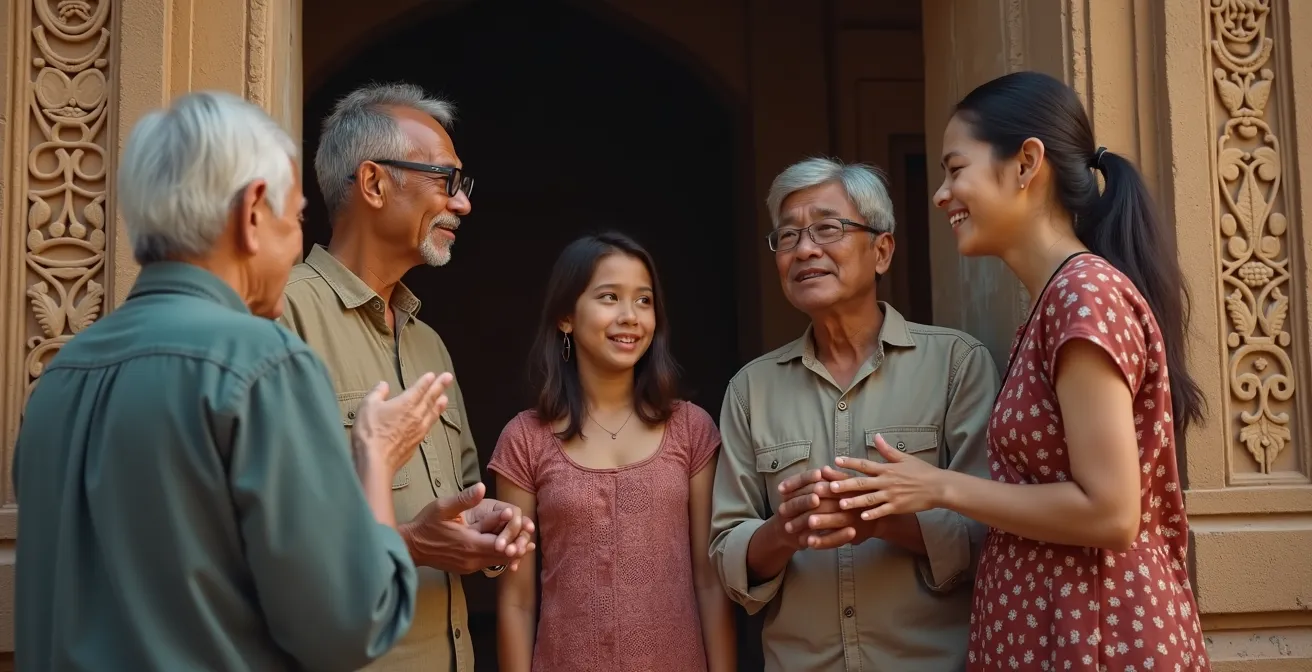
The success of a family cultural trip isn’t the destination, but the strategy; it’s about transforming passive sightseeing into an active, shared story.
- Frame historical sites within a narrative using books, movies, and local guides to build context before and during your trip.
- Turn museums from quiet halls into playgrounds for the mind with active discovery tools like scavenger hunts.
- Intentionally balance iconic landmarks with local experiences and scheduled downtime to prevent “culture burnout.”
Recommendation: Shift your planning focus from “what to see” to “how to experience,” and you’ll unlock a deeper, more memorable journey for everyone.
You’ve envisioned it: your family, standing in awe before a historic monument, soaking in centuries of culture. But the reality can often sound more like, “Are we done yet?” or the silent glow of a screen in the back of a tour bus. Many parents, eager to move beyond generic theme parks, invest time and money into cultural travel, only to find the experience falls flat, becoming a checklist of sights rather than a collection of meaningful memories. We’re often told the solution is to “visit museums” or “involve the kids,” but these tips rarely address the core challenge: how do you make history, art, and heritage genuinely engaging for different ages?
The common approach is to focus on the *what*—the famous cathedral, the world-renowned museum. This strategy treats culture as a series of items to be consumed. But what if the secret to an unforgettable educational trip wasn’t about the prestige of the landmark, but about the narrative you build around it? What if the key was not just seeing the art, but actively searching for its secrets? This guide is built on that very principle: the most impactful cultural travel comes from intentional framing and active discovery, not passive observation.
This article will provide a practical framework to help you plan a trip that educates and inspires. We will explore concrete strategies for turning historical sites into interactive adventures, finding the right balance between iconic destinations and hidden gems, and tailoring the experience to your family’s unique personality. It’s time to stop just visiting places and start creating stories together.
In this guide, you will find a complete roadmap for planning your next family cultural adventure. The following sections break down everything from hiring the right guide to keeping the experience exciting from the first day to the last.
Summary: A Strategic Guide to Crafting an Educational Family Journey
- Why Hiring a Local Guide Is Worth 10x More Than an Audio Guide?
- How to Create a Scavenger Hunt That Makes Museums Fun for Kids?
- UNESCO Site vs Hidden Gem: Which Offers a More Authentic Historical Experience?
- The “Museum Burnout” Mistake That Ruins the Last Days of Your Trip
- How to Use Movies and Books to Prep Your Kids for a Historical Destination?
- How to Book Housing for Oktoberfest 12 Months in Advance?
- Why You Clap at Shrines but Bow at Temples?
- Finding the Bespoke Itinerary to Suit Wanderlust: How to Plan a Trip That Matches Your Personality Type?
Why Hiring a Local Guide Is Worth 10x More Than an Audio Guide?
An audio guide can recite facts, but a local guide can tell a story. This is the fundamental difference that transforms a walk through ruins into a journey through time. While audio tours offer a standardized, one-size-fits-all script, a skilled local guide acts as a cultural translator, adapting their narrative to your family’s interests and questions. They can pivot from a dry historical account to a captivating local legend about the very stones you’re standing on, making the experience personal and dynamic. This human connection is something no recording can replicate, and it’s what children remember long after the dates and names have faded.
The value of this connection is not just anecdotal; recent data confirms that travelers crave this authenticity. In fact, a study shows that 74% of travelers prefer getting recommendations from locals, highlighting a deep-seated desire for genuine interaction over pre-packaged information. A great guide doesn’t just show you the sights; they introduce you to their home. They can point you to the best family-friendly trattoria that isn’t in any guidebook or explain a local custom you’ve just witnessed. They provide the unscripted moments and contextual understanding that turn a good trip into a great one.
However, not all guides are created equal, especially when children are involved. The key is finding someone who is not just a historian but also a gifted storyteller and educator. Before booking, you should vet them specifically for their ability to engage a younger audience. A guide who can explain a complex political event through a simple analogy or who knows which details will capture a child’s imagination is an invaluable asset to your cultural journey.
Your Action Plan: Key Questions to Ask Before Hiring a Family Guide
- Engagement Style: “Can you give me an example of how you would explain this historical concept to a 10-year-old?”
- Local Flavor: “What’s one local legend about this place that kids particularly love?”
- Adaptability: “How do you adapt your tour when children ask unexpected questions?”
- Practicality: “Can you recommend family-friendly local restaurants or hidden spots we can visit after the tour?”
- Experience: “Do you have experience with multi-generational groups with varying interests and mobility?”
Ultimately, investing in the right local guide is an investment in the narrative of your trip. It elevates the experience from a passive history lesson to an interactive dialogue with the past.
How to Create a Scavenger Hunt That Makes Museums Fun for Kids?
The traditional museum experience can feel like a test of endurance for children: walk slowly, speak softly, and don’t touch anything. A scavenger hunt flips this script entirely. It provides a mission, transforming children from passive observers into active detectives on a quest. Instead of aimlessly wandering through galleries, they are now searching for specific details: a griffin on a shield, a ship in a painting with three masts, or the signature of a particular artist. This simple shift in perspective gives them a purpose and a sense of ownership over the experience.
The beauty of a scavenger hunt is its adaptability. For younger children, it can be a simple visual checklist of objects to find. For older kids, it can involve more complex tasks like answering a riddle based on an exhibit’s description or sketching a particular artifact. This strategy of “gamifying” the museum visit is a powerful tool for engagement. Institutions like the Smithsonian have seen great success with this approach; their family programs often use interactive elements to draw children in, with reports showing families spend significantly more time engaged with exhibits when using such structured discovery activities.
This paragraph introduces the concept of active discovery through a scavenger hunt. To truly bring this idea to life, it is helpful to visualize the focused engagement it creates. The illustration below captures this moment of intense curiosity.

As this image demonstrates, the goal is to foster moments of close, focused observation. A well-designed scavenger hunt encourages children to look beyond the obvious and notice the intricate details they would otherwise miss. It’s not about rushing through the museum to check off items; it’s about using the list as a key to unlock deeper engagement with the art and history on display. Preparing this simple tool before your visit can be the single most effective way to ensure a positive and educational museum day for the entire family.
By giving your children a mission, you’re not just making the museum fun; you’re teaching them how to look at art, how to find stories in objects, and how to be curious explorers in any environment.
UNESCO Site vs Hidden Gem: Which Offers a More Authentic Historical Experience?
The debate between visiting a world-famous UNESCO World Heritage Site and seeking out a lesser-known “hidden gem” is central to modern cultural travel. On one hand, iconic sites like the Colosseum or Machu Picchu offer a powerful sense of connection to a grand historical narrative. They are backed by extensive educational resources, family-friendly infrastructure, and a universal recognition that can be exciting for children. The downside, of course, is the potential for overwhelming crowds and a “tourist bubble” feeling that can dilute the sense of discovery.
On the other hand, hidden gems—smaller, local heritage sites or “second cities”—offer a different kind of authenticity. They provide a window into everyday life and a more intimate connection with local culture. Here, you’re less likely to be jostled by tour groups and more likely to have a quiet moment of reflection or a spontaneous interaction with a local. However, these sites may lack multilingual support, detailed guidebooks, or the accessibility features families sometimes need. The choice isn’t about which is “better,” but which aligns with your family’s goals for a particular trip. As travel expert Rick Steves notes on the appeal of alternative destinations:
Second cities are ‘undiscovered corners and untrampled towns that have, for various reasons, missed the modern parade.’
– Rick Steves, Travel expert commentary on alternative destinations
Deciding between these two options depends on your travel style and where you are in your cultural journey. For a first visit to a country, a well-managed UNESCO site can provide an essential, comprehensive overview. For return visitors or families seeking deeper immersion, a hidden gem might offer a more rewarding and personal experience. A truly great itinerary often includes a mix of both, balancing the epic scale of a world-famous landmark with the quiet charm of a local secret. The following table breaks down the trade-offs to help you make an informed choice.
| Aspect | UNESCO Sites | Hidden Gems |
|---|---|---|
| Educational Resources | Extensive guides, multilingual support | Limited formal resources |
| Infrastructure | Family-friendly facilities | Variable accessibility |
| Crowds | Peak season congestion | Peaceful exploration |
| Cultural Context | Grand historical narrative | Local everyday life connection |
| Best For | First-time visitors, comprehensive overview | Return visitors, deeper immersion |
Ultimately, an “authentic” experience is subjective. It can be found in the shared awe of a globally recognized wonder or in the quiet discovery of a place you feel is yours alone.
The “Museum Burnout” Mistake That Ruins the Last Days of Your Trip
It’s a classic travel mistake: you’ve packed your itinerary with back-to-back cultural activities, determined to see everything. The first few days are exhilarating, but by the end of the trip, everyone is exhausted, irritable, and another magnificent cathedral just feels like a chore. This is “museum burnout” or “culture fatigue,” and it’s the fastest way to undermine an otherwise wonderful educational vacation. The root of the problem is treating a trip like a sprint instead of a marathon. The goal isn’t to see the most things, but to meaningfully experience the things you see.
Preventing this burnout requires a conscious strategy of experience pacing. One of the most effective rules is to maintain a rough 50/50 balance each day between structured educational activities and pure, unstructured fun. This could mean following a morning museum visit with an afternoon spent at a local playground, swimming pool, or simply relaxing at a cafe with gelato. This downtime isn’t wasted time; it’s essential processing time. It allows your family, especially children, to absorb what they’ve learned and recharge their mental batteries for the next adventure.
Another powerful technique is to end on a high note. Instead of dragging tired kids through one last gallery, make a point to leave an activity while everyone is still engaged and enjoying it. When someone says, “That was so cool!”—that’s your cue to exit. This leaves them with a positive final impression, eager for the next cultural outing, rather than a lingering memory of being bored and tired. Incorporating “Zero-Culture Days”—full days with no educational agenda at all—can also be a lifesaver on longer trips, providing a much-needed reset for the whole family.
- Mix educational activities with pure fun, maintaining a 50/50 balance each day.
- Leave on a high note; exit an activity when someone says, “That was cool!” to create a positive memory.
- Schedule “Zero-Culture Days” with no educational agenda to allow for a full reset.
- Build in significant downtime between major cultural sites for rest and processing.
- Rotate the “Chief of Fun Facts” role among family members to keep everyone involved and break monotony.
By strategically pacing your itinerary, you protect your family’s energy and curiosity, ensuring that the last day of your trip is just as joyful and enriching as the first.
How to Use Movies and Books to Prep Your Kids for a Historical Destination?
The best cultural trips begin long before you pack your bags. Arriving at a historical site with zero context is like walking into the middle of a movie; you see what’s happening, but you don’t understand why it matters. By using age-appropriate books, movies, and documentaries to introduce your destination beforehand, you provide what educators call “cultural scaffolding.” You are building a framework of stories, characters, and concepts that will give meaning to the places you visit. When your child stands before the Roman Forum, they won’t just see a pile of old stones; they’ll see the place where the characters from their favorite book on Roman history once walked.
This pre-trip preparation transforms abstract history into a tangible narrative. Successful educational trips often begin with this kind of structured learning. For instance, some effective pre-trip preparation methods involve creating a “narrative map” that connects book chapters or movie scenes to real-world locations. This gives children a story skeleton that they can flesh out with their own experiences during the trip. This process doesn’t have to feel like homework; it can be as simple as family movie nights or reading a chapter of a historical novel together each evening.
This paragraph explains the concept of building a narrative framework before a trip. The image below captures the cozy, engaging atmosphere of this pre-trip preparation phase, where the adventure begins at home.

As you gather on the sofa to explore these stories, you are planting seeds of curiosity. A well-chosen movie can bring a historical period to life, while a beautifully illustrated book can make a foreign culture feel familiar and exciting. This shared learning experience also builds anticipation for the journey ahead, uniting the family in a common quest. When you finally arrive, the sites you visit will be imbued with personal meaning, transforming your family from simple tourists into time-traveling adventurers following a story they already know and love.
This preparation is the foundation upon which memorable, educational experiences are built, ensuring that every site you visit resonates on a much deeper level.
How to Book Housing for Oktoberfest 12 Months in Advance?
While a trip to a specific event like Oktoberfest might seem different from a general cultural tour, it operates on the same core principle: major cultural events require major advance planning. The reason you need to book accommodation for Oktoberfest a full year out is a simple matter of supply and demand. These global events are a huge driver of the tourism economy, which was valued at a staggering $604.38 billion for heritage tourism in 2024. You are competing with millions of other people for a limited number of hotel rooms, flights, and event tickets.
The strategy for tackling a massive cultural event like Oktoberfest can be applied to any high-demand experience, whether it’s the Carnival in Rio, the Cherry Blossom festival in Japan, or a major art biennale. The key is a tiered planning timeline that breaks the process into manageable steps. For Oktoberfest, this means securing accommodations well outside the city center a year in advance, as central Munich becomes impossibly expensive. Nine months out is the time to research and book family-friendly tent reservations, which offer a more controlled environment. This is followed by booking flights and transport at the six-month mark.
This long-range planning does more than just secure you a spot; it reduces stress and often saves a significant amount of money. For families, an alternative strategy is to aim for a more “local” experience by visiting smaller, surrounding towns that host their own, less-crowded *Volksfeste*. This can offer a more authentic and manageable taste of the tradition without the logistical challenges of the main event. Below is a sample timeline that illustrates this structured approach, using Oktoberfest as a case study for any large-scale cultural trip.
- 12 months ahead: Research and book accommodations, prioritizing locations just outside the main city center with good transport links.
- 9 months ahead: For event-specific tickets or reservations (like family-friendly tents), book them as soon as they become available.
- 6 months ahead: Book flights and arrange for any long-distance train travel. Prices will begin to rise sharply after this point.
- 3 months ahead: Plan your daily itineraries and research peripheral activities, such as parades or smaller local events.
- 1 month ahead: Finalize logistics. Download relevant apps, learn a few basic phrases in the local language, and confirm all reservations.
By treating the planning as a long-term project, you can successfully navigate the complexities of a world-class cultural event without the last-minute panic, ensuring a fun and memorable experience for your family.
Why You Clap at Shrines but Bow at Temples?
Understanding the difference between clapping at a Shinto shrine and bowing at a Buddhist temple in Japan is more than just learning travel trivia; it’s the key to respectful and meaningful cultural immersion. These actions, seemingly small, are rooted in vastly different belief systems. Clapping at a shrine is done to get the attention of the *kami* (Shinto gods) before you make your prayer. In contrast, the silent bow at a temple is a sign of humility and reverence for the Buddha and his teachings. Not knowing the difference is a common tourist mistake, but learning it shows a deeper level of engagement.
For families, learning these nuances of cultural etiquette can be a fun and engaging part of the travel process. It moves beyond simply observing a culture to actively and respectfully participating in it. An effective method for this is the “Observe, Ask, Participate” model. First, take time as a family to quietly observe how locals behave in a sacred or cultural space. If you are unsure about something, politely ask a guide, a local, or even a temple official when appropriate. Finally, once you understand the custom, you can participate in a respectful manner. This three-step process empowers children to be thoughtful travelers rather than just passive onlookers.
Turning this learning into a game can be highly effective. Before your trip, you can create a “cultural spy mission” for your kids, tasking them with researching the answers to 3-5 specific etiquette questions about your destination. This could be anything from “How do we properly greet someone?” to “What are the rules for visiting a family’s home?” This pre-trip research not only prepares them for the cultural environment but also builds excitement and a sense of expertise. It frames cultural differences not as strange or intimidating, but as interesting codes to be deciphered, fostering a mindset of curiosity and respect that will last a lifetime.
By taking the time to learn and practice local customs, you are teaching your children the most valuable travel lesson of all: that respect is a universal language.
Key Takeaways
- Transform passive sightseeing into active discovery by using tools like local guides and museum scavenger hunts.
- Build a narrative for your trip by preparing with books and movies to give historical context to the places you visit.
- Prevent “culture burnout” by strategically pacing your trip with a balance of educational activities and downtime.
Finding the Bespoke Itinerary to Suit Wanderlust: How to Plan a Trip That Matches Your Personality Type?
The final layer of crafting a truly successful cultural trip is personalization. A one-size-fits-all itinerary will never work perfectly because every family has a unique dynamic, a mix of different personalities and travel styles. Recognizing these individual preferences is the key to designing a trip where everyone feels seen, engaged, and fulfilled. A family with young, active children will have a very different ideal trip than a multi-generational group that includes grandparents with limited mobility. The rise of multi-generational travel, with research showing that over 50% of parents plan to travel with grandparents and children, makes this personalization even more critical.
A helpful way to approach this is to think in terms of family travel archetypes. Is there a “Scholar” in your group who loves digging into museum placards and historical details? An “Adventurer” who would rather be hiking the ancient walls than looking at them from below? A “Socialite” who thrives on market visits and interactions with locals? Or a “Chiller” who needs regular cafe breaks to observe the world go by? Identifying these roles helps you balance the itinerary. You can ensure there are deep-dive museum visits for the Scholar, a physical challenge for the Adventurer, a bustling market for the Socialite, and planned downtime for the Chiller.
This doesn’t mean creating four separate vacations. It means weaving different types of activities into a cohesive whole, and even assigning roles to each family member. The Scholar can be the “Keeper of the Tickets and Fun Facts,” while the Adventurer can be the “Activity Planner.” This approach fosters collaboration and ensures that every family member’s needs are considered. The table below outlines these archetypes to help you identify the travel personalities within your own family.
To help you identify and cater to the different personalities in your group, here is a breakdown of common family travel archetypes. Understanding who is who can help you build a more balanced and enjoyable itinerary for everyone.
| Archetype | Preferred Activities | Learning Style | Ideal Trip Role |
|---|---|---|---|
| The Scholar | Museums, historical sites | Reading, research | Keeper of the Tickets |
| The Adventurer | Hiking, climbing, exploring | Kinesthetic, hands-on | Activity Planner |
| The Socialite | Markets, local interactions | Auditory, conversation | Chief Greeter |
| The Chiller | Cafes, beaches, relaxation | Visual, observation | Pace Setter |
Ultimately, the most educational and memorable cultural trip is one that doesn’t just teach you about the world, but also teaches you more about each other. Start planning not just your next destination, but your family’s next great story.
Frequently Asked Questions About Planning a Family Cultural Trip
Why do we clap at Shinto shrines?
The clapping is meant to get the attention of the kami (Shinto gods) and show respect before making your prayer or wish.
Why do we bow at Buddhist temples?
Bowing shows respect for the Buddha and his teachings. It’s a sign of humility and reverence for the spiritual space.
How can families learn local customs before traveling?
Turn it into a ‘cultural spy mission’ for kids – have them research 3-5 etiquette questions online about your destination before the trip.