
To build an art collection with future value, you must move beyond “buy what you love” and learn to decode the art market’s structural signals.
- Future value is often indicated by an artist’s “pedigree”—their education, mentors, and early gallery representation—not just raw talent.
- Understanding the difference between original works and prints, and the mechanics of scarcity, is critical for investment.
Recommendation: Start by attending MFA degree shows from top-tier art schools, focusing on artists whose work shows not only technical skill but also a clear conceptual narrative.
For many young professionals, the idea of collecting art is evolving. It’s no longer just about decorating a home; it’s about engaging with culture and making a tangible investment. As a study highlighted by NPR points out, “younger collectors are more inclined than their older peers to view art as a financial investment.” Yet, the art world can feel like an opaque, insiders-only club. The common advice to “buy what you love” is a fine starting point for personal enjoyment, but it offers little guidance for spotting an artist whose work might appreciate in value.
The real challenge isn’t finding art you like; it’s learning to see art through a curator’s lens. This means understanding the subtle signals of potential that exist long before an artist’s work appears at a major auction house. The key isn’t a secret handshake but a developed eye for market mechanics, from an artist’s educational pedigree to the archival integrity of a frame.
This guide demystifies that process. We will move beyond aesthetics to explore the structural pillars that support an artist’s career and, consequently, the value of their work. We’ll examine how to identify promising talent at the source, make intelligent choices between different art forms, and protect your acquisitions for the long term. This is your entry into the strategic side of art collecting.
This article provides a framework for navigating the art market like a professional. You will learn to identify key value indicators, make informed purchasing decisions, and curate a collection that is both personally meaningful and financially astute.
Summary: A Strategic Guide to Starting Your Art Collection
- Why Buying Art at a Degree Show Can Be Your Best Investment Strategy?
- How to Hang a Gallery Wall That Looks Professionally Curated?
- Original Canvas vs Limited Edition Print: Which Is the Smarter Buy?
- The Framing Mistake That Ruins Paper Art Within 5 Years
- How to Light Your Art Collection Without Causing Heat Damage?
- Commercial Gallery vs Museum: Where Should You Buy Your First Piece?
- The Recessed Lighting Mistake That Ruins the Integrity of Vintage Ceilings
- Visiting Galleries Like a Critic: How to Interpret Contemporary Art Without a Guide?
Why Buying Art at a Degree Show Can Be Your Best Investment Strategy?
The primary art market begins not in pristine white-walled galleries, but in the studios and exhibition halls of art schools. A Master of Fine Arts (MFA) degree show is where the next generation of talent makes its debut. This is the ground floor for a strategic collector. While it’s a high-risk environment— according to Yale research on the art market, an MFA is one of the advanced degrees most likely to lead to unemployment—it is also an environment of immense opportunity. It’s where you can acquire work for hundreds, not thousands, of dollars, directly from an artist on the cusp of their career.
The key to navigating these shows is to look for what curators call “pedigree signals.” This goes beyond the quality of the work itself and involves researching the institutional and intellectual framework supporting the artist. An artist’s potential is often linked to the network of influence they are a part of. Who were their professors? Are they associated with a historically significant program? This lineage can act as an early indicator of future success.
By focusing on these structural factors, you shift from being a passive buyer to an active talent scout. You are betting on the combination of raw talent and the institutional momentum that can propel an artist from a school show to a gallery roster. This early-stage investment requires research and a trained eye, but the potential returns—both financial and cultural—are unmatched.
Your Action Plan: The Art School Pedigree Framework
- Artist’s Lineage: Research the artist’s teachers and mentors. Training under a famous or historically significant artist dramatically increases value potential.
- Institutional Prestige: Verify MFA credentials from top-tier art schools known for producing successful artists, such as Yale, RISD, or CalArts.
- Master-Student Relationship: Check if the artist was part of a small, selective group of students under a renowned master. This proximity often translates to higher-value work.
- Document the Connection: For your records, document the teacher-student lineage (e.g., the relationship between Thomas Hart Benton and his student Jackson Pollock) as part of the artwork’s provenance.
- Examine the Program’s Focus: Look for artists emerging from programs with a strong conceptual and critical framework, as this rigor is often a prerequisite for long-term relevance.
How to Hang a Gallery Wall That Looks Professionally Curated?
Once you’ve acquired a few pieces, the next challenge is display. A common mistake is to simply fill a wall, resulting in a cluttered, chaotic look. A professionally curated gallery wall is not about density; it’s about narrative and visual coherence. It transforms a group of individual artworks into a single, compelling statement. The goal is to make the whole greater than the sum of its parts, where the negative space between frames is just as important as the art itself.
To achieve this, curators think in terms of relationships. How does a photograph speak to a painting next to it? How does a color in one piece echo in another? This is where the concept of “curatorial narrative” comes into play. Instead of grouping by size or frame color, you group by theme, subject matter, or even the artist’s journey. This creates a wall that invites viewers to look closer and discover connections.
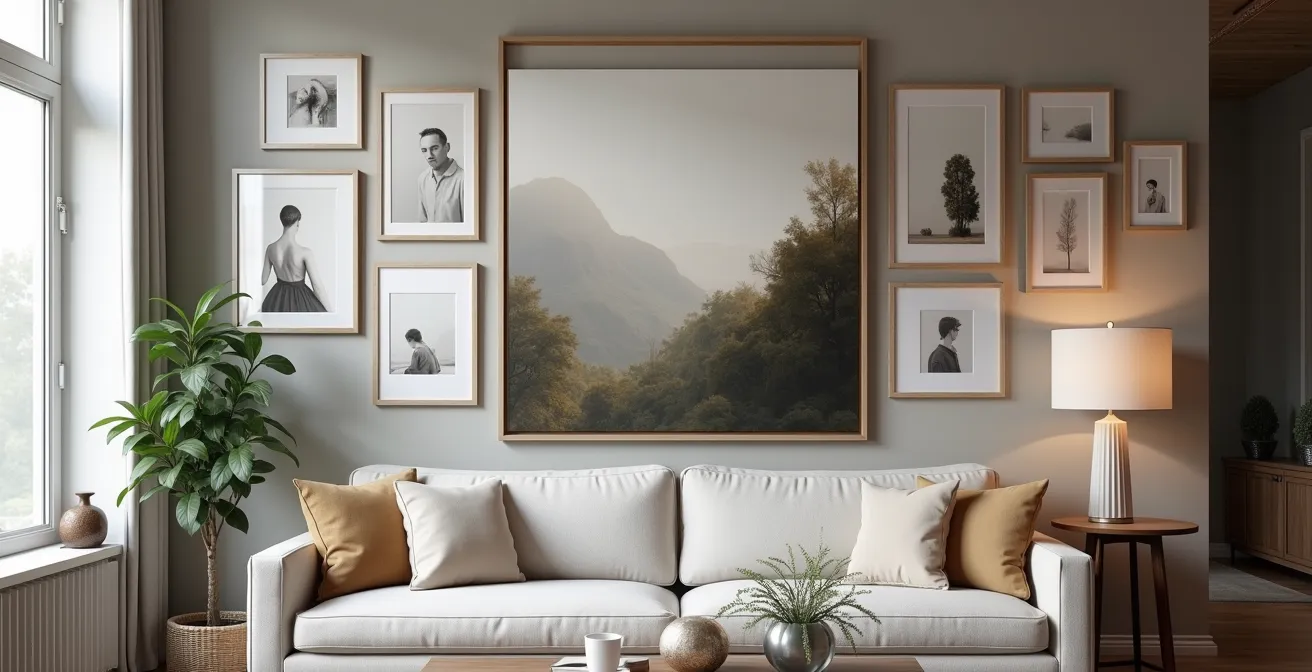
As you can see, strategic spacing and mixing of sizes and mediums create a dynamic visual rhythm. It’s less about perfect symmetry and more about balanced composition. Adopting a clear curatorial strategy is what separates a decorative wall of pictures from a thoughtful, personal exhibition that reflects your unique perspective as a collector.
To structure your approach, consider the different methods professionals use to build visual harmony. As this analysis from art display experts shows, there is more than one way to achieve a cohesive look.
| Approach | Benefits | Best For | Key Technique |
|---|---|---|---|
| Narrative Curation | Tells a cohesive story | Personal collections | Group by theme or artist journey |
| High-Low Mix | Dynamic visual texture | Eclectic collectors | Combine originals with prints |
| Color Palette | Visual harmony | Modern interiors | Match 2-3 dominant colors |
| Negative Space | Professional appearance | Minimalist style | Leave 2-4 inches between frames |
Original Canvas vs Limited Edition Print: Which Is the Smarter Buy?
For a new collector, the choice between an original artwork and a limited edition print is a fundamental strategic decision. An original—be it a painting, drawing, or sculpture—is a one-of-a-kind object, representing the direct output of the artist’s hand. Its uniqueness is the primary driver of its long-term value potential. A print, by contrast, is one of a series. While more accessible, its value is dictated by a different set of rules, primarily centered on the concept of scarcity mechanics.
The smartest buy depends entirely on your goals. For maximum investment potential, an original work by a promising emerging artist is unparalleled. The appreciation can be astronomical, as seen in iconic examples from art history.
Case Study: The Exponential Value of an Original Work
To understand the potential upside, consider Robert Rauschenberg’s seminal work, “Buffalo II”. According to market analysis by Masterworks, the piece was sold for $16,900 in 1964. In May 2019, it was auctioned for a staggering $88.8 million, demonstrating the immense value creation possible with a unique, historically significant artwork.
However, high-quality, limited-edition prints from established artists also offer a solid entry point into the market. Here, the details of the edition are paramount. A small edition size (e.g., under 50) is more valuable than a large one. Furthermore, certain types of prints, like an “Artist’s Proof” (AP), are considered more desirable. Understanding the vocabulary of printmaking is essential to making a smart purchase.
- Artist’s Proof (AP): A small number of prints set aside from the main edition for the artist. They are often more valuable due to their rarity and direct connection to the artist.
- Edition Size: The total number of prints created in an edition. The smaller the edition, the more valuable each individual print is, as scarcity is higher. Once the edition is sold out, the artist will not produce more.
- Hand-pulled vs. Digital: Traditional printmaking methods like lithography, etching, and screenprinting are “hand-pulled” and generally hold more value than digital reproductions like giclée prints.
- Bon à Tirer (B.A.T.): French for “good to pull,” this is the single print the artist approves, which then serves as the standard for the entire edition. It is a unique and valuable piece.
The Framing Mistake That Ruins Paper Art Within 5 Years
One of the most critical yet overlooked aspects of art collecting is preservation. You can acquire a masterpiece, but if it is not protected correctly, its value can be permanently compromised. For works on paper—drawings, photographs, and prints—the single most destructive mistake is improper framing. Standard, off-the-shelf frames often use acidic materials that will actively damage the artwork over time, a process known as “acid burn,” which causes irreversible yellowing and brittleness.
The solution lies in “archival framing,” a museum-quality approach designed for long-term preservation. This isn’t an aesthetic choice; it’s a technical necessity to protect your investment. The core principle is to create a stable, acid-free micro-environment for the artwork. This involves several key components that are invisible in the final presentation but are absolutely essential for the art’s survival.
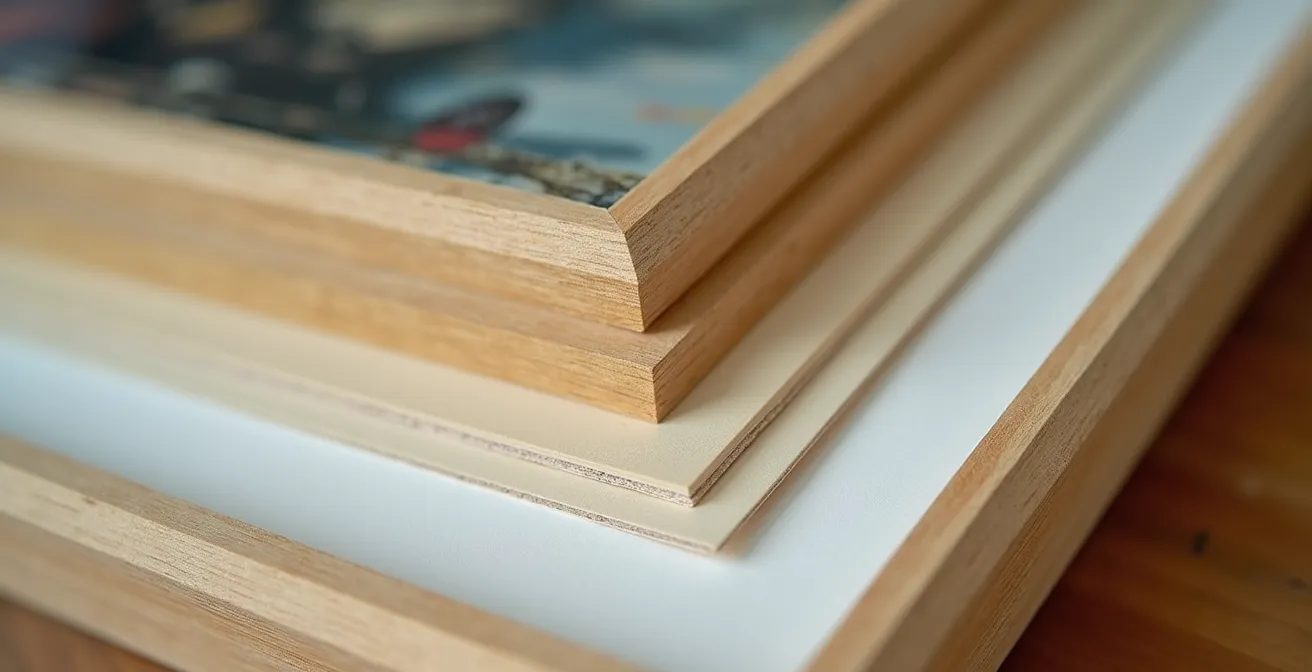
The most crucial element of archival framing is ensuring that the artwork never directly touches the glazing (the glass or acrylic front). A tiny, often invisible air gap, created by using mats or spacers, is vital to prevent moisture condensation and mold growth. Furthermore, all materials that do touch the art—the mat board and the backing board—must be 100% acid-free. Investing in archival framing is a non-negotiable cost of collecting works on paper; failing to do so is like buying a classic car and parking it in the rain.
The glazing itself is the final line of defense. Here is a tiered guide to conservation-grade glazing options:
- Conservation Clear Glass: This is the baseline for archival framing. It blocks over 97% of harmful UV rays but can have some reflection.
- Museum Glass: The premium choice. It combines maximum UV protection with an anti-reflective coating that makes the glass virtually invisible, offering the purest view of the artwork.
- Archival-grade Acrylic (Plexiglass): A lightweight and shatter-resistant alternative to glass, it offers excellent UV protection but is more susceptible to scratching.
- Acid-Free Materials: Always insist on replacing standard mat boards with acid-free or “rag” alternatives to prevent the yellowing ‘burn’ that destroys paper over time.
How to Light Your Art Collection Without Causing Heat Damage?
Lighting is a powerful tool in art display. It can bring a piece to life, highlight texture, and create a dramatic focal point. However, it is also one of the most potent agents of destruction. Improper lighting can cause irreversible damage: light exposure fades pigments, while the heat generated by bulbs can dry out and crack paint or warp paper. The curator’s challenge is to find the perfect balance between beautiful presentation and meticulous preservation.
The first rule of art lighting is to eliminate UV radiation and minimize heat. This immediately disqualifies direct sunlight and traditional incandescent or halogen bulbs placed too close to the artwork. The modern standard is to use high-quality LED fixtures. They produce very little heat and almost no UV light. However, not all LEDs are created equal. For art, the most important specification is the Color Rendering Index (CRI). CRI measures how accurately a light source reveals the true colors of an object. For art, you need lighting where the color rendering index (CRI) is 90 or higher to ensure colors appear vibrant and truthful.
Beyond CRI, the color temperature and beam angle must be tailored to the specific medium. A warm, dramatic spotlight that makes an oil painting glow will wash out the subtleties of a delicate watercolor. Each medium has its own unique needs for optimal viewing and safety, requiring a nuanced lighting strategy rather than a one-size-fits-all approach.
This table, based on recommendations from professional art handling services, breaks down the ideal lighting conditions for different types of art.
| Medium | Ideal Color Temperature | Beam Angle | Special Considerations |
|---|---|---|---|
| Oil Paintings | 2700K-3000K warm | 20-35° focused | Benefits from dramatic lighting |
| Works on Paper | 3500K-4000K neutral | 35-50° wide | Requires softer, even illumination |
| Photography | 4000K-5000K cool | 35-50° wide | Maintain color accuracy |
| Sculpture | 3000K warm | 10-20° spot | Multiple angles for dimension |
Commercial Gallery vs Museum: Where Should You Buy Your First Piece?
For an aspiring collector, understanding the art market ecosystem is crucial. The two most visible institutions are commercial galleries and museums, but they play fundamentally different roles. A museum is a collecting institution; its primary mission is to preserve and exhibit art for the public good. With very few exceptions, museums do not sell work from their collections. You visit a museum to learn, not to shop.
A commercial gallery, on the other hand, is a for-profit business. Its role is to represent artists, promote their careers, and sell their work to collectors. This is the primary marketplace where you, as a collector, will acquire new art. A gallery invests in its artists, funding their exhibitions and marketing them to a network of clients. When you buy from a reputable gallery, you are not just buying an object; you are buying into the gallery’s belief in that artist’s long-term value.
This distinction is key to your strategy. However, the gallery world can be intimidating, particularly when it comes to price. Deep research from Yale’s art market analysis reveals a disconnect: “The average price point in a gallery is around $9,000. Most buyers would like to spend less than $5,000.” This is why starting with galleries that specialize in emerging or mid-career artists is a smart move. Their price points are more accessible, and they are actively looking to build relationships with new collectors.
The ultimate goal for many artists is to have their work acquired by a museum, a process known as institutional validation. This is a major milestone that solidifies an artist’s place in art history and significantly increases the value of their other works. As a collector, watching which gallery artists are being acquired by museums is a powerful signal of who is gaining long-term traction. Galleries are the feeder system for museums and, by extension, the secondary auction market.
The Recessed Lighting Mistake That Ruins the Integrity of Vintage Ceilings
For collectors who live in homes with historical character—such as those with plaster ceilings, intricate moldings, or vintage details—the desire to properly light their art can create a serious conflict. The most common modern solution, recessed lighting (or “can lights”), requires cutting large holes into the ceiling. This act can permanently destroy the very architectural integrity that makes a vintage space unique and valuable. It’s a preservation mistake that can’t be undone.
Drilling into a 100-year-old plaster ceiling to install a grid of modern fixtures is often an overcorrection that compromises the home’s soul for the sake of a clean look. Fortunately, there are numerous preservation-focused alternatives that provide excellent, museum-quality art lighting without causing irreversible architectural damage. These solutions respect the original structure while offering the flexibility and control needed for a growing art collection.
The key is to leverage existing structures or employ surface-mounted systems that are minimally invasive. A track lighting system, for example, can be installed with only a few strategic anchor points and can power multiple adjustable spotlights. Monopoint fixtures can be attached to existing ceiling junction boxes, replacing a generic central light with a targeted art light. These approaches treat the ceiling as a historical feature to be preserved, not a blank canvas to be punctured.
For those who must use recessed lighting, a careful, targeted approach is essential. The “30-degree rule” is a professional guideline for placement: aim to position the light on the ceiling at a point that creates a 30-degree angle down to the center of the artwork. This typically illuminates the piece effectively without creating distracting glare or shadows. By choosing a less invasive lighting strategy, you can successfully be both an art collector and a steward of architectural history.
- Minimalist Track Systems: Install modern track lighting that can be mounted with minimal drilling, preserving the ceiling plane.
- Monopoint Spotlights: Utilize existing ceiling junction boxes to mount single, adjustable spotlights aimed at your artwork.
– Surface-Mounted Fixtures: Deploy adjustable fixtures that attach to the surface of the ceiling, requiring only small screws for installation. – Picture Rail Systems: Consider traditional picture rail molding, from which art can be hung and which can incorporate integrated lighting elements.
Key Takeaways
- Spotting Value: Look for “pedigree signals” like an artist’s education and mentors, not just aesthetic appeal.
- Preservation is Paramount: Use archival framing and UV-protective, low-heat LED lighting to protect your investment from irreversible damage.
- Market Awareness: Understand the roles of galleries (where you buy) and museums (which validate long-term value) to navigate the art world strategically.
Visiting Galleries Like a Critic: How to Interpret Contemporary Art Without a Guide?
The final and most personal skill a collector must develop is their “eye”—the ability to look at a piece of contemporary art and form a meaningful interpretation without a guide. This can be the most intimidating part of visiting a gallery, where art is often abstract or conceptually dense. The fear of “not getting it” prevents many from engaging deeply. However, critics and curators use a simple, structured framework to analyze any work, and you can too.
This process separates observation from interpretation, allowing you to build a conclusion from evidence rather than a vague feeling. It’s a three-step method:
- Objective Description: First, simply state what you see, as if to a person who can’t. “It is a large square canvas painted entirely in shades of dark blue. There is a single, thin red line running vertically, slightly off-center.” Avoid all interpretation (e.g., “it feels sad”).
- Formal Analysis: Next, analyze *how* it’s made. Look at the materials, the technique, the composition. “The blue paint is applied in thick, textured layers. The red line is perfectly sharp, suggesting it was made with tape. The composition is minimalist and balanced.”
- Subjective Interpretation: Only now, after gathering the evidence, do you ask what it might mean. “The tension between the textured blue field and the clean red line could represent order emerging from chaos, or a moment of interruption.” This is your personal connection, but it’s grounded in observation.
This framework gives you a way to enter a conversation with the artwork. To further aid your interpretation, always pick up the gallery’s press release or artist statement. Think of it as your Rosetta Stone; it contains the key concepts, influences, and vocabulary the artist is working with. Finally, trust your gut, but give it time. A powerful piece of advice for collectors is to never buy on first viewing. If an artwork stays with you, if you find yourself thinking about it 24 hours later, it has made a genuine connection. Ask yourself: “Can I imagine living with this for the next ten years?” If the answer is a clear yes, you may have found a piece for your collection.
Now that you are equipped with a framework for identifying, acquiring, and preserving art, the next logical step is to begin building your collection with a clear, strategic vision.