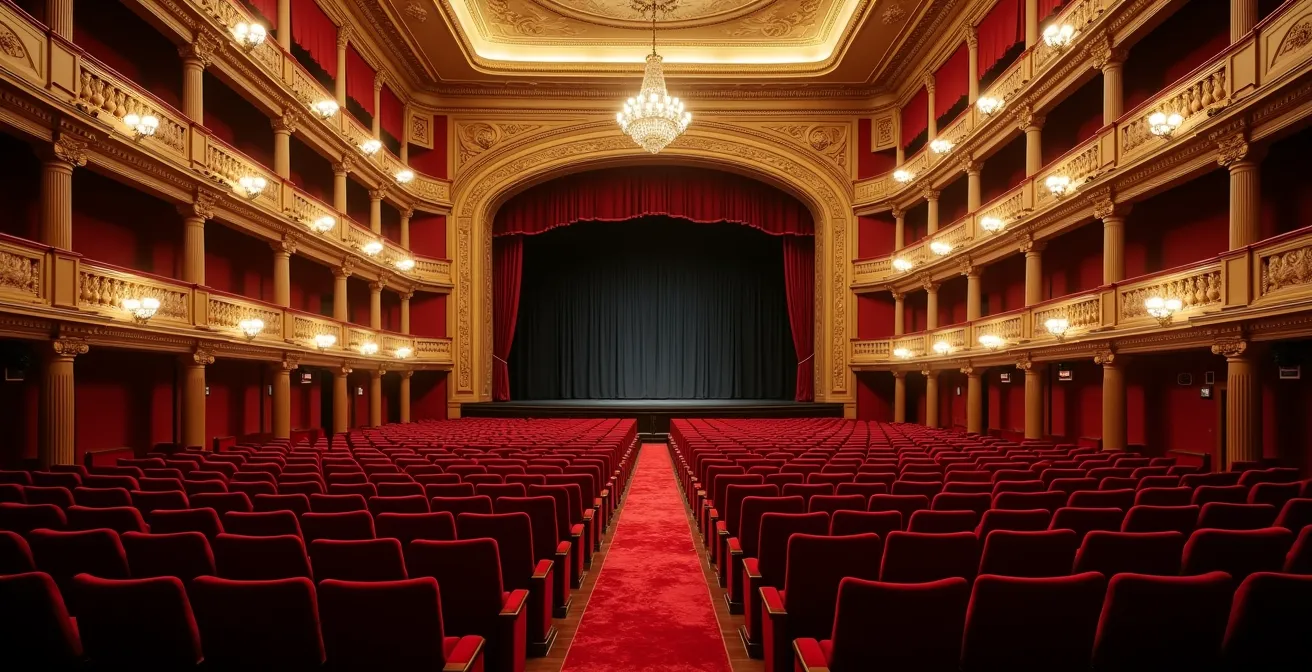
The common belief that the most expensive front-row seat guarantees the best experience is a costly myth; true theatrical appreciation comes from strategically selecting a seat that aligns with the venue’s acoustic and visual design.
- The acoustic “sweet spot” is rarely at the front but typically in the center orchestra, where direct and reflected sound achieve a perfect blend.
- Visual perception is not just about being close; it’s about achieving an optimal viewing angle and proscenium framing, often found in the front mezzanine.
Recommendation: Before your next booking, abandon the “closer is better” mindset. Instead, analyze the seating chart as an acoustic map, prioritizing central, slightly elevated positions to master both sound and sight.
The dimming of the house lights, the hush of the crowd, the first resonant note from the orchestra pit—these are the prologues to magic. Yet, how often is that magic diminished by a nagging flaw in the experience? A muffled dialogue, a key piece of stage action obscured by the head in front, the sense that despite a premium ticket price, you are receiving a compromised version of the performance. For the discerning theater-goer, this is not a minor inconvenience; it is a fundamental betrayal of the art form.
Conventional wisdom offers simple, almost platitudinous advice: aim for the center, check the seating chart, avoid the extreme sides. While not incorrect, this guidance barely scratches the surface. It treats seat selection as a game of chance, a matter of avoiding the worst rather than actively curating the best. It fails to acknowledge that a theater is a meticulously engineered instrument, and your position within it dictates the quality of the music it plays for you.
But what if the key to a sublime experience was not merely location, but a deeper understanding of the environment itself? This guide is predicated on a more demanding philosophy: selecting the perfect seat is an art, not a gamble. It requires the insight of an audiophile and the eye of a critic. It’s about decoding the physics of sound, the architecture of the venue, and the hidden logistics of the production. It’s about transforming from a passive spectator into an informed connoisseur who can anticipate the nuances of the performance before the curtain even rises.
This exploration will deconstruct the elements that define a transcendent theatrical experience. We will dissect why proximity can be the enemy of sonic purity, how to engage with the material before the show to deepen its emotional impact, and how to navigate the practical challenges of a night at the theater with the efficiency of a seasoned professional. Prepare to change not just where you sit, but how you listen and see.
Summary: Attending Theatrical Performances: How to Select the Best Seats for Acoustics and View?
- Why the Front Row Is Often the Worst Place to Hear the Orchestra?
- How to Read the Libretto Before an Opera to Enhance Emotional Impact?
- Matinee vs Evening: Which Performance Typically Has the Main Cast?
- The Phone Etiquette Mistake That Enrages Actors and Audience Alike
- How to Pre-Order Drinks to Avoid the 15-Minute Intermission Queue?
- How to Dampen Echo and Noise in Open-Plan Homes Using Textiles?
- Why General Admission at Major Festivals Often Means Seeing Nothing?
- Navigating Cultural Events: How to Attend the Rio Carnival Without Falling into Tourist Traps?
Why the Front Row Is Often the Worst Place to Hear the Orchestra?
The allure of the front row is a powerful, primal instinct: to be as close to the creation of art as possible. Yet, for the audiophile, this proximity is a trap. In acoustics, the ideal experience is not about raw, direct sound; it’s about a masterfully balanced blend. Sitting in the front row, particularly for a performance with an orchestra, places you in a position of sonic imbalance. You receive an overwhelming amount of direct, unmixed sound from the nearest instruments, while the sound from the rest of the ensemble arrives later and with less clarity. You are hearing the raw ingredients, not the finished dish.
The most coveted seats are located in the “acoustic sweet spot,” a zone where the direct sound from the stage and the first reflections from the hall’s architectural surfaces converge perfectly. This is where the sound engineer mixes the show to be heard. It is typically found in the center of the orchestra section, roughly one-half to two-thirds back. Visually, standards also suggest that an optimal position allows for a 36-degree viewing angle of the screen or stage, a perspective impossible to achieve from the first few rows.
Modern venues like the YouTube Theater invest heavily in sophisticated sound systems to mitigate these issues. Their design, which can feature hundreds of precisely aimed speakers, illustrates the complexity involved. As detailed in a press release about its L-Acoustics system, engineers use adjustable directivity steering to tailor coverage precisely and evenly throughout the theater. This technology aims to give every seat a high-quality experience, but it cannot defy physics entirely. The fundamental principle remains: the truest sound is found where the mix is allowed to coalesce in the air before reaching your ears.
How to Read the Libretto Before an Opera to Enhance Emotional Impact?
Attending an opera is not a passive activity; it is an emotional and intellectual engagement. To arrive unprepared is to experience only a fraction of its intended power. The libretto is not merely a script; it is an emotional blueprint, a composer’s guide to the human heart. Engaging with it beforehand transforms the viewing from a simple spectacle into a profound, personal journey. The goal is to move beyond merely following the plot to anticipating and fully absorbing the emotional crescendos of the performance.
This preparation is a form of active listening. By familiarizing yourself with the text, its poetic devices, and its dramatic structure, you free your mind during the performance to focus on the interplay between music, voice, and staging. This analytical approach to emotion is not just an artistic suggestion; it’s a field of academic study. A 2024 study on Verdi’s Macbeth published in *Applied Mathematics and Nonlinear Sciences* used “emotion calculation” to map the script’s intensity, finding that in the first six minutes alone, there were two periods where emotional tension exceeded 7.5 points. This level of granular analysis demonstrates how every word is a calibrated emotional trigger.
By creating your own emotional map, you can trace these peaks and valleys. Annotate the libretto, not just with plot points, but with the specific emotions at play. Note the shifts in tone, the foreshadowing, and the moments of dissonance and resolution. When you are in the theater, you will recognize these signposts, allowing the music to amplify an emotional state you are already prepared to feel. It is the difference between being told a story and living it.
Action Plan: Creating Your Emotional Map
- Identify the emotional “Humour” (or blend of Humours, such as sanguine, melancholic) at play in the libretto, word by word.
- Anticipate the performance approach for key phrases: imagine the required voice color, facial expression, and physical posture.
- Look beyond simple dynamics (loud/soft) to match the emotional subtext and precise meaning of each specific word.
- Time the emotional peaks by linking them to the musical process of Preparation-Dissonance-Resolution you anticipate hearing.
- Create a visual map connecting the text to potential staging directions and design choices, building a complete mental picture.
Matinee vs Evening: Which Performance Typically Has the Main Cast?
The conventional wisdom among casual theater-goers is that the evening performance is the “A-show,” featuring the primary cast at the peak of their energy, while the matinee is a lesser, often-compromised affair. This is a simplistic and frequently incorrect assumption. For the discerning aficionado, the matinee can present a unique and sometimes superior opportunity. The decision of which to attend is not about good versus bad, but about understanding performance logistics and energy management.
For long-running, physically or vocally demanding shows, particularly on a two-show day, it is common for the lead performer to be scheduled for only one of the performances. While this is often the evening show, there is no universal rule. The production’s priority is the longevity of its star and the consistency of the run. Therefore, an alternate or understudy, who may be a rising star in their own right, will take the stage. To witness an understudy can be a thrilling experience; these are highly talented performers, and their performance may be their only chance to shine that week, leading to an electrifying, all-or-nothing delivery.
A theater professional’s insight confirms this perspective, highlighting the strategic nature of casting on two-show days.
On two-show days, lead performers strategically manage their energy. The matinee often becomes a unique opportunity to witness understudies and alternates delivering powerhouse performances, as it might be their only show that week. These performances can become legendary – many Broadway stars were discovered when stepping in as understudies.
Ultimately, the main cast is most reliably present at evening shows during the week. On weekends with two-show days, the choice is less certain. Rather than assuming, the expert move is to check with the box office or the show’s official website on the day of the performance. However, dismissing a matinee out of hand is a novice’s mistake. It often provides a raw, energetic performance that can be just as, if not more, memorable.
The Phone Etiquette Mistake That Enrages Actors and Audience Alike
There is no greater sacrilege in the modern theater than the glow of a phone screen in the darkness. It is more than a simple breach of etiquette; it is a fundamental violation of the shared contract between audience and performer. That small rectangle of light shatters the carefully constructed fourth wall, rips fellow audience members from their immersion, and signals a profound disrespect to the artists on stage. While talking or making noise is disruptive, the visual intrusion of a phone is uniquely infuriating because it is a beacon of disengagement.
The problem is pervasive and, to some extent, generational. A study by the National Research Group highlighted the challenge, finding that 20% of teens use their phones during movies, a habit that bleeds into live theater. The mistake, however, goes beyond simple use. The ultimate transgression is a failure to prepare: not silencing the device, not lowering its brightness to zero, and not placing it completely out of sight. The “quick check” of a notification is a narcissistic act that prioritizes the user’s fleeting digital curiosity over the collective, focused experience of hundreds of people.
This behavior is not merely a matter of poor manners but a symptom of a larger societal challenge, as explained by Jay Van Bavel, a Professor of Psychology at New York University.
We live in the most distracted time in human history. Our brains did not evolve for this. The technology is incredibly recent and we don’t have the self-regulatory capacity to manage it very well.
– Jay Van Bavel, Professor of Psychology at New York University
Understanding this psychological pull does not excuse the behavior, but it underscores the need for a conscious, almost ritualistic act of disconnection before the performance begins. The true theater enthusiast understands that putting the phone away is not a rule to be followed, but a prerequisite for the magic to begin. It is an act of intentional focus, a commitment to the singular, unrepeatable moment of live art.
How to Pre-Order Drinks to Avoid the 15-Minute Intermission Queue?
The intermission is a paradox: a much-needed pause that often devolves into a frantic, 15-minute sprint against the clock. The twin queues for the restrooms and the bar are a predictable bottleneck, turning a moment for reflection into a source of anxiety. For the seasoned attendee, however, the intermission is a seamless and civilized affair. The key is not to be faster than the crowd, but to be smarter, leveraging pre-show foresight and modern technology to bypass the queues entirely.
The most elegant solution is pre-ordering. Many modern theaters have streamlined this process, moving beyond the old system of writing your order on a slip of paper. They now employ mobile-first strategies to enhance the guest experience. As one example of modern technology integration shows, the implementation of QR code ordering systems and dedicated mobile apps can dramatically reduce wait times, often from a stressful 10 minutes to a swift pickup in under 3 minutes for pre-ordered items. This simple act transforms the intermission from a chore into a pleasure.
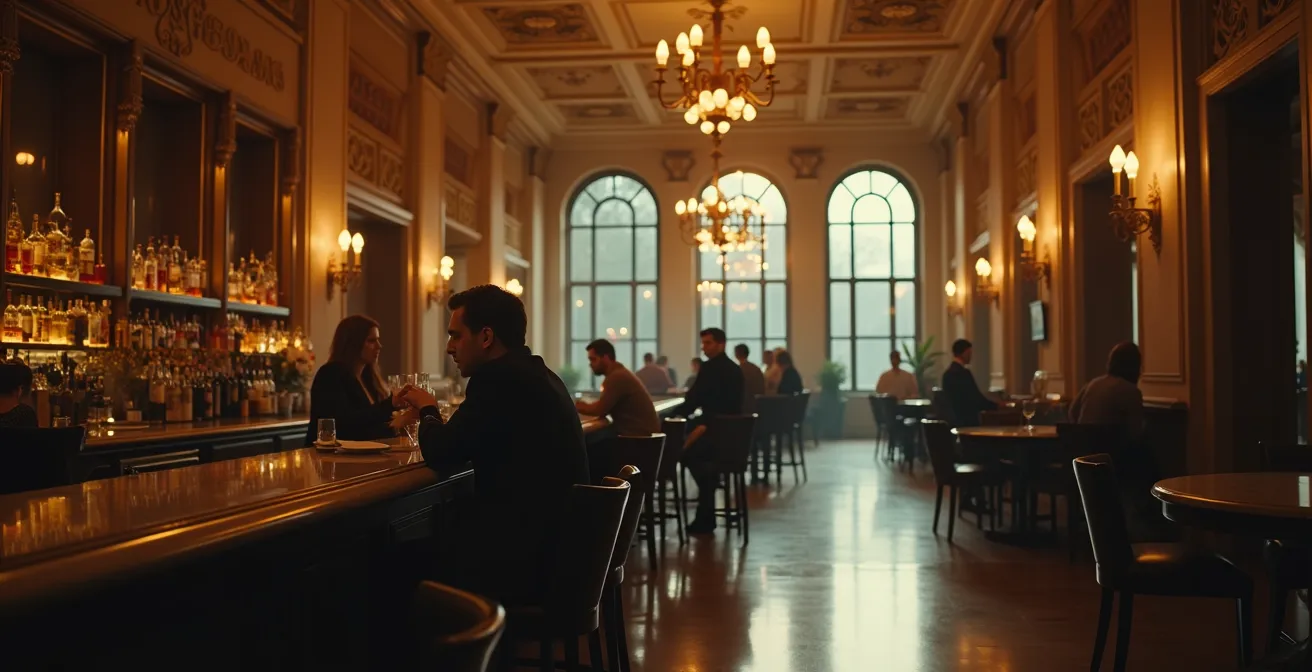
Even in venues without such technology, a strategic approach pays dividends. The expert theater-goer operates with a plan. This may involve locating less obvious secondary bars on upper levels or employing a “divide and conquer” strategy with a companion. The goal is to eliminate the queue as a variable, ensuring the intermission can be used for its intended purpose: to discuss the first act, anticipate the second, and refresh oneself without a frantic rush back to your seat as the lights flicker.
Mastering these strategies is an essential part of a holistic, high-quality theater experience. Here are several tactics to consider:
- Scan the QR code often found at your seat upon arrival to order drinks via your phone for intermission pickup.
- Scout for secondary, less-crowded bars on upper floors or in basement areas before the show begins.
- Use the divide and conquer method: one person heads to the pre-order collection point while another tackles the restroom queue.
- Place your order during the pre-show period when bartenders are typically less busy.
- Consider premium seating areas, which often come with the perk of a dedicated bar service and significantly shorter lines.
How to Dampen Echo and Noise in Open-Plan Homes Using Textiles?
The principles that make a grand concert hall sound magnificent can be reverse-engineered to bring acoustic comfort to a domestic space. The modern preference for open-plan living—with its hard surfaces, high ceilings, and lack of walls—often creates an unintended and unpleasant side effect: poor acoustics. Echo, reverberation, and ambient noise can turn a beautiful space into a fatiguing one. The solution, as theater designers have known for centuries, lies in the strategic use of soft materials, particularly textiles.
In a professional theater, every surface is considered for its acoustic properties. The goal is controlled reflection, not total absorption. As a rule of thumb, professional theaters typically require textile and acoustic treatment on 35-40% of their surfaces to achieve balanced sound. This includes heavy velour curtains, upholstered seating, and carpeting. These materials don’t just “soak up” sound; they break up sound waves, preventing the harsh, flat reflections that create echo. This is a powerful metric for homeowners: aiming for a similar percentage of soft surface coverage can dramatically improve a room’s sonic character.
The application of this principle at home is straightforward. Large, hard surfaces are the primary culprits. Think of windows, hardwood floors, and bare walls as acoustic mirrors. To dampen the echo, you must interrupt these reflections. Consider the following applications:
- Heavy, lined curtains: A sheer curtain does little, but a heavy, floor-to-ceiling drape acts as a powerful sound absorber, especially for high-frequency flutter echo.
- Large area rugs: A thick wool or plush rug on a hardwood or tile floor is the single most effective way to reduce ambient noise and floor-to-ceiling echo.
- Upholstered furniture: As home theater design guides note, the material of your seating significantly impacts room acoustics. A fabric sofa will absorb sound, while a leather one will reflect it.
- Textile wall art: Large tapestries or acoustic art panels serve a dual purpose, adding aesthetic value while breaking up the flat, reflective plane of a large wall.
By thinking like a theater designer, you can transform a noisy, open-plan house into a space with the acoustic warmth and clarity of a well-designed performance venue. The key is strategic absorption through textiles.
Why General Admission at Major Festivals Often Means Seeing Nothing?
The promise of a major music festival’s General Admission (GA) ticket is one of freedom and communal energy. The reality, for the discerning spectator, is often one of chaos, compromised sightlines, and abysmal sound. The festival environment is the antithesis of the controlled, engineered experience of a theater. Understanding this distinction is crucial for managing expectations and appreciating the immense value provided by a reserved theater seat.
A festival ground is typically a flat plane, a sonic and visual free-for-all. Your experience is dictated by the height of the person in front of you and your proximity to a speaker tower, which often delivers an unbalanced, overwhelming wall of sound. There is no architectural framing to direct your focus; the stage is a distant point in a sea of distractions. In contrast, a theater is a machine for viewing. Its entire design—from the raked seating to the proscenium arch—is engineered for optimal, focused perception. As the IMAX CTO Brian Bonnick explains, the level of precision is microscopic: “We use lasers to aim each loudspeaker to its individual target so that sound dispersion hits every seat evenly.” This is the core difference: engineered precision vs. organic chaos.
This table starkly contrasts the two experiences, highlighting the often-unseen benefits built into a reserved theater ticket.
| Aspect | Festival General Admission | Theater Reserved Seating |
|---|---|---|
| Sightlines | Flat plane, obstructed by crowd | Raked seating, engineered angles |
| Acoustic Experience | Uncontrolled, varies by position | Designed for even sound distribution |
| Viewing Frame | No architectural framing | Proscenium arch directs focus |
| Crowd Control | Chaotic movement possible | Fixed positions, organized flow |
| Historical Precedent | Similar to Elizabethan ‘groundlings’ | Evolution of tiered theater design |
Choosing a reserved seat in a theater is not merely a purchase; it is an investment in a carefully crafted sensory experience. It’s an assurance that the sightlines have been calculated, the acoustics have been balanced, and your focus will be directed where the artists intend it. A GA festival ticket, on the other hand, is a lottery where seeing and hearing the performance as intended is often the losing outcome.
Key takeaways
- Sonic Purity Over Proximity: The best sound is rarely in the front row, but in the central orchestra where the audio mix is balanced.
- Preparation Amplifies Emotion: Engaging with a libretto or play beforehand transforms passive viewing into a profound, immersive experience.
- Strategic Selection is Key: The ideal seat is a calculated choice based on acoustic science and visual design, not a gamble on location.
Navigating Cultural Events: How to Attend the Rio Carnival Without Falling into Tourist Traps?
The principles for navigating a massive cultural spectacle like the Rio Carnival are identical to those for securing the best seat at a Broadway show. The “tourist trap” is always the same: paying a premium for the most obvious, yet often experientially inferior, option. The savvy attendee, whether in the Sambadrome or a West End theatre, operates with insider knowledge, prioritizing value and quality of experience over mere proximity or hype. It’s about applying an aficionado’s mindset to any ticketed event.
The cardinal rule is to defy the novice’s instinct to be as close as possible. Just as the front row is poor for orchestral sound, the most expensive trackside “tourist” seats at a parade can offer a chaotic, overwhelming, and partial view. Experts know that auditoriums are meticulously designed so that, for a balanced audio-visual experience, the ‘best’ seat is one-half to two-thirds back from the stage or main action. An elevated position, such as the front of the first balcony (or *frisas* in Rio), often provides a superior, panoramic view that allows one to appreciate the grand choreography and scale of the event—the full artistic vision—rather than just the nearest performers.
This strategic approach extends to how and when you buy. The tourist buys the first available ticket at full price. The insider knows the system. They use official lotteries, rush ticket policies, and attend preview performances, securing the same quality experience for a fraction of the cost. This is the essence of navigating any cultural event like a pro: trading money for knowledge.
Your Action Plan for Authentic Cultural Experiences
- Audit Your Points of Contact: Avoid the “tourist trap” of expensive front-row tickets; choose the front mezzanine or first balcony for optimal acoustics and a grand overview, especially for spectaculars like a Sambadrome parade.
- Collect Your Options: For intimate dramas, prioritize closer orchestra or dress circle seats. For all events, inventory alternative ticket sources beyond the main vendor, such as official lottery systems and rush ticket booths.
- Check for Coherence: Confront the high price of a “prime” ticket with its actual value. Is it for the best view, or just the closest? Attend preview performances for the same artistic quality at a reduced price, a smarter value proposition.
- Assess the Experience: Research the specific venue’s “sweet spot” before purchasing. A seat with a grand, unobstructed overview is often more memorable and emotionally impactful than a cramped, partial view from the front.
- Integrate a Plan: Instead of spontaneous buying, create a purchasing strategy. Prioritize lotteries and rush tickets first, then advance sales for well-researched seats, leaving full-price, last-minute tickets as a final resort.
To truly elevate your theatrical attendance from a simple outing to an art form, the next step is to apply this knowledge. Begin by analyzing the seating chart of your next prospective show not as a map of prices, but as a blueprint of acoustic and visual potential. This is how you guarantee not just a seat, but an experience.