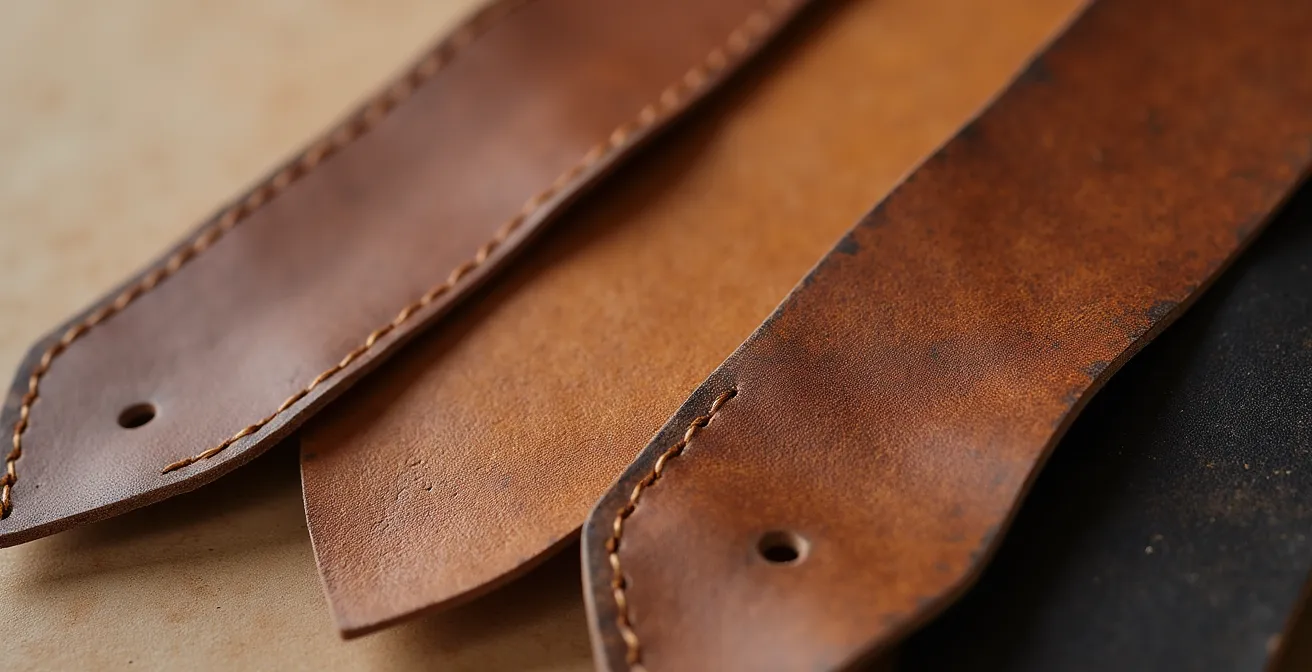
True leather quality lies not in misleading labels like “Genuine Leather,” but in its structural integrity (full-grain) and its capacity to tell a story through patina.
- “Genuine Leather” is a marketing term for one of the lowest grades, made from the weaker, inner layers of the hide.
- The tanning method—natural vegetable tannins versus chemical chrome salts—is the single most important factor determining how a piece will age.
Recommendation: To assess quality, learn to read the material’s surface, understand its tanning origins, and inspect the stitching—just as a craftsman would.
There is an undeniable honesty to a piece of high-quality leather. It’s a sensory experience that begins before you even own it. It’s the rich, earthy scent that fills the air, the way the surface feels cool and substantial under your fingertips, the satisfying heft of a well-made bag. Many shoppers rely on these simple tests—the smell, the feel, the price tag—to guide their purchase. They look for a label that says “100% Genuine Leather,” believing it to be a seal of quality and durability. But this is where the deception begins.
As a craftsman who has spent years with my hands on every grade of hide, I can tell you that the most common assumptions are often wrong. The world of leather is filled with carefully chosen words designed to obscure, not clarify. What if the label you trust most is actually a warning sign? What if the key to identifying true quality isn’t about looking for perfection, but for the beautiful imperfections that tell the story of a natural material?
This guide will pull back the curtain on an industry of smoke and mirrors. We will move beyond the superficial and teach you to think like an artisan. We’ll deconstruct the myth of “Genuine Leather,” explore how the tanning process dictates a product’s soul, and show you how to diagnose quality through simple, tactile tests. You will learn why the principles of haute couture and even the structure of silk fabric hold valuable lessons for a leather connoisseur. By the end, you will no longer be a mere consumer; you will be an informed judge of quality, able to invest with confidence.
To navigate this world of craftsmanship, it helps to have a clear map. This article is structured to walk you through the essential knowledge, from deconstructing marketing myths to understanding the finer points of material science.
Summary: A Craftsman’s Handbook for Judging Leather and Textiles
- Why “Genuine Leather” Is Actually the Lowest Quality Grade?
- How to Perform the Water Drop Test on Leather Goods?
- Vegetable Tanned vs Chrome Tanned: Which Patina Ages Better?
- The Storage Mistake That Ruins Leather Bags in Humid Climates
- How to Condition Leather Boots to Double Their Lifespan?
- How to Distinguish Hand-Embroidered Beading from Machine Work?
- Silk vs Satin: Which Fabric Drapes Better for an Elegant Evening Look?
- Understanding Haute Couture: Why Does a Single Custom Garment Cost More Than a Luxury Car?
Why “Genuine Leather” Is Actually the Lowest Quality Grade?
Let’s address the most pervasive myth in the industry head-on. The term “Genuine Leather” does not mean a product is of high quality. In fact, it often signifies the opposite. It’s a catch-all term that simply means “contains some amount of real leather.” It’s legally true but editorially deceptive. This grade is typically derived from the lower, weaker layers of the hide after the valuable top layers have been split off for higher-end goods. The surface is often heavily processed—sanded, painted, and embossed with an artificial grain to hide a multitude of flaws.
The hierarchy of quality is clear. At the pinnacle is Full-Grain leather, which uses the entire top layer of the hide, including all its natural markings and imperfections. This is the strongest, most durable, and most breathable part of the hide, and it develops a beautiful patina over time. Below that is Top-Grain, where the very top surface is lightly sanded to remove blemishes. “Genuine Leather” sits far below these. It’s no wonder that experts estimate only 10-15% of leather products on the market are made from top-tier full-grain.
To protect yourself, you must learn the lexicon of deceptive marketing. Be wary of these terms:
- Bonded Leather: This is the particle board of the leather world. It’s made from leather scraps and dust, mixed with a polyurethane binder and pressed into sheets. It has very little durability.
- Corrected Grain: A lower-quality hide that has its surface sanded down to remove imperfections, then has an artificial grain pattern stamped onto it.
- Split Leather: The fibrous bottom layer of the hide, which is much weaker than the top grain. It’s often coated with a polymer to create a leather-like appearance.
- PU Leather: A fabric base (like polyester) coated with polyurethane. It contains no actual hide.
How to Perform the Water Drop Test on Leather Goods?
Your senses are your best tools, and one of the most revealing tests you can perform requires nothing more than a single drop of water. High-quality, properly finished leather is a natural material; it’s porous and it breathes. Heavily processed or synthetic leathers, on the other hand, are sealed under a layer of plastic or paint. The water test helps you diagnose this fundamental difference. Before conditioning or treating any leather item, you should perform this simple test on an inconspicuous area.
Simply place a small droplet of water on the surface. Now, watch closely. The behavior of this droplet is your answer. The illustration below demonstrates the different reactions you might see.
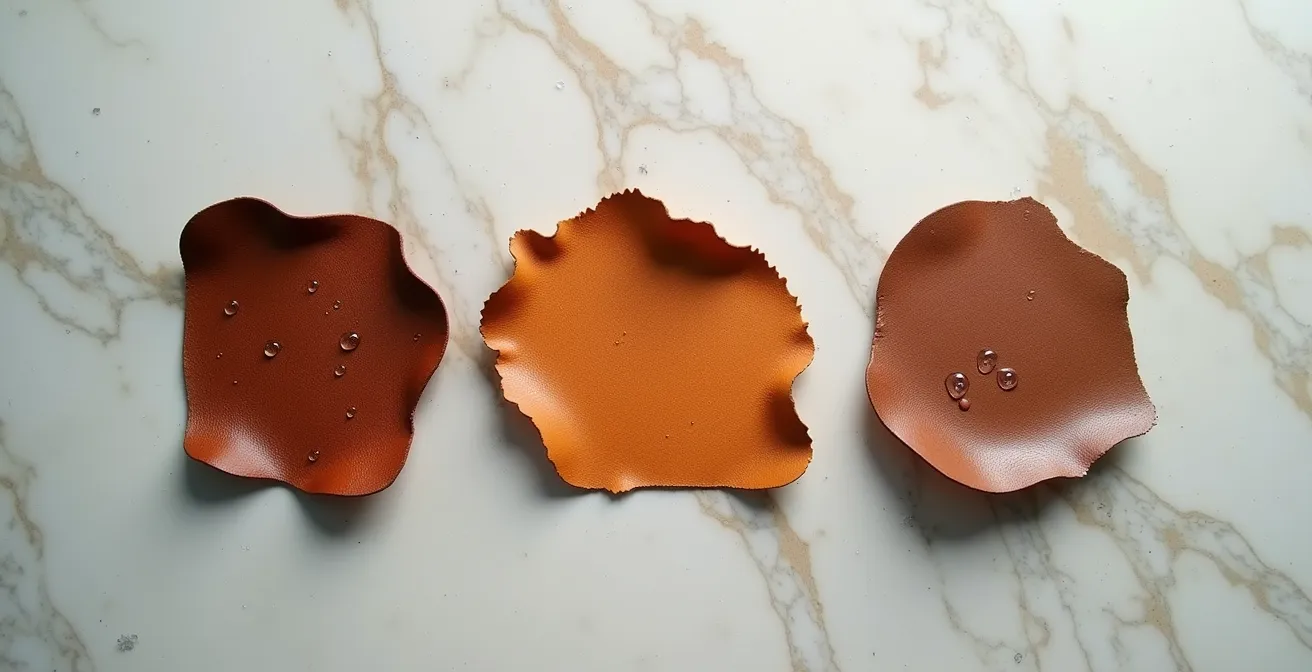
As the image shows, the results can be starkly different. On full-grain, aniline-dyed leather, the water will slowly darken the surface as it soaks in, demonstrating the hide’s natural porosity. This is a sign of high quality. On semi-aniline leather, the water may bead for a moment before slowly being absorbed. However, on corrected-grain or bonded leather with a heavy topcoat, the water will simply bead up and sit on the surface indefinitely, just as it would on a raincoat. If the water runs off immediately without any absorption, you are likely looking at a synthetic material.
Vegetable Tanned vs Chrome Tanned: Which Patina Ages Better?
If the hide is the body of a leather good, the tanning process is its soul. This is what converts raw animal skin into a stable, durable material, and the method used has a profound impact on how the product will look, feel, and age. The two dominant methods are vegetable tanning and chrome tanning, each with a distinct philosophy.
Vegetable tanning is the ancient, artisanal method, using natural tannins found in tree bark and other plant matter. It’s a slow, complex process that can take months, resulting in a firm, breathable leather with a rich, earthy scent. Its defining characteristic is its ability to develop a deep, complex patina—the beautiful darkening and sheen that develops with use, sun exposure, and contact with the oils from your skin. A vegetable-tanned bag doesn’t just get old; it chronicles its journey with you. Chrome tanning, developed during the industrial revolution, uses chromium salts to tan a hide in as little as a day. It produces a softer, more pliable leather that is often more water-resistant from the start and comes in a wider array of vibrant colors. However, this consistency comes at a cost: chrome-tanned leather ages far less gracefully, with its color remaining largely static throughout its life.
This table breaks down the fundamental differences in their aging characteristics.
| Characteristic | Vegetable Tanned | Chrome Tanned |
|---|---|---|
| Patina Development | Rich, deep color evolution over time | Minimal color change, stays consistent |
| Chemical Process | Natural tannins oxidize with UV light | Chromium salts lock fibers and pigments |
| Water Resistance | Low initially, improves with conditioning | High from start, maintains throughout |
| Aging Philosophy | Celebrates journey through marks and scratches | Values day-one perfection and consistency |
| Breathability | High, pores remain open | Lower, pores sealed by chrome process |
However, it’s not always a simple binary choice. Some of the most revered leathers are a hybrid, borrowing the best of both worlds. As leather expert Ryan Popoff of Popov Leather notes:
Chromexcel uses both tanning methods to achieve a unique balance of rugged durability, water resistance, and the ability to develop a rich patina.
– Ryan Popoff, Popov Leather Workshop Guide
The Storage Mistake That Ruins Leather Bags in Humid Climates
A quality leather piece is an investment, but that investment can be destroyed by one common enemy: improper storage, especially in humid environments. Leather is a skin; it needs to breathe. Storing a leather bag in a plastic container, a sealed bag, or a damp, unventilated closet is a recipe for disaster. This traps moisture against the surface, creating a perfect breeding ground for mold and mildew, which can permanently stain and weaken the hide.
The ideal environment for leather is one that is cool, dry, and allows for air circulation. To prevent damage, always store leather goods in the breathable fabric dust bag they came in—never plastic. If you live in a particularly humid climate, consider placing silica gel packets inside your bags to absorb excess moisture. Professional conservators recommend maintaining a stable environment with relative humidity between 40-50% to prevent microbial growth. Never store leather in direct sunlight, which can dry it out and cause the color to fade.
If you do discover the fuzzy, unwelcome sight of mold, act immediately. Follow this emergency protocol:
- Step 1: Immediately isolate the affected item in a well-ventilated area (preferably outdoors) away from other leather goods to prevent cross-contamination.
- Step 2: Use a soft-bristle brush to gently brush off all surface mold. Do this outdoors to avoid spreading spores inside your home.
- Step 3: Mix a solution of one part isopropyl alcohol and one part water. Dampen a clean microfiber cloth with the solution.
- Step 4: Gently wipe down the affected areas in circular motions, being careful not to oversaturate the leather.
- Step 5: Allow the item to air dry completely in a shady, well-ventilated spot for at least 24-48 hours.
- Step 6: Once completely dry, apply a quality leather conditioner to restore the moisture that the alcohol may have stripped away.
How to Condition Leather Boots to Double Their Lifespan?
Conditioning leather is not about making it look shiny; it’s about feeding it. Leather is a natural material composed of a complex web of fibers lubricated by fats and oils. Over time, these emollients dry out, causing the fibers to become brittle, stiff, and prone to cracking. Regular conditioning replenishes these essential oils, keeping the leather supple, strong, and water-resistant. A well-conditioned pair of boots can easily last twice as long as a neglected pair.
The technique is as important as the product. Always start with a clean, dry surface. Apply a small, pea-sized amount of conditioner to your fingers or a soft cloth. The warmth of your hands helps the conditioner penetrate the leather’s pores. Apply it in small, gentle circular motions, ensuring an even, thin coat. It’s better to apply two thin coats than one thick, goopy one.
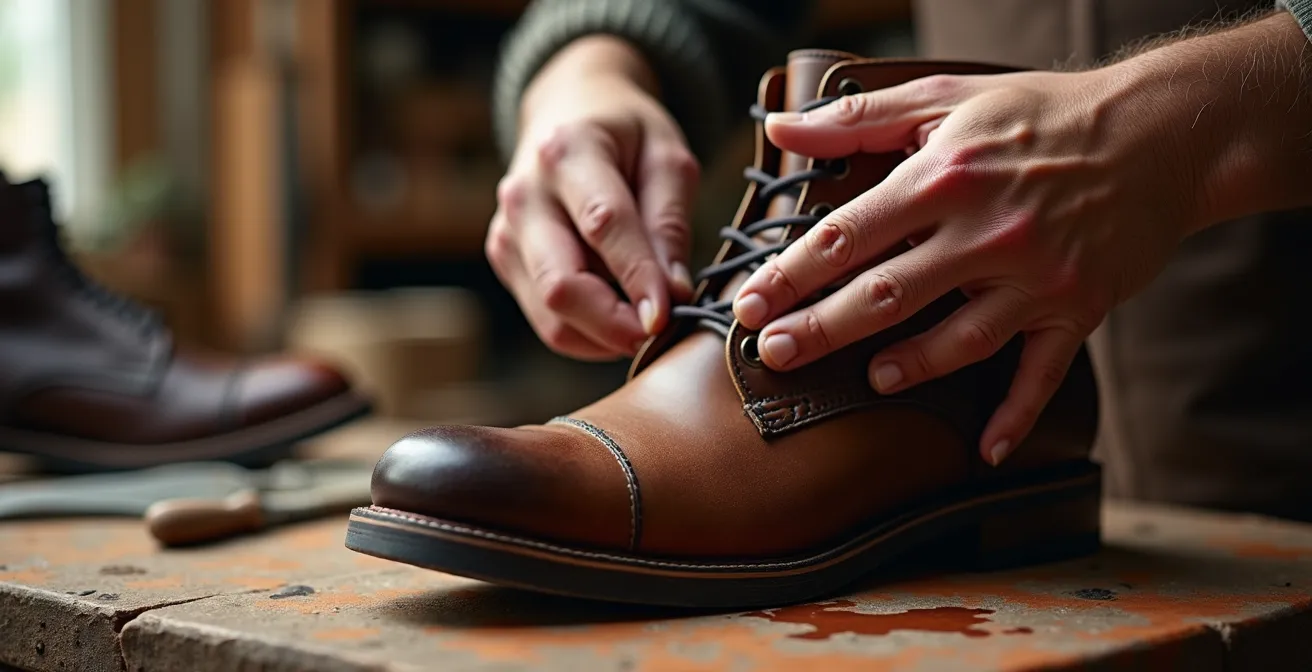
Crucially, you must use the right type of conditioner for your specific leather. Using a heavy, waxy grease on delicate calfskin dress shoes can be as damaging as using no conditioner at all. Each type of leather has different needs, and using the wrong product can lead to permanent darkening, a sticky finish, or even flattening the nap on suede.
This matrix will help you match the conditioner to the material to avoid common mistakes.
| Leather Type | Correct Conditioner | Wrong Choice Result |
|---|---|---|
| Oily Pull-up | Light leather cream | Over-saturation, mushy leather |
| Dress Calfskin | Delicate cream polish | Mink oil causes permanent darkening |
| Shell Cordovan | Specialty cordovan cream | Regular conditioner dulls unique shine |
| Roughout/Suede | Waterproofing spray only | Cream flattens nap permanently |
| Chromexcel | Venetian shoe cream | Heavy wax blocks natural pullup |
How to Distinguish Hand-Embroidered Beading from Machine Work?
The principles of quality are universal. Just as the soul of a leather bag is found in its tanning and hide selection, the quality of a garment is often revealed in the details that most people overlook. When assessing fine work like beading or embroidery, the secret is to look “under the hood.” Turn the garment inside out. The story of its creation is written on the reverse side.
This is directly analogous to leather stitching. At first glance, both machine and hand stitching can look straight and neat. But a machine uses two separate threads that lock together. If one of those threads breaks, the entire seam can unravel quickly. A traditional saddle stitch, done by hand with a single thread and two needles, creates an independent lock at every single hole. If one stitch breaks, the rest of the seam holds firm. The structural integrity is fundamentally superior. The same logic applies to beading.
Machine beading is fast and perfectly uniform, often done on a mesh stabilizer that is attached to the fabric. The reverse side will show unnaturally perfect, repeating thread patterns. Hand beading, by contrast, is a slower, more deliberate art. The back of the work will reveal the craftsman’s hand: slight, charming irregularities, and individual knots that secure sections of beads. This method not only allows for more intricate designs but also ensures that if a single bead is lost, it won’t cause a cascade of others to fall off. Use the following checklist to audit the work.
Action Plan: Auditing Craftsmanship Details
- Points of contact: List all the channels where the quality signal is emitted (e.g., stitching, hardware, lining, beading).
- Collection: Inventory the existing elements for a specific item (e.g., check thread type, bead material, zipper brand).
- Coherence: Compare these elements against the brand’s stated values or positioning (e.g., does a “heritage” brand use cheap plastic zippers?).
- Memorability/emotion: Identify what feels unique and characterful (hand-stitching variations) versus what feels generic and mass-produced (perfectly uniform machine work).
- Integration plan: Based on this audit, decide if the piece meets your quality standard or if there are “gaps” in its craftsmanship that are deal-breakers.
Silk vs Satin: Which Fabric Drapes Better for an Elegant Evening Look?
The confusion between “silk” and “satin” is a perfect parallel to the confusion around leather grades. Many people use the terms interchangeably, assuming “satin” is a type of luxurious, silky material. This fundamental misunderstanding can lead to poor choices when seeking a garment with an elegant, fluid drape. The truth is simple: satin is a weave, not a fiber; silk is a fiber.
This is like asking, “Which is better, pebbled or leather?” One is a texture (the process), and the other is the raw material. You can have high-quality, full-grain leather with a pebbled finish, or you can have cheap, corrected-grain leather with a pebbled finish. The quality depends on the underlying material, not the surface treatment.
Similarly, you can have silk satin, which is the pinnacle of luxury—a fabric woven from silk fibers using a satin weave to create a smooth, glossy surface with a magnificent drape. Or you can have polyester satin, which uses the same weave structure but with a synthetic, plastic-based fiber. While it may look shiny from a distance, polyester satin lacks the breathability, subtle luster, and fluid movement of its silk counterpart. It often feels stiff, static-prone, and drapes in a more rigid way. For an elegant evening look where movement and drape are paramount, silk satin is unquestionably superior. It flows and contours to the body in a way synthetics simply cannot replicate.
Key Takeaways
- “Genuine Leather” is not a sign of luxury but typically a low-quality grade; always prioritize full-grain for durability and beauty.
- The tanning method is the soul of the leather; vegetable tanning creates a rich patina and story, while chrome tanning offers consistency and water resistance.
- True craftsmanship is revealed in the unseen details, like the reverse side of embroidery or the type of thread used in stitching.
Understanding Haute Couture: Why Does a Single Custom Garment Cost More Than a Luxury Car?
The world of haute couture, where a single dress can command a six-figure price tag, may seem impossibly removed from everyday life. Yet, the philosophy that drives it is the ultimate expression of the principles we’ve been discussing. The astronomical cost is not about the brand name; it’s a direct reflection of two things: uncompromising material quality and an almost fanatical investment in artisanal man-hours.
In haute couture, nothing is “good enough.” Every single component, from the fabric down to the thread, must be the absolute best available. A workshop might reject dozens of fabric bolts to find one with the perfect drape. This same obsession is mirrored in high-end leatherwork, where a craftsman might inspect a hundred hides to find the one with the right grain and character for a specific project. This ethos is perfectly captured in the approach to something as basic as thread: “At Mission Mercantile, we use only the very best German-spun marine-grade polyester thread available as it has been proven to be the most durable, weather and UV resistant thread in existence.”
The second factor is time. A couture garment is built by hand, by teams of highly specialized artisans called “petites mains.” A single sleeve featuring intricate Lunéville embroidery, a technique using a special hook to apply beads and sequins, can take over 800 hours to complete. It’s not uncommon for the embroidery on a single bodice to cost more than a family car; in fact, some sources show a single sleeve requiring 800 artisan hours can exceed $30,000 in labor alone. This is not manufacturing; it is the slow, painstaking creation of functional art. It’s the same spirit that guides a master saddler hand-stitching a bag or a bootmaker shaping a shoe over a last for weeks. It is a stand against a world of disposable goods.
Armed with this artisan’s perspective, you are now equipped to evaluate not just the price tag, but the true value, story, and soul behind every piece you consider. Go forth and choose with wisdom.